10.2eV=λhcλ=10.2eV1245eV−nm=122.06 nm
In Franck-Hertz experiment, the first dip in the current-voltage graph for hydrogen is observed at 10.2 V. The wavelength of light emitted by…
JEE Main 2024 — Physics Modern Physics
2024integermedium
In Franck-Hertz experiment, the first dip in the current-voltage graph for hydrogen is observed at 10.2 V. The wavelength of light emitted by hydrogen atom when excited to the first excitation level is _________ nm. (Given hc=1245eVnm,e=1.6×10⁻¹⁹C ).
Official previous-year question
Held on 6 Apr 2024 · Verified 6 Jul 2026.
Did you get this right?
Sign in to track your attempts and accuracy.
Your note
Sign in to keep a private note on this question. Nothing you write is ever public.
JEE Main Modern Physics in other years
More JEE Main Modern Physics questions
An electron is travelling with a velocity $v$ in free space and when it enters a medium, its velocity is reduced by $20\%$. The de Broglie wavelength of electron in the medium is $\alpha\lambda_0$, where $\lambda_0$ is its de Broglie wavelength in free space. The value of $\alpha$ is _______.
2026easy
The maximum rated power of the LED is $2$ mW and it is used in the circuit with input voltage of $5$ V as shown in the figure below. The current through resistance $R_S$ is $0.5$ mA. The minimum value of the resistance of $R_S$, to ensure that the LED is not damaged is _______ k$\Omega$. 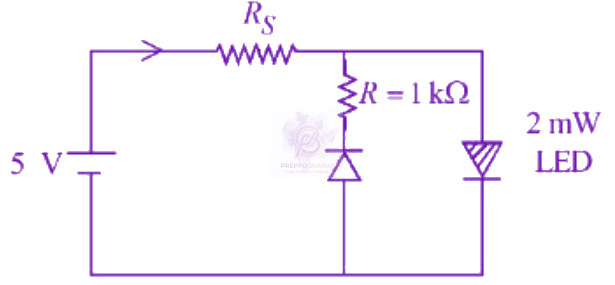
2026medium
Two $4$ bits binary numbers, $A = 1101$ and $B = 1010$ are given in the inputs of a logic circuit shown in figure below. The output $(Y)$ will be: 
2026easy
Assuming the experimental mass of ${}^{12}_{6}C$ as $12\text{ u}$, the mass defect of ${}^{12}_{6}C$ atom is _______ $\text{MeV}/c^2$. (Mass of proton $= 1.00727\text{ u}$, mass of neutron $= 1.00866\text{ u}$, $1\text{ u} = 931.5\text{ MeV}/c^2$ and $c$ is the speed of the light in vacuum).
2026medium
A light wave described by $E=60\left[\sin \left(3 \times 10^{15}\right) t+\sin \left(12 \times 10^{15}\right) t\right]$ (in SI units) falls on a metal surface of work function 2.8 eV. The maximum kinetic energy of ejected photoelectron is (approximately) $\_\_\_\_$ eV. $\left(h=6.6 \times 10^{-34} \mathrm{~J}\right.$. s. and $\left.e=1.6 \times 10^{-19} \mathrm{C}\right)$
2026medium
Other Physics topics for JEE Main
Keep practicing Modern Physics
Work through every JEE Main Modern Physics PYQ, year by year.