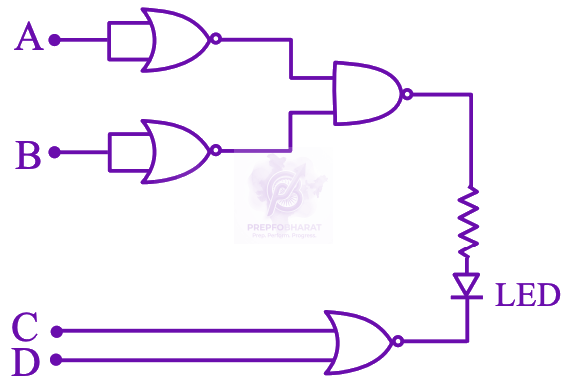
The LED will glow if it is forward biased, which means the potential at the p-side must be higher than the potential at the n-side.
Let Y1 be the output of the upper NAND gate (p-side) and Y2 be the output of the lower NOR gate (n-side).
For the LED to glow, we need Y1=1 and Y2=0.
The upper circuit consists of two NOT gates (NOR gates with shorted inputs) followed by a NAND gate.
Output of first NOT gate is Aˉ, and second is Bˉ.
Y1=Aˉ⋅Bˉ=Aˉ+Bˉ=A+B (using De Morgan's Law).
The lower circuit is a NOR gate with inputs C and D.
Y2=C+D.
Condition 1: Y1=1⟹A+B=1. This means at least one of A or B must be 1.
Condition 2: Y2=0⟹C+D=0⟹C+D=1. This means at least one of C or D must be 1.
Checking the options:
(1) A=1,B=1,C=0,D=1: Y1=1+1=1 and Y2=0+1=0. (Satisfied)
(2) A=0,B=0,C=1,D=1: Y1=0+0=0. (Not satisfied)
(3) A=1,B=0,C=0,D=0: Y2=0+0=1. (Not satisfied)
(4) A=0,B=1,C=0,D=0: Y2=0+0=1. (Not satisfied)
Thus, the correct combination is 1101.