The de Broglie wavelength is λ=mvh. For an ideal gas, vrms=m3kT
Therefore: λ=3mkTh
Substituting values: λ=3×5.31×10−26×1.38×10−23×3006.63×10−34
λ=6.62×10−466.63×10−34=2.57×10−236.63×10⁻³⁴
λ=2.58×10⁻¹¹ m =25.8×10⁻¹² m, so x≈26
JEE Main 2026 — Physics Modern Physics
The de Broglie wavelength of an oxygen molecule at 27∘C is x×10−12 m. The value of x is (take Planck's constant =6.63×10⁻³⁴ J.s, Boltzmann constant =1.38×10⁻²³ J/K, mass of oxygen molecule =5.31×10⁻²⁶ kg)
Held on 23 Jan 2026 · Verified 6 Jul 2026.
24
26
30
20
Sign in to track your attempts and accuracy.
Sign in to keep a private note on this question. Nothing you write is ever public.
An electron of mass $m$ is moving in an electric field $\vec{E} = -2E_0\hat{i}$ ($E_0 =$ constant $> 0$), with an initial velocity $\vec{V} = v_0\hat{i}$ ($v_0 =$ constant $> 0$). If $\lambda_0 = \dfrac{h}{4mv_0}$, its de Broglie wavelength at time $t$ is __________. ($e =$ charge of electron)
In a semiconductor p-n diode, the doping concentrations on p-side and n-side are $10^{15}\text{ atoms/cm}^3$ and $10^{18}\text{ atoms/cm}^3$, respectively. Which one of the following statements is true ?
The following diagram shows a Zener diode as a voltage regulator. The Zener diode is rated at $V_{z}=5 \mathrm{~V}$ and the desired current in load is 5 mA. The unregulated voltage source can supply upto 25 V. Considering the Zener diode can withstand four times of the load current, the value of resistor $R_{S}$ (shown in circuit) should be $\_\_\_\_$ $\Omega$. 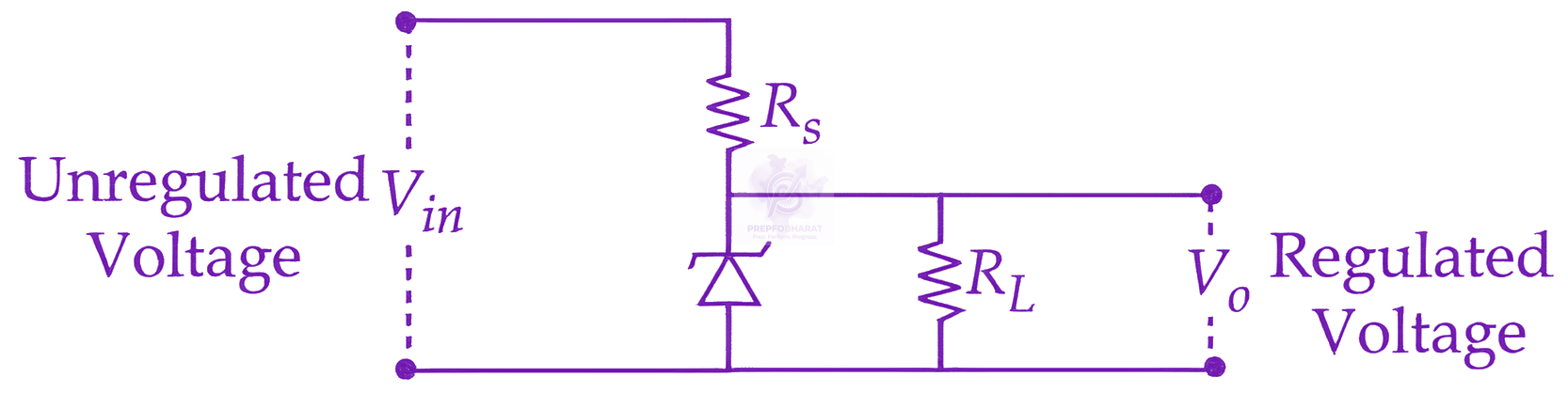
Given below are two statements: one is labelled as Assertion (A) and the other is labelled as Reason (R). Assertion (A): The electromagnetic wave exerts pressure on the surface on which they are allowed to fall. Reason (R): There is no mass associated with the electromagnetic waves. In the light of the above statements, choose the correct answer from the options given below :
In hydrogen atom spectrum, $(R \rightarrow$ Rydberg's constant $)$ A. the maximum wavelength of the radiation of Lyman series is $\frac{4}{3 R}$ B. the Balmer series lies in the visible region of the spectrum C. the minimum wavelength of the radiation of Paschen series is $\frac{9}{R}$ D. the minimum wavelength of Lyman series is $\frac{5}{4 R}$ Choose the correct answer from the options given below :
Work through every JEE Main Modern Physics PYQ, year by year.