Electromagnetism PYQ
NEET UG Physics — Electromagnetism previous year questions with solutions.
Browse by Year
Electromagnetism at a glance
Questions per year
503 across 25 yearsDifficulty mix
503 total- easy249 · 50%
- medium179 · 36%
- hard75 · 15%
Subtopic-wise weightage
Breakdown of the 503 Electromagnetism questions tagged to a subtopic, by year — darker cells mean more questions.
| Subtopic | Weightage | Total | 2026 | 2025 | 2024 | 2023 | 2022 | 2021 | 2020 | 2019 | 2018 | 2017 | 2016 | 2015 | 2014 | 2013 | 2012 | 2011 | 2010 | 2009 | 2008 | 2007 | 2006 | 2005 | 2004 | 2003 | 2002 |
|---|---|---|---|---|---|---|---|---|---|---|---|---|---|---|---|---|---|---|---|---|---|---|---|---|---|---|---|
| Current Electricity | 25.6% | 129 | 3 | 8 | 8 | 8 | 5 | 8 | 4 | 3 | 2 | 4 | 7 | 4 | 6 | 6 | 6 | 3 | 9 | 9 | 3 | 5 | 4 | 9 | 2 | 3 | |
| Electrostatics | 24.5% | 123 | 1 | 4 | 10 | 9 | 9 | 6 | 8 | 7 | 2 | 3 | 4 | 4 | 3 | 4 | 5 | 6 | 7 | 6 | 6 | 4 | 3 | 4 | 2 | 3 | 3 |
| Magnetism & Magnetic Effects | 21.3% | 107 | 3 | 10 | 5 | 7 | 4 | 3 | 4 | 2 | 2 | 6 | 4 | 2 | 6 | 4 | 5 | 6 | 8 | 6 | 5 | 3 | 4 | 5 | 3 | ||
| Alternating Current | 12.3% | 62 | 1 | 5 | 8 | 5 | 3 | 3 | 2 | 2 | 1 | 5 | 2 | 1 | 2 | 3 | 4 | 2 | 2 | 2 | 3 | 2 | 1 | 2 | 1 | ||
| Electromagnetic Waves | 8.5% | 43 | 2 | 3 | 2 | 4 | 2 | 5 | 2 | 1 | 1 | 1 | 2 | 1 | 2 | 2 | 1 | 2 | 2 | 2 | 1 | 1 | 1 | 3 | |||
| Electromagnetic Induction | 7.8% | 39 | 1 | 2 | 3 | 3 | 1 | 2 | 4 | 1 | 2 | 1 | 1 | 2 | 2 | 1 | 2 | 4 | 4 | 1 | 2 | ||||||
| All subtopics | 503 | 1 | 14 | 38 | 35 | 36 | 21 | 29 | 23 | 10 | 10 | 22 | 20 | 12 | 22 | 22 | 23 | 22 | 31 | 29 | 16 | 14 | 14 | 13 | 13 | 13 |
All Electromagnetism Questions (503)
Two point charges +2μC and -2μC are placed 10 cm apart. The electric field at the midpoint is:
A parallel plate capacitor made of circular plates is being charged such that the surface charge density on its plates is increasing at a constant rate with time. The magnetic field arising due to displacement current is :
A constant voltage of 50 V is maintained between the points A and B of the circuit shown in the figure. The current through the branch CD of the circuit is :- 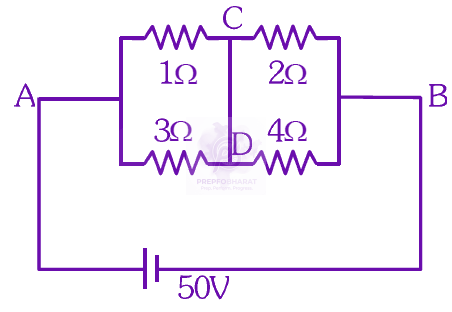
AB is a part of an electrical circuit (see figure). The potential difference " $\mathrm{V}_{\mathrm{A}}-\mathrm{V}_{\mathrm{B}}$ ", at the instant when current $\mathrm{i}=2 \mathrm{~A}$ and is increasing at a rate of $1 \mathrm{amp} / \mathrm{second}$ is : 
A wire of resistance R is cut into 8 equal pieces. From these pieces two equivalent resistances are made by adding four of these together in parallel. Then these two sets are added in series. The net effective resistance of the combination is :
The electric potential at distance r from a point charge q is V = q/(4πε₀r). The electric field E is:
The electric field in a plane electromagnetic wave is given by $E_z=60 \cos \left(5 \mathrm{x}+1.5 \times 10^9 \mathrm{t}\right) \mathrm{V} / \mathrm{m} .$ Then expression for the corresponding magnetic field is (here subscripts denote the direction of the field) :
The current passing through the battery in the given circuit, is : 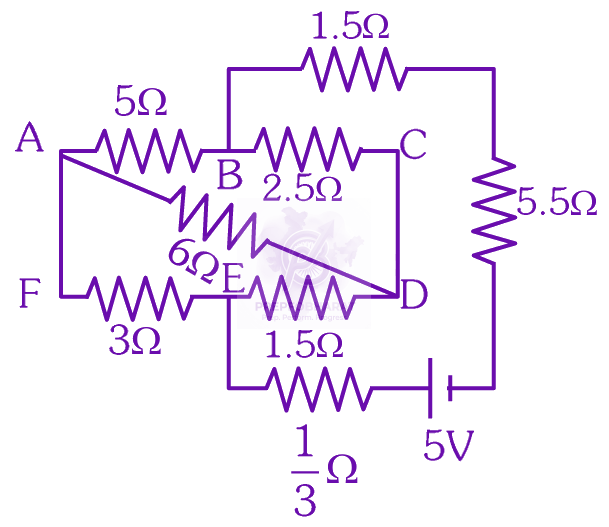
To an ac power supply of 220 V at 50 Hz , a resistor of $20 \Omega$, a capacitor of reactance $25 \Omega$ and an inductor of reactance $45 \Omega$ are connected is series. The corresponding current in the circuit and the phase angle between the current and the voltage is, respectively-
The plates of a parallel plate capacitor are separated by d. Two slabs of different dielectric constant $K_1$ and $K_2$ with thickness $\frac{3}{8} d$ and $\frac{d}{2}$, respectively are inserted in the capacitor. Due to this, the capacitance becomes two times larger than when there is nothing between the plates. (If $K_1=1.25 K_2$, the value of $K_1$ is:
An electric dipole with dipole moment $5 \times 10^{-6} \mathrm{Cm}$ is aligned with the direction of a uniform electric field of magnitude $4 \times 10^5 \mathrm{~N} / \mathrm{C}$ The dipole is then rotated through an angle of $60^{\circ}$ with respect to the electric field. The change in the potential energy of the dipole is:
An electron (mass $9 \times 10^{-31} \mathrm{~kg}$ and charge $1.6 \times 10^{-19} \mathrm{C}$ ) moving with speed $\mathrm{c} / 100(\mathrm{c}=$ speed of light) is injected into a magnetic field $\vec{B}$ of magnitude $9 \times 10^{-4} \mathrm{~T}$ perpendicular to its direction of motion. We wish to apply an uniform electric field $\vec{E}$ together with the magnetic field so that the electron does not deflect from its path. Then (speed of light $\mathrm{c}=3 \times 10^8 \mathrm{~ms}^{-1}$ )
Two identical charged conducting spheres $A$ and $B$ have their centres separated by a certain distance. Charge on each sphere is q and the force of repulsion between them is $F$. A third identical uncharged conducting sphere is brought in contact with sphere A first and then with B and finally removed from both. New force of repulsion between spheres $A$ and $B$ (Radii of $A$ and $B$ are negligible compared to the distance of separation so that for calculating force between them they can be considered as point charges) is best given as :
A 2 amp current is flowing through two different small circular copper coils having radii ratio $1: 2$. The ratio of their respective magnetic moments will be
A model for quantized motion of an electron in a uniform magnetic field $B$ states that the flux passing through the orbit of the electron is $n(h / e)$ where $n$ is an integer, $h$ is Planck's constant and $e$ is the magnitude of electron's charge. According to the model, the magnetic moment of an electron in its lowest energy state will be ( $m$ is the mass of the electron)
The amplitude of the charge oscillating in a circuit decreases exponentially as $Q=Q_0 e^{-R t 2 L}$, where $Q_0$ is the charge at $t=0 \mathrm{~s}$. The time at which charge amplitude decreases to $0.50 Q_0$ is nearly: [Given that $R=1.5 \Omega, L=12 \mathrm{mH}, \ln (2)=0.693$ ]
The terminal voltage of the battery, whose emf is 10 V and internal resistance $1 \Omega$, when connected through an external resistance of $4 \Omega$ as shown in the figure is: 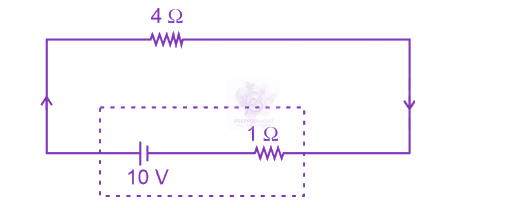
In an ideal transformer, the turns ratio is $\frac{N_P}{N_S}=\frac{1}{2}$. The ratio $V_S: V_P$ is equal to (the symbols carry their usual meaning) :
If the ratio of relative permeability and relative permittivity of a uniform medium is $1: 4$. The ratio of the magnitudes of electric field intensity $(E)$ to the magnetic field intensity $(H)$ of an EM wave propagating in that medium is (Given that $\sqrt{\frac{\mu_0}{\varepsilon_0}}=120 \pi$ )
In the circuit shown below, the inductance $L$ is connected to an ac source. The current flowing in the circuit is $I=I_0 \sin \omega t$. The voltage drop $\left(V_L\right)$ across $L$ is 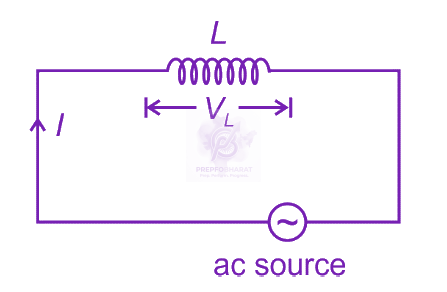
A wire of length ' 1 and resistance $100 \Omega$ is divided into 10 equal parts. The first 5 parts are connected in series while the next 5 parts are connected in parallel. The two combinations are again connected in series. The resistance of this final combination is:
A uniform wire of diameter $d$ carries a current of 100 mA when the mean drift velocity of electrons in the wire is $v$. For a wire of diameter $\frac{d}{2}$ of the same material to carry a current of 200 mA , the mean drift velocity of electrons in the wire is
The capacitance of a capacitor with charge $q$ and a potential difference $V$ depends on
A metal cube of side 5 cm is charged with $6 \mu \mathrm{C}$. The surface charge density on the cube is