NEET UG 2023 — Electromagnetism
Physics Electromagnetism questions from NEET UG 2023.
Other Years
35 Electromagnetism Questions from 2023
If $Z_1$ and $Z_2$ are the impedances of the given circuits (a) and (b) as shown in figures, then choose the correct option. 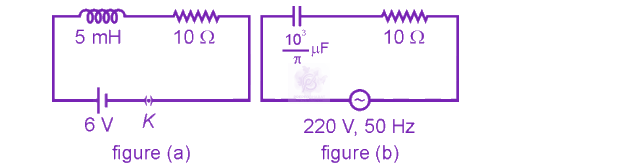
The magnetic energy stored in an inductor of inductance $4\mu H$ carrying a current of $2A$ is:
In a series$LCR$ circuit, the inductance$L$ is $10\mathrm{mH}$, capacitance $C$ is $1\mu F$ and resistance $R$ is $100\Omega$. The frequency at which resonance occurs is:
The resistance of platinum wire at $0^{\circ}C$ is $2\Omega$ and $6.8\Omega$ at $80^{\circ}C$. The temperature coefficient of resistance of the wire is:
A very long conducting wire is bent in a semi- circular shape from $A$ to $B$ as shown in figure. The magnetic field at point$P$ for steady current configuration is given by: 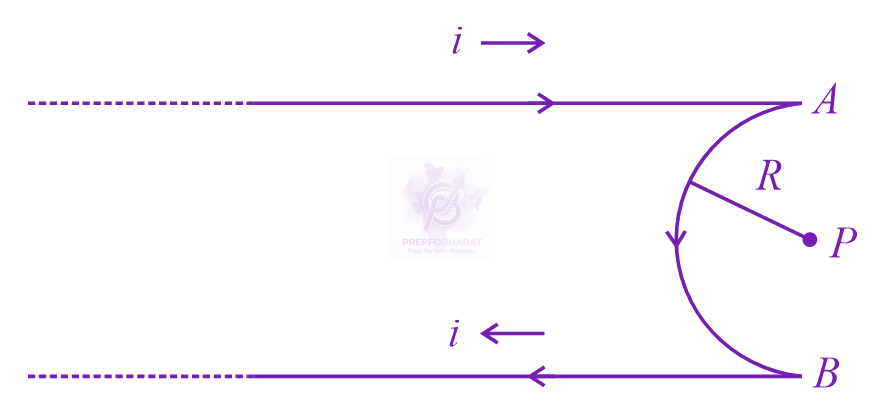
The net impedance of circuit (as shown in figure) will be: 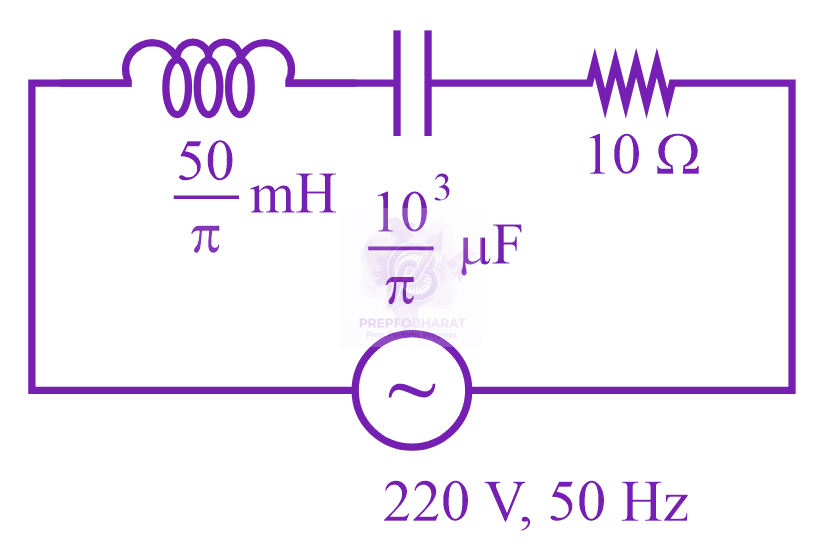
For very high frequencies, the effective impedance of the circuit (shown in the figure) will be 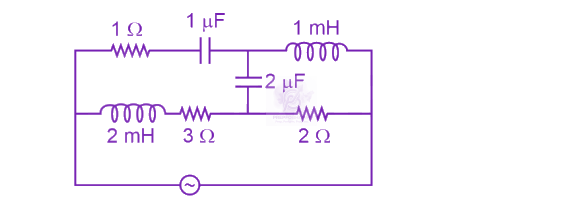
The net magnetic flux through any closed surface is:
An ac source is connected in the given circuit. The value of $\phi$ will be 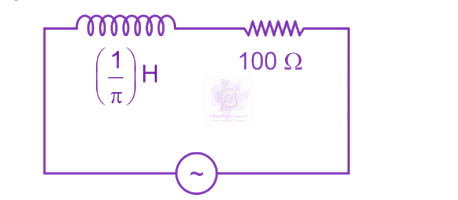
On the basis of electrical conductivity, which one of the following material has the smallest resistivity?
To produce an instantaneous displacement current of $2 \mathrm{~mA}$ in the space between the parallel plates of a capacitor of capacitance $4 \mu \mathrm{F}$, the rate of change of applied variable potential difference $\left(\frac{d V}{d t}\right)$ must be
$10$ resistors, each of resistance $R$ are connected in series to a battery of emf $E$ and negligible internal resistance. Then those are connected in parallel to the same battery, the current is increased $n$ times. The value of $n$ is:
If a conducting sphere of radius $R$ is charged. Then the electric field at a distance $r(r>R)$ from the centre of the sphere would be, $(V=$ potential on the surface of the sphere $)$
A $12V,60W$ lamp is connected to the secondary of a step down transformer, whose primary is connected to ac mains of $220V$. Assuming the transformer to be ideal, what is the current in the primary winding?
A uniform electric field and a uniform magnetic field are acting along the same direction in a certain region. If an electron is projected in the region such that its velocity is pointed along the direction of fields, then the electron
A copper wire of radius $1 \mathrm{~mm}$ contains $10^{22}$ free electrons per cubic metre. The drift velocity for free electrons when $10 \mathrm{~A}$ current flows through the wire will be (Given, charge on electron $=1.6 \times 10^{-19} \mathrm{C}$ )
An emf is generated by an ac generator having 100 turn coil, of loop area $1 \mathrm{~m}^2$. The coil rotates at a speed of one revolution per second and placed in a uniform magnetic field of $0.05 \mathrm{~T}$ perpendicular to the axis of rotation of the coil. The maximum value of emf is
An ac source is connected to a capacitor $C$. Due to decrease in its operating frequency:
The magnitude and direction of the current in the following circuit is 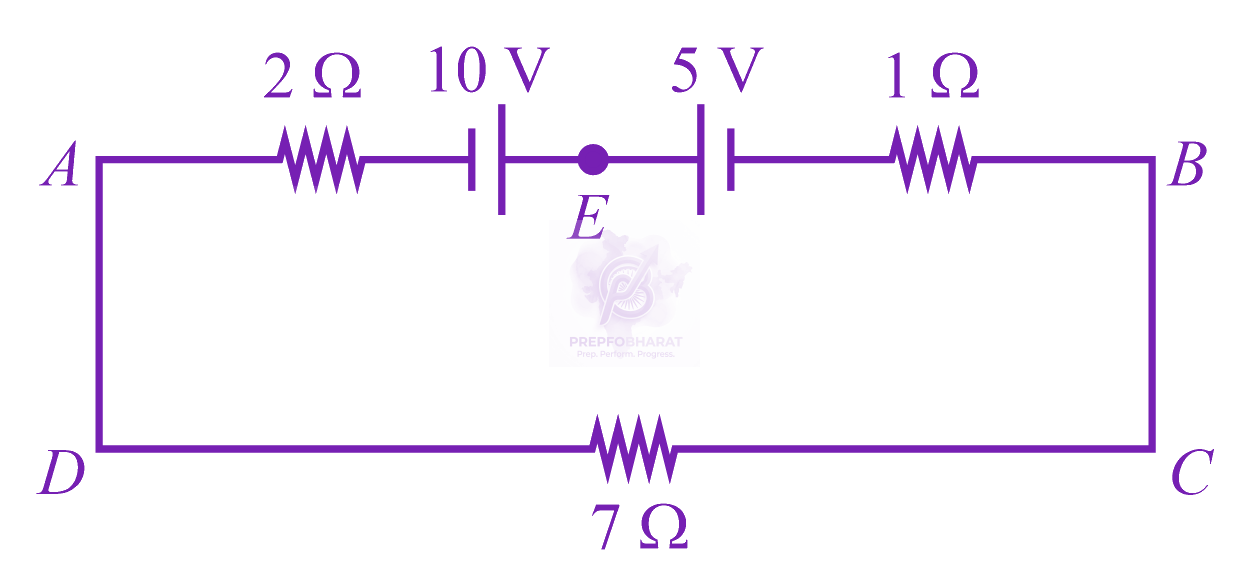
A charge $Q \mu C$ is placed at the centre of a cube. The flux coming out from any one of its faces will be (in SI unit)
The electric field inside a conductor is
If the galvanometer $G$ does not show any deflection in the circuit shown, the value of $R$ is given by: 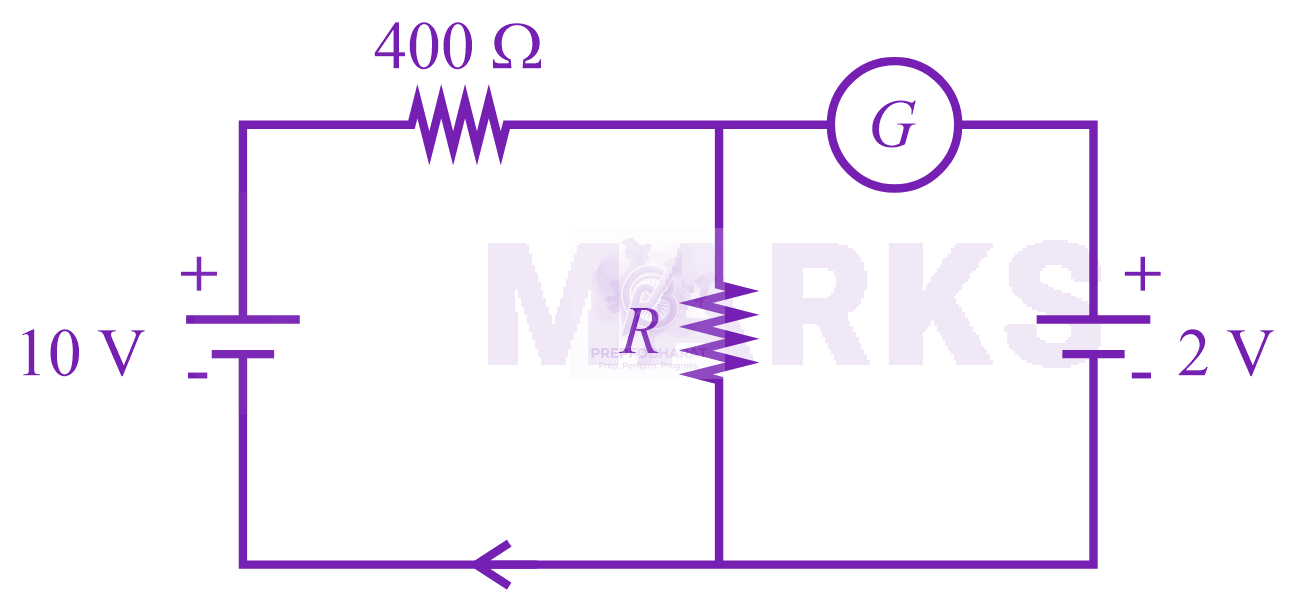
According to Gauss law of electrostatics, electric flux through a closed surface depends on
The emf of a cell having internal resistance $1 \Omega$ is balanced against a length of $330 \mathrm{~cm}$ on a potentiometer wire. When an external resistance of $2 \Omega$ is connected across the cell, the balancing length will be
The equivalent capacitance of the system shown in the following circuit is: 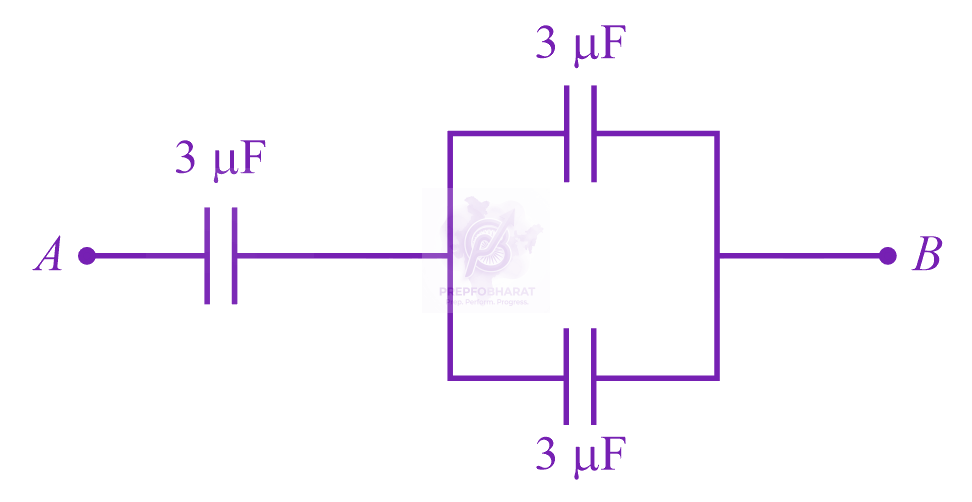
A long straight wire of length $2 \mathrm{~m}$ and mass $250 \mathrm{~g}$ is suspended horizontally in a uniform horizontal magnetic field of $0.7 \mathrm{~T}$. The amount of current flowing through the wire will be $\left(g=9.8 \mathrm{~ms}^{-2}\right)$
A certain wire $A$ has resistance $81 \Omega$. The resistance of another wire $B$ of same material and equal length but of diameter thrice the diameter of $A$ will be
The maximum power is dissipated for an ac in a/an
A wire carrying a current $I$ along the positive x-axis has length $L$. It is kept in a magnetic field $\vec{B}=(2\hat{i}+3\hat{j}-4\hat{k})T$. The magnitude of the magnetic force acting on the wire is:
If $\underset{S}{\oint }\vec{E}\cdot d\vec{S}=0$ over a surface, then:
The variation of susceptibility $(\chi)$ with absolute temperature $(T)$ for a paramagnetic material is represented as:
The equivalent capacitance of the arrangement shown in figure is 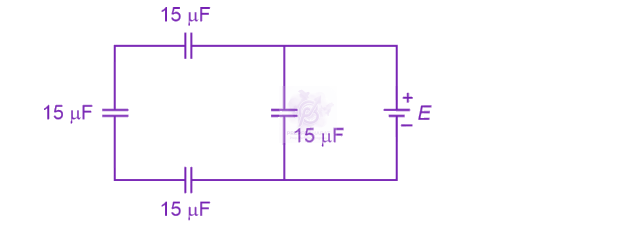
In a plane electromagnetic wave travelling in free space, the electric field component oscillates sinusoidally at a frequency of $2.0\times {10}^{10}\mathrm{Hz}$ and amplitude $48V{m}^{-1}$. Then the amplitude of oscillating magnetic field is: (Speed of light in free space =$3\times {10}^{8}m{s}^{-1}$)
An electric dipole is placed as shown in the figure. 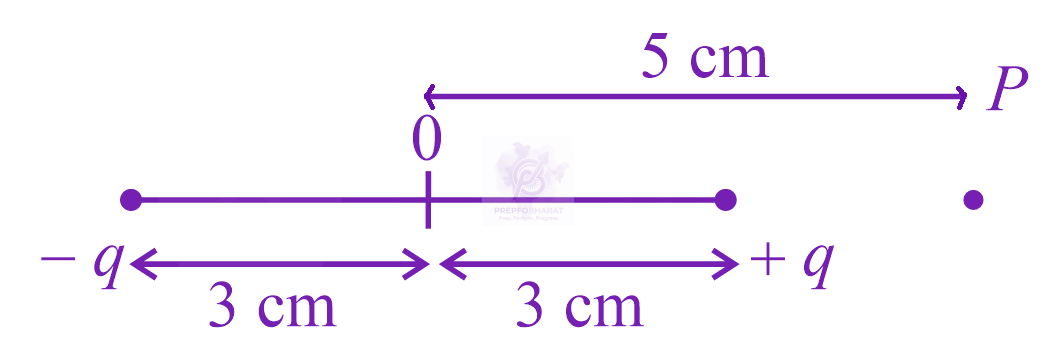 The electric potential (in ${10}^{2}V$) at point $P$ due to the dipole is (${\epsilon }_{0}$=permittivity of free space and $\frac{1}{4\pi {\epsilon }_{0}}=K$)
An electric dipole is placed at an angle of $30^{\circ}$ with an electric field of intensity $2\times {10}^{5}N{C}^{-1}$. It experiences a torque equal to $4Nm$. Calculate the magnitude of charge on the dipole, if the dipole length is $2\mathrm{cm}$.