NEET UG 2017 — Electromagnetism
Physics Electromagnetism questions from NEET UG 2017.
Other Years
10 Electromagnetism Questions from 2017
A capacitor is charged by a battery. The battery is removed and another identical uncharged capacitor is connected in parallel. The total electrostatic energy of resulting system
The diagrams below show regions of equipotential. 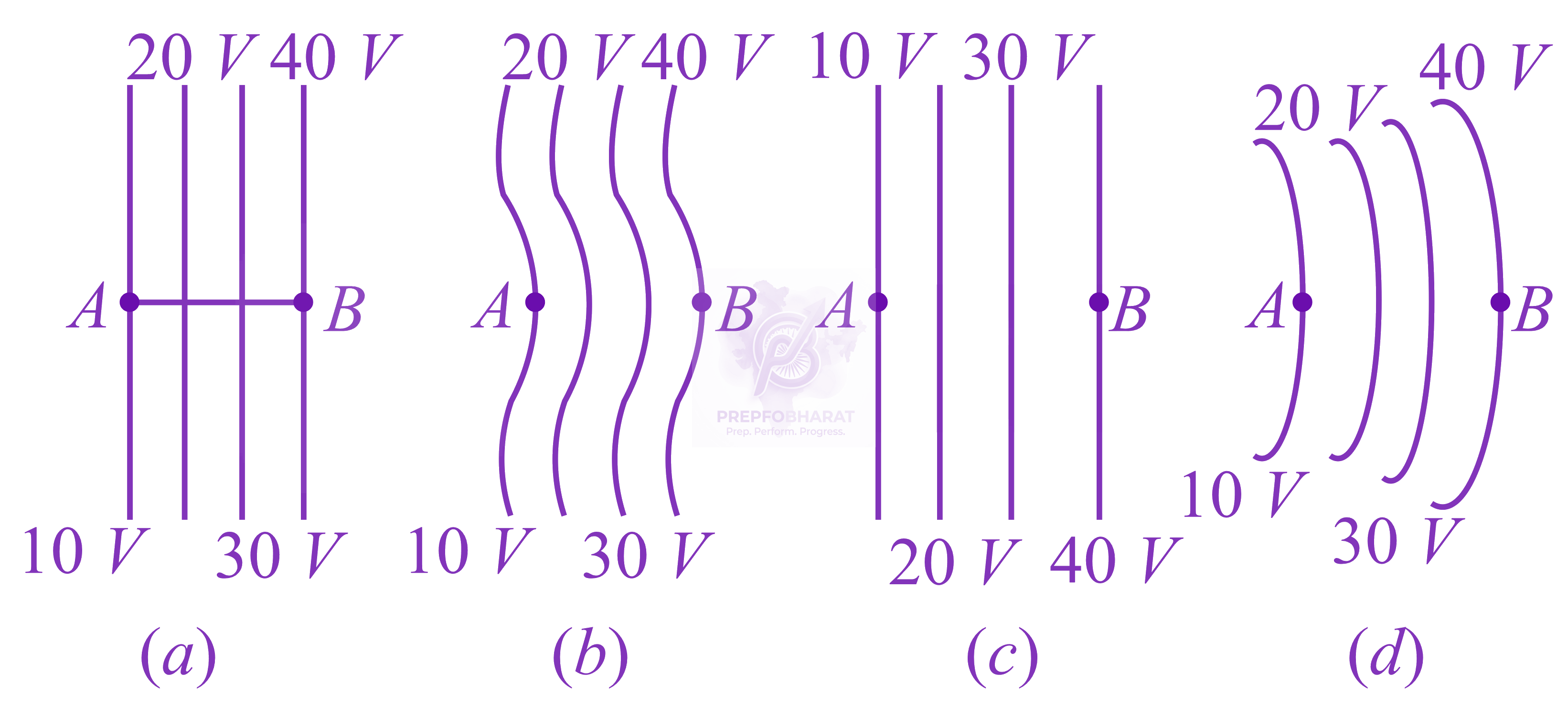 A positive charge is moved from $A$ to $B$ in each diagram.
In an electromagnetic wave in free space the root mean square value of the electric field is ${E}_{rms}=6V{m}^{-1}$. The peak value of the magnetic field is
A long solenoid of diameter $0.1m$ has $2\times {10}^{4}$ turns per meter. At the centre of the solenoid, a coil of $100$ turns and radius $0.01m$ is placed with its axis coinciding with the solenoid axis. The current in the solenoid reduces at a constant rate to $0A$ from $4A$ in $0.05s$. If the resistance of the coil is $10{\pi }^{2} \Omega ,$ the total charge flowing through the coil during this time is
Figure shows a circuit contains three identical resistors with resistance $R=9.0 \Omega$ each, two identical inductors with inductance $L=2.0\mathrm{mH}$ each, and an ideal battery with emf $\epsilon = 18 V$. The current $i$ through the battery just after the switch closed is: 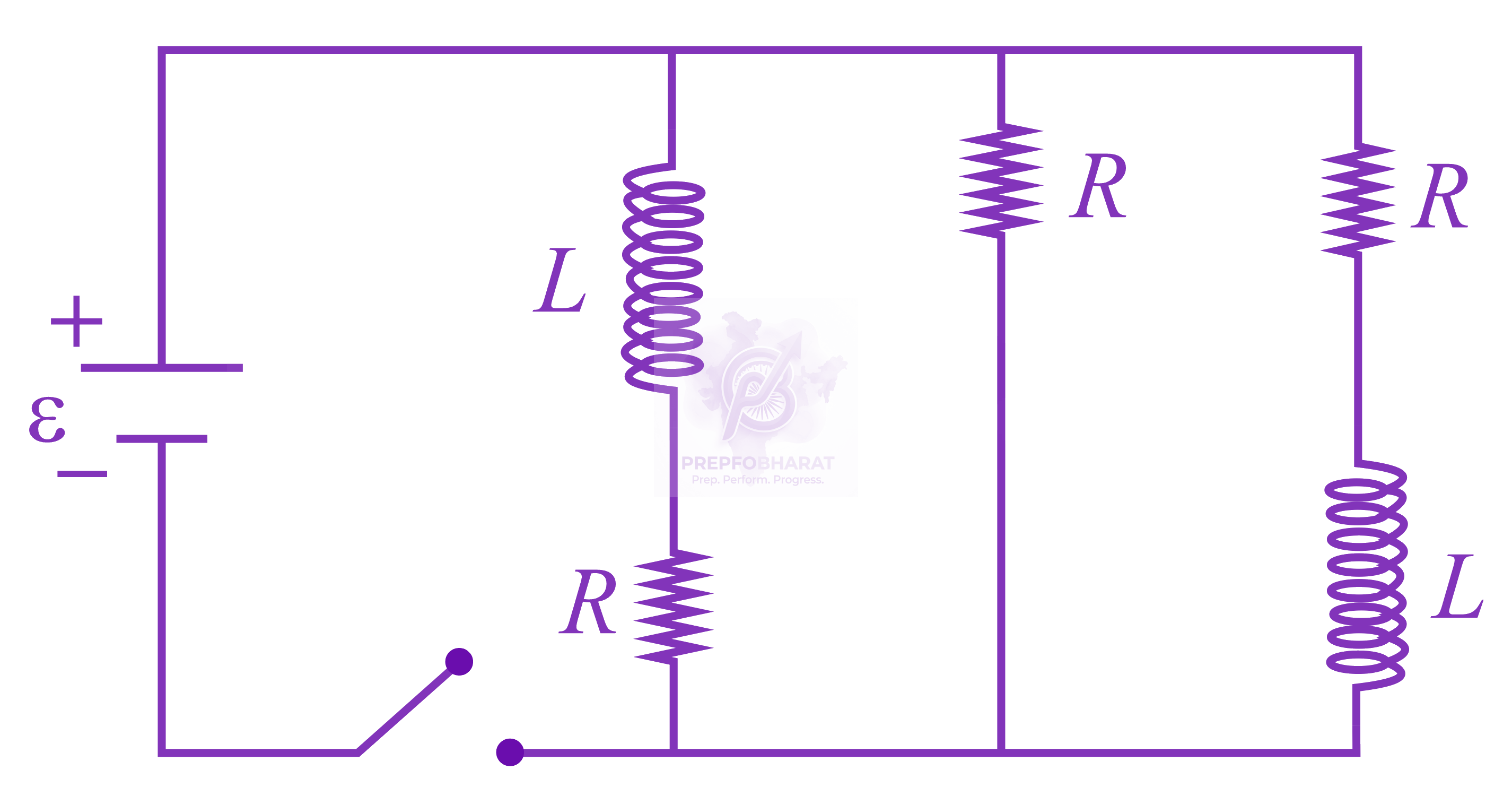
A potentiometer is an accurate and versatile device to make electrical measurements of E.M.F, because the method involves:
A $250$-Turn rectangular coil of length $2.1 cm$ and width $1.25 cm$ carries a current of $85 \mu A$ and subjected to a magnetic field of strength $0.85 T.$ Work done for rotating the coil by $180^{\circ}$ against the torque is:
An arrangement of three parallel straight wires placed perpendicular to plane of paper carrying same current $I$ along the same direction is shown in Figure. Magnitude of force per unit length on the middle wire $B$ is given by 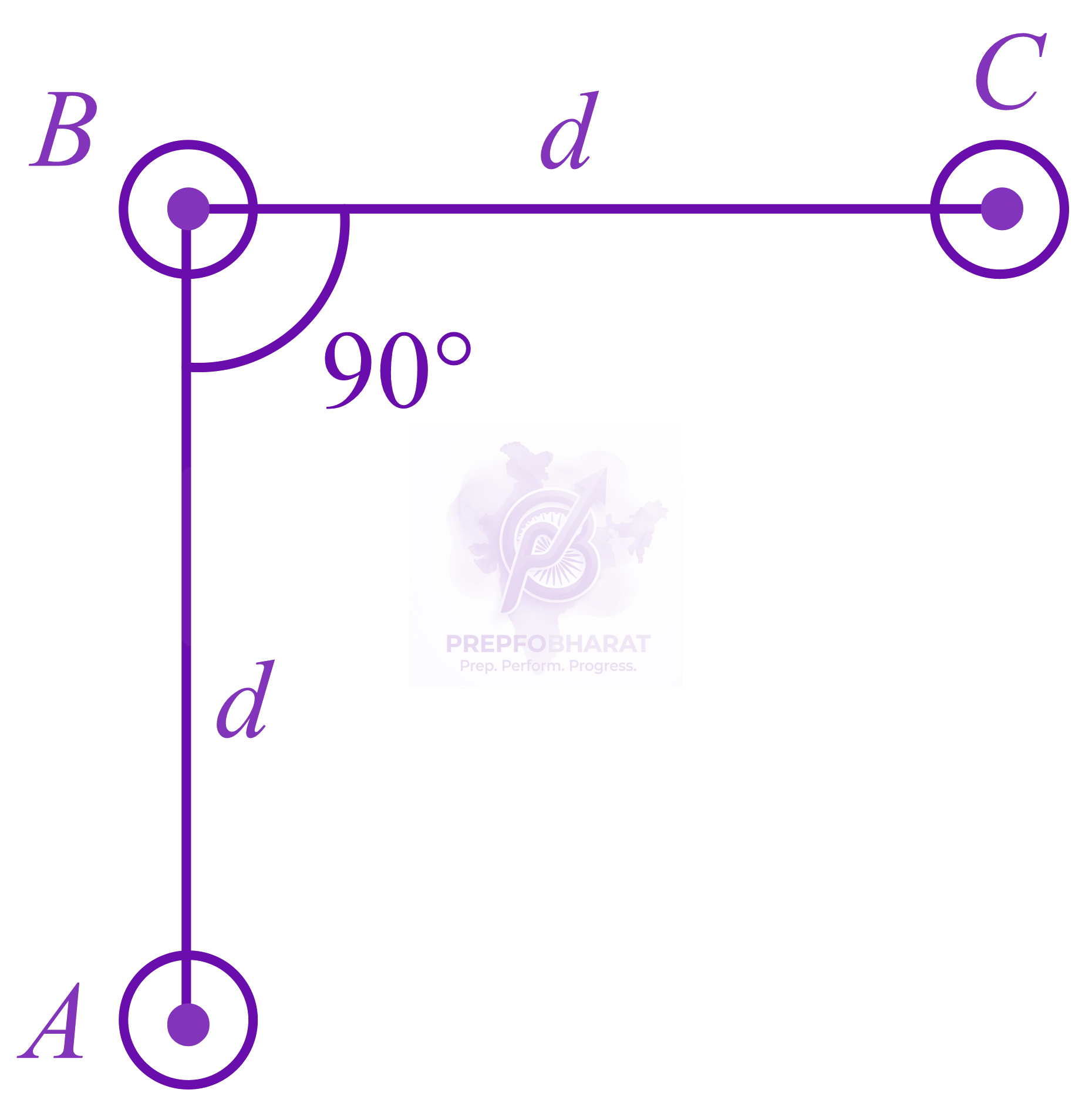
The resistance of a wire is $R$ ohm. If it is melted and stretched to $n$ times its original length, its new resistance will be
Suppose the charge of a proton and an electron differ slightly. One of them is $e$, the other is $(e+\Delta e)$. If the net electrostatic force and gravitational force between two hydrogen atoms placed at a distance $d$ (much greater than atomic size) apart is zero, then $\Delta e$ is of the order of [Given mass of hydrogen ${m}_{h}= 1.67\times {10}^{–27} \mathrm{kg}$]