NEET UG 2022 — Electromagnetism
Physics Electromagnetism questions from NEET UG 2022.
Other Years
36 Electromagnetism Questions from 2022
The unit of electric potential is
The magnetic field of a plane electromagnetic wave is given by $\overrightarrow{\mathrm{B}}=3 \times 10^{-8} \cos \left(1.6 \times 10^3 x+\right.$ $48 \times 10^{10}$ t) $\hat{j}$, then the associated electric field will be:
A capacitor of capacitance $C=900\mathrm{pF}$ is charged fully by $100V$ battery $B$ as shown in figure (a). Then it is disconnected from the battery and connected to another uncharged capacitor of capacitance $C=900\mathrm{pF}$ as shown in figure (b). The electrostatic energy stored by the system (b) is 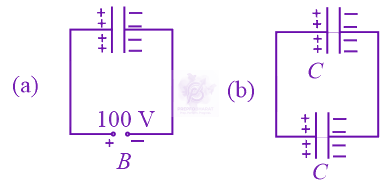
The equivalent resistance of the infinite network given below is: 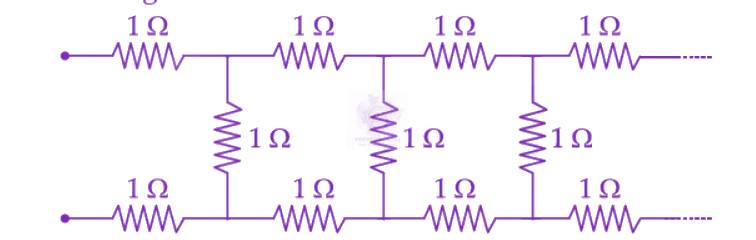
An inductor of inductance $2 \mathrm{mH}$ is connected to a $220 \mathrm{~V}, 50 \mathrm{~Hz}$ a.c. source. Let inductive reactance in the circuit is $X_1$. If a $220 \mathrm{~V}$ d.c. source replaces the a.c. source in the circuit, then the inductive reactance in the circuit is $\mathrm{X}_2 \cdot \mathrm{X}_1$ and $\mathrm{X}_2$ respectively are:
The magnetic field on the axis of a circular loop of radius $100 \mathrm{~cm}$ carrying current $I=\sqrt{2} \mathrm{~A}$, at point $1 \mathrm{~m}$ away from the centre of the loop is given by:
The ratio of coulomb's electrostatic force to the gravitational force between an electron and a proton separated by some distance is $2.4 \times 10^{39}$. The ratio of the proportionality constant, $\mathrm{K}=$ $\frac{1}{4 \pi \varepsilon_0}$ to the Gravitational constant G is nearly (Given that the charge of the proton and electron each $=1.6 \times 10^{-19} \mathrm{C}$, the mass of the electron $=9.11 \times 10^{-31} \mathrm{~kg}$, the mass of the proton $=$ $\left.1.67 \times 10^{-27} \mathrm{~kg}\right)$
The shape of the magnetic field lines due to an infinite long, straight current carrying conductor is:
The ratio of the magnitude of the magnetic field and electric field intensity of a plane electromagnetic wave in free space of permeability $\mu_0$ and permittivity $\varepsilon_0$ is (Given that $c$ - velocity of light in free space):
A long solenoid of radius $1\mathrm{mm}$ has $100\mathrm{turns}$ per $\mathrm{mm}$. If $1A$ current flows in the solenoid, the magnetic field strength at the centre of the solenoid is:
Given below are two statements: Statement-I: In an a.c. circuit, the current through a capacitor leads the voltage across it. Statement-II: In a.c. circuits containing pure capacitance only, the phase difference between the current and the voltage is $\pi$ : In the light of the above statements, choose the most appropriate answer from the options given below:
The effective capacitances of two capacitors are 3 $\mu \mathrm{F}$ and $16 \mu \mathrm{F}$, when they are connected in series and parallel respectively. The capacitance of two capacitors are:
A Wheatstone bridge is used to determine the value of unknown resistance $X$ by adjusting the variable resistance $Y$ as shown in the figure. For the most precise measurement of $X$, the resistances $P$ and $Q$ 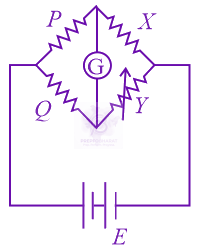
The reciprocal of resistance is:
A series LCR circuit with inductance $10H$, capacitance $10\mu F$, resistance $50\Omega$ is connected to an AC source of voltage, $V=200\mathrm{sin}(100t)$ volt. If the resonant frequency of the LCR circuit is ${\nu }_{0}$ and the frequency of the AC source is $\nu$, then
Match List - I with List - II: <table class="pyq-table"><tbody><tr><td colspan="2" rowspan="1">List - I (Electromagnetic waves)</td><td colspan="2" rowspan="1">List - II (Wavelength)</td></tr><tr><td>(a)</td><td>AM radio waves</td><td>(i)</td><td>${10}^{-10}m$</td></tr><tr><td>(b)</td><td>Microwaves</td><td>(ii)</td><td>${10}^{2}m$</td></tr><tr><td>(c)</td><td>Infrared radiations</td><td>(iii)</td><td>${10}^{-2}m$</td></tr><tr><td>(d)</td><td>X-rays</td><td>(iv)</td><td>${10}^{-4}m$</td></tr></tbody></table>Choose the correct answer from the options given below:
A copper wire of length $10m$ and radius $(\frac{{10}^{-2}}{\sqrt{\pi }})m$ has electrical resistance of $10\Omega$. The current density in the wire for an electric field strength of $10V{m}^{-1}$ is:
Two resistors of resistance, $100\Omega$ and $200\Omega$ are connected in parallel in an electrical circuit. The ratio of the thermal energy developed in $100\Omega$ to that in $200\Omega$ in a given time is
Two point charges $-q$ and $+q$ are placed at a distance of $L$, as shown in the figure. 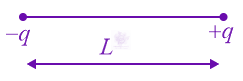 The magnitude of electric field intensity at a distance $R(R\gg L)$ varies as
The peak voltage of the ac source is equal to
The sliding contact $C$ is at one fourth of the length of the potential wire $(A B)$ from $A$ as shown in the circuit diagram. If the resistance of the wire $A B$ is $R_0$, then the potential drop $(V)$ across the resistor $R$ is: 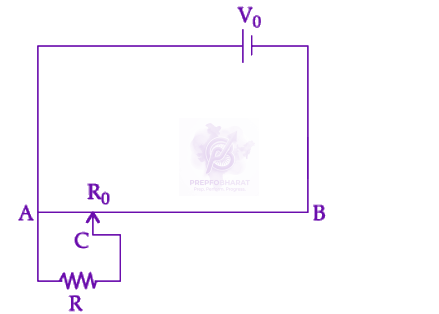
The magnetic flux linked to a circular coil of radius $R$ is: $\phi=2 t^3+4 t^2+2 t+5 \mathrm{~Wb}$ The magnitude of induced emf in the coil at $t=5 \mathrm{~s}$ is:
Two hollow conducting spheres of radii ${R}_{1}$ and ${R}_{2}$ $({R}_{1}\gg {R}_{2})$ have equal charges. The potential would be:
The angle between the electric lines of force and the equipotential surface is
From Ampere's circuital law for a long straight wire of circular cross-section carrying a steady current, the variation of magnetic field in the inside and outside region of the wire is
A standard filament lamp consumes $100 \mathrm{~W}$ when connected to $200 \mathrm{~V}$ a.c. mains supply. The peak current through the bulb will be :
A closely packed coil having 1000 turns has an average radius of $62.8 \mathrm{~cm}$. If current carried by the wire of the coil is $1 \mathrm{~A}$, the value of magnetic field produced at the centre of the coil will be (permeability of free space $=4 \pi \times 10^7 \mathrm{H} / \mathrm{m}$ ) nearly:
A big circular coil of $1000$ turns and average radius $10m$ is rotating about its horizontal diameter at $2\mathrm{rad}{s}^{-1}$. If the vertical component of earth's magnetic field at that place is $2\times {10}^{-5}T$ and electrical resistance of the coil is $12.56\Omega$, then the maximum induced current in the coil will be:
A cell of emf $4 \mathrm{~V}$ and internal resistance $0.5 \Omega$ is connected to a $7.5 \Omega$ external resistance. The terminal potential difference of the cell is:
A square loop of side $1m$ and resistance $1\Omega$ is placed in a magnetic field of $0.5T$. If the plane of loop is perpendicular to the direction of magnetic field, the magnetic flux through the loop is:
When light propagates through a material medium of relative permittivity ${\epsilon }_{r}$ and relative permeability ${\mu }_{r}$, the velocity of light, $v$ is given by : ($c$ - velocity of light in vacuum)
Given below are two statements: Statement I : Biot-Savart's law gives us the expression for the magnetic field strength of an infinitesimal current element $(Idl)$ of a current carrying conductor only. Statement II : Biot-Savart's law is analogous to Coulomb's inverse square law of charge $q$, with the former being related to the field produced by a scalar source, $Idl$ while the latter being produced by a vector source, $q$. In light of above statements choose the most appropriate answer from the options given below:
The distance between the two plates of a parallel plate capacitor is doubled and the area of each plate is halved. If $\mathrm{C}$ is its initial capacitance, its final capacitance is equal to:
Two very long, straight, parallel conductors A and $\mathrm{B}$ carry current of $5 \mathrm{~A}$ and $10 \mathrm{~A}$ respectively and are at a distance of $10 \mathrm{~cm}$ from each other. The direction of current in two conductors is same. The force acting per unit length between two conductors is $\left(\mu_0=4 \pi \times 10^{-7}\right.$ SI unit):
Six charges $+q,-q,+q,-q,+q$ and $-q$ are fixed at the corners of a hexagon of side $d$ as shown in the figure. The work done in bringing a charge $q_0$ to the centre of the hexagon from infinity is $\left(\varepsilon_0-\right.$ permittivity of free space): 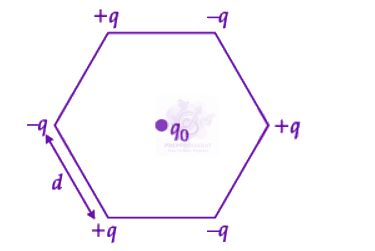
As the temperature increases, the electrical resistance