NEET UG 2016 — Electromagnetism
Physics Electromagnetism questions from NEET UG 2016.
Other Years
22 Electromagnetism Questions from 2016
The charge flowing through a resistance $\text{R}$ varies with time $t$ as $Q=at-b{t}^{2}$ where $\text{a}$ and $\text{b}$ are positive constants. The total heat produced in $\text{R}$ is:
A parallel-plate capacitor of area $A$, plate separation $d$ and capacitance $C$ is filled with four dielectric materials having dielectric constants${k}_{1}$, ${k}_{2}$, ${k}_{3}$ and ${k}_{4}$ as shown in the figure below. If a single dielectric material is to be used to have the same capacitance $C$ in this capacitor, then its dielectric constant $k$ is given by 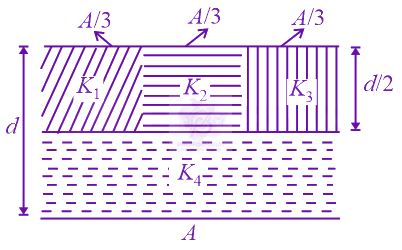
Which of the following combinations should be selected for better tuning of an LCR circuit used for communication?
A potentiometer wire is $100\mathrm{cm}$ long and a constant potential difference is maintained across it. Two cells are connected in series first to support one another and then in opposite direction. The balance points are obtained at $50\mathrm{cm}$ and $10\mathrm{cm}$ from the positive end of the wire in the two cases. The ratio of EMF's is :
The potential differences across the resistance, capacitance, and inductance are $80V,40V$ and $100V$, respectively in an LCR circuit. The power factor of this circuit is
A $100 \Omega$ resistance and a capacitor of $100 \Omega$ reactance are connected in series across a $220 V$ source. When the capacitor is $50%$ charged, the peak value of the displacement current is
The potential difference $({V}_{A}-{V}_{B})$ between the points $A$ and $B$ in the given figure is 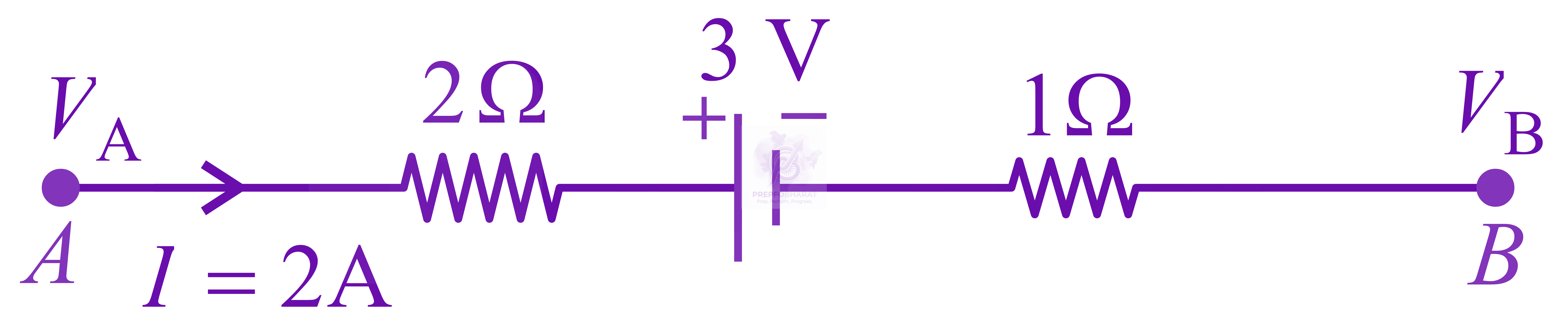
An electric dipole is placed at an angle of $30^{\circ}$ with an electric field intensity $2\times {10}^{5}{\text{ N C}}^{-1}$. It experiences a torque equal to $\text{4} \text{N} \text{m}$. The charge on the dipole, if the dipole length is $\text{2} \text{cm}$, is
A filament bulb $(500W,100V)$ is to be used in a $230V$ main supply. When a resistance, $R$ is connected in series, it works perfectly and the bulb consumes $500W$. The value of $R$ is
A small signal voltage $V(t)={V}_{0}\mathrm{sin}\omega t$ is applied across an ideal capacitor $\text{C}$:
A bar magnet is hung by a thin cotton thread in a uniform horizontal magnetic field and is in equilibrium state. The energy required to rotate it by ${60}^{o}$ is $W$. Now, the torque required to keep the magnet in this new position is
Out of the following options which one can be used to produce a propagating electromagnetic wave?
An electron is moving in a circular path under the influence of a transverse magnetic field of $3.57\times {10}^{-2} T$. If, the value of $\frac{e}{m}$ is $1.76\times {10}^{11}C{\mathrm{kg}}^{-1}$, the frequency of revolution of the electron is
Two identical charged spheres suspended from a common point by two massless strings of lengths $l$, are initially at a distance $d( d\ll l )$ apart because of their mutual repulsion. The charges begin to leak from both the spheres at a constant rate. As a result, the spheres approach each other with a velocity $\upsilon$. Then $\upsilon$ varies as a function of the distance $x$ between the spheres, as
The magnetic susceptibility is negative for:
A square loop $ABCD$ carrying a current $i$, is placed near and coplanar with a long straight conductor $XY$ carrying a current $I$, the net force on the loop will be: 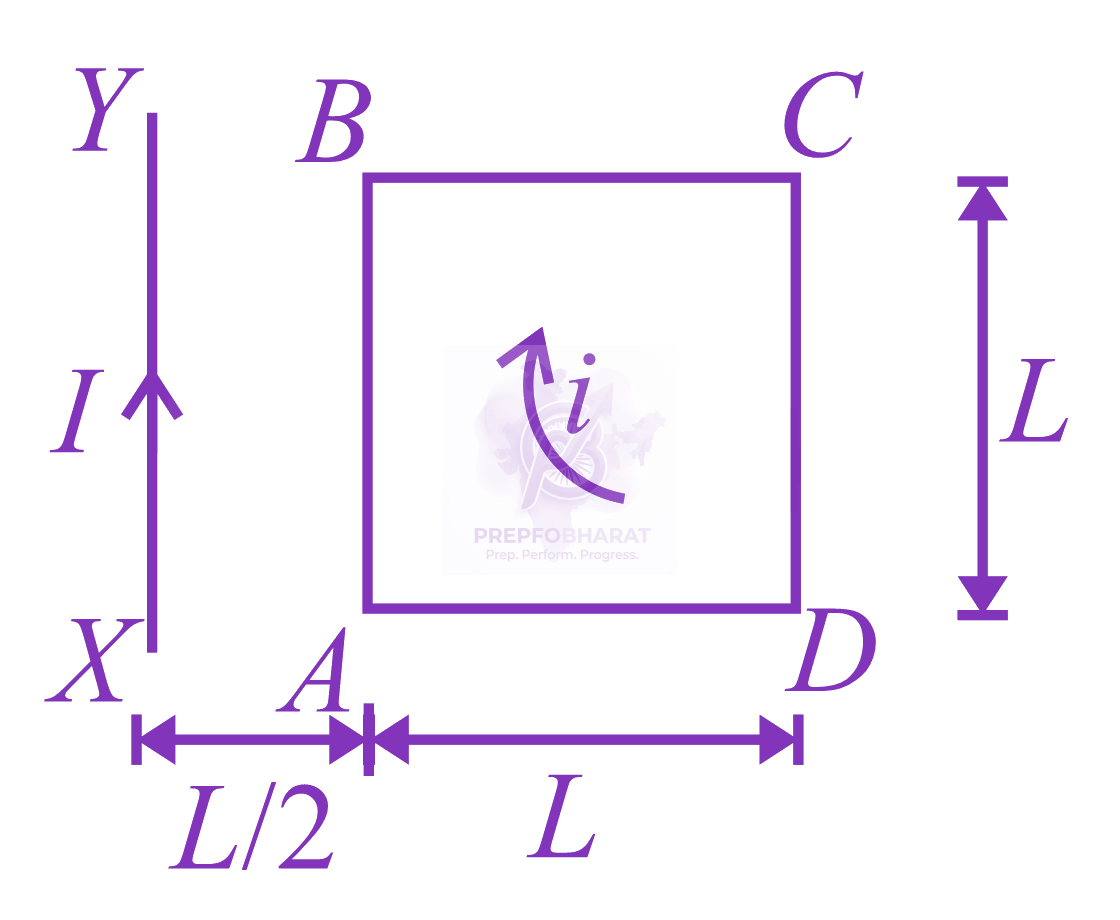
An inductor $20 \text{mH}$, a capacitor $50 \mu F$ and a resistor $40 \Omega$ are connected in series across a source of emf $V=10\mathrm{sin}340 t$. The power loss in $\text{AC}$. circuit is:
A capacitor of $2 \mu F$ is charged as shown in the diagram. When the switch $\text{S}$ is turned to position $2$, the percentage of its stored energy dissipated is 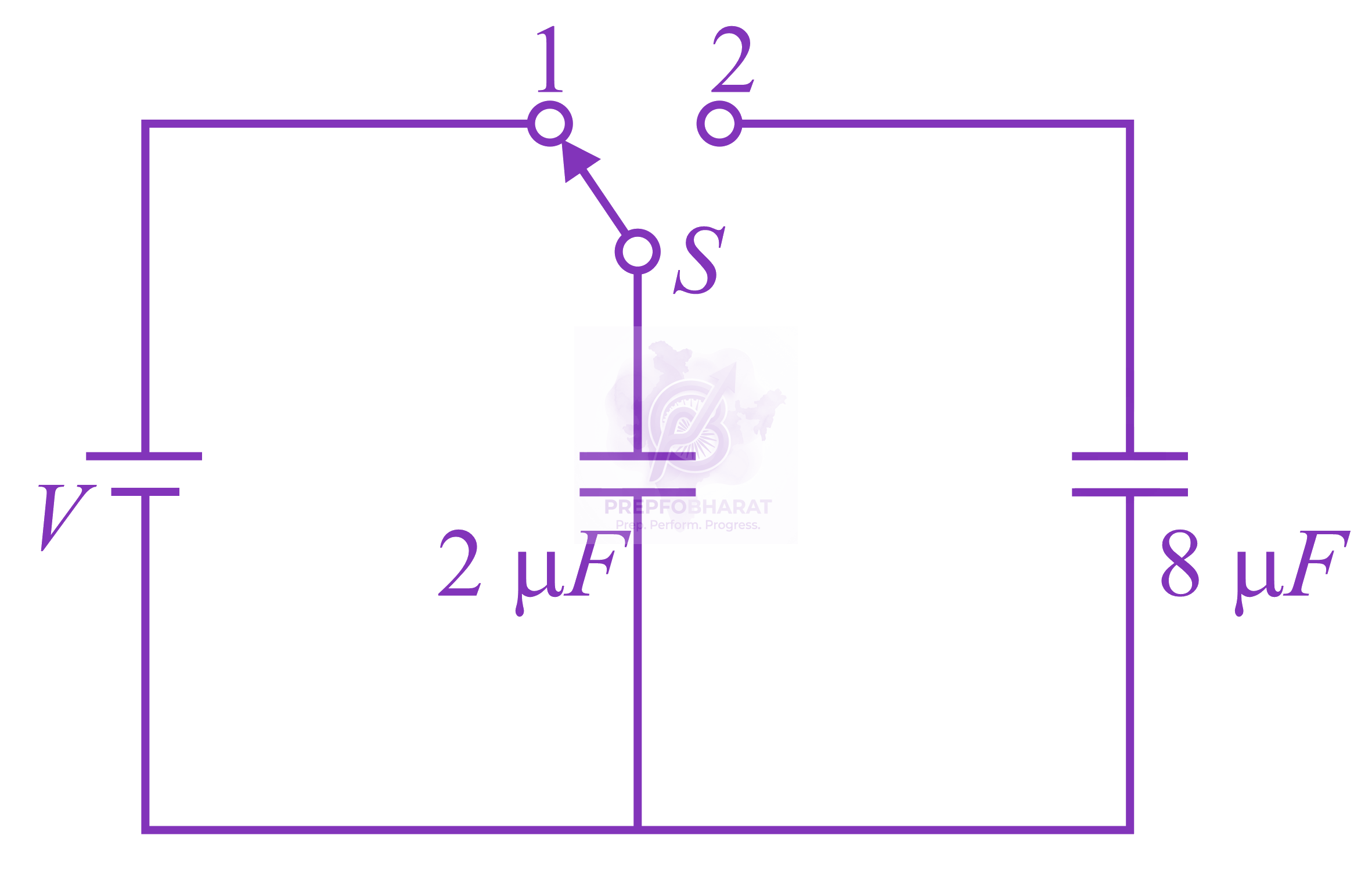
A uniform magnetic field is restricted within a region of radius, $r.$ The magnetic field changes with time at a rate, $\frac{d\vec{B}}{dt}$. Loop one of radius $R>r$ encloses the region, $r$ and loop two of radius, $R$ is outside the region of magnetic field as shown in the figure below. Then the emf generated is 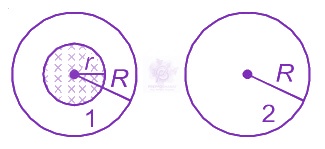
A long straight wire of radius $\text{a}$ carries a steady current $\text{I}$. the current is uniformly distributed over its cross-section. The ratio of the magnetic fields $\text{B}$ and $\text{B'}$, at radial distances $\frac{a}{2}$ and $2a$ respectively, from the axis of the wire is:
A long wire carrying a steady current is bent into a circular loop of one turn. The magnetic field at the centre of the loop is $B.$ It is then bent into a circular coil of $n$ turns. The magnetic field at the centre of this coil of $n$ turns will be
A long solenoid has $1000$ turns. When a current of $4 A$ flows through it the magnetic flux linked with each turn of the solenoid is $4\times {10}^{-3} Wb.$ The self-inductance of the solenoid is: