NEET UG 2019 — Electromagnetism
Physics Electromagnetism questions from NEET UG 2019.
Other Years
23 Electromagnetism Questions from 2019
A hollow metal sphere of radius $R$ is uniformly charged. The electric field due to the sphere at a distance $r$ from the center
The reading of an ideal voltmeter in the circuit shown is 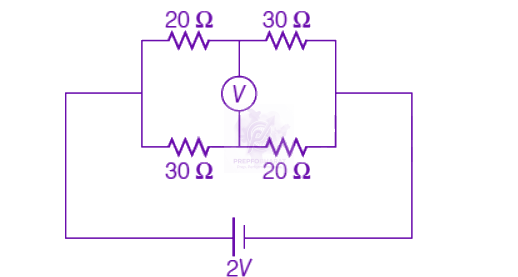
In which of the following devices, the eddy current effect is not used?
For a transparent medium relative permeability and permittivity $\mu_{\mathrm{r}}$ and $\epsilon_{\mathrm{r}}$ are 1.0 and 1.44 respectively. The velocity of light in this medium would be
In the circuits shown below, the readings of the voltmeters and the ammeters will be, 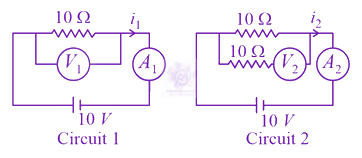
Ionized hydrogen atoms and $\text{α}$-particles with same momenta enters perpendicular to a constant magnetic field $B$. The ratio of their radii of their paths ${r}_{H}:{r}_{\text{α}}$ will be
Which of the following acts as a circuit protective device?
Six similar bulbs are connected as shown in the figure with a DC source of emf $E$, and zero internal resistance. The ratio of power consumption by the bulbs when $(i)$ all are glowing and $(\mathrm{ii})$ in the situation when two from section $A$ and one from section $B$ are glowing will be, 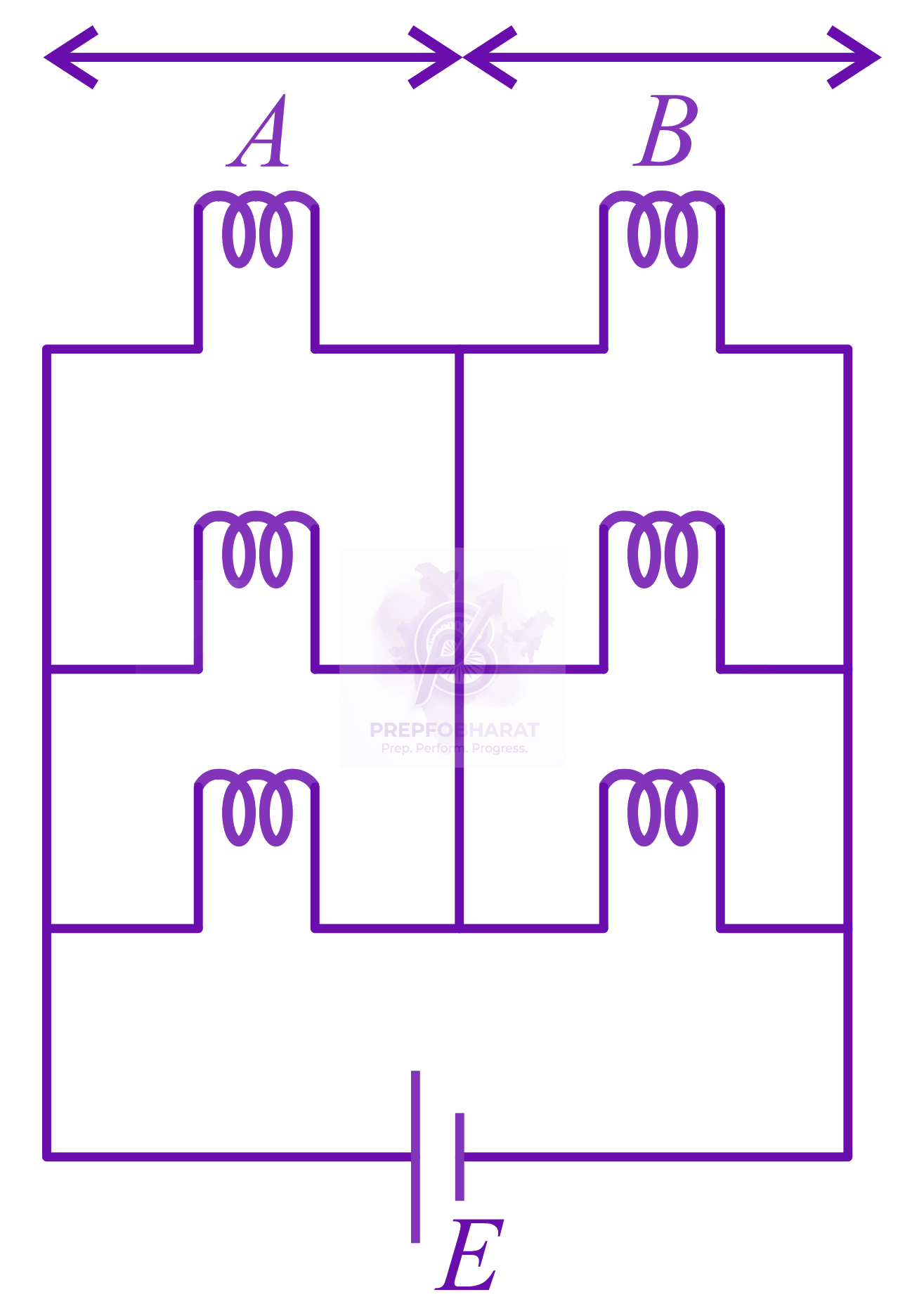
A circuit when connected to an AC source of $12 \mathrm{~V}$ gives a current of $0.2 \mathrm{~A}$. The same circuit when connected to a DC source of $12 \mathrm{~V}$, gives a current of $0.4 \mathrm{~A}$. The circuit is
Which colour of the light has the longest wavelength?
Two identical capacitors $C_1$ and $C_2$ of equal capacitance are connected as shown in the circuit. Terminals a and $\mathrm{b}$ of the key $\mathrm{k}$ are connected to charge capacitor $\mathrm{C}_1$ using battery of emf $\mathrm{V}$ volt. Now, disconnecting a and $b$ the terminals $b$ and $c$ are connected. Due to this, what will be the percentage loss of energy? 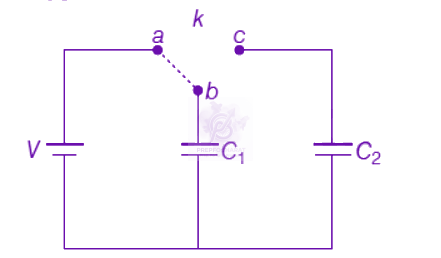
A parallel plate capacitor of capacitance $20\text{ μ}F$ is being charged by a voltage source whose potential is changing at the rate of $3 V{s}^{-1}$. The conduction current through the connecting wires, and the displacement current through the plates of the capacitor would be, respectively:
A straight conductor carrying current $i$ splits into two parts as shown in the figure. The radius of the circular loop is $R$. The total magnetic field at the centre $P$ at the loop is 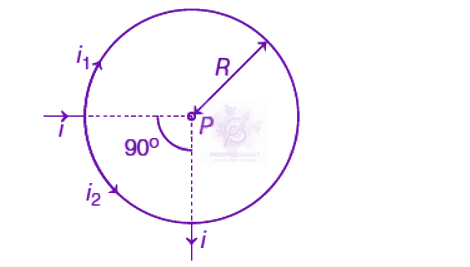
Two toroids 1 and 2 have total number of turns 200 and 100 respectively with average radii $40 \mathrm{~cm}$ and $20 \mathrm{~cm}$ respectively. If they carry same current $i$, the ratio of the magnetic fields along the two loops is
The meter bridge shown in the balance position with $\frac{\mathrm{P}}{\mathrm{Q}}=\frac{\mathrm{l}_1}{\mathrm{l}_2}$. If we now interchange the positions of galvanometer and cell, will the bridge work? If yes, that will be balanced condition? 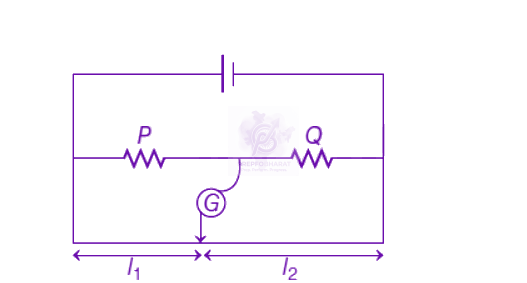
A cylindrical conductor of radius $R$ is carrying a constant current. The plot of the magnitude of the magnetic field $B$ with the distance $d$ from the centre of the conductor is correctly represented by the figure.
The variation of EMF with time for four types of generators are shown in the figures. Which amongst them can be called AC? (a) 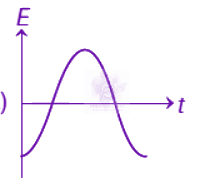 (b)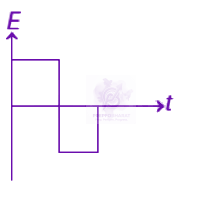 (c)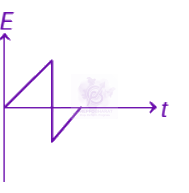 (d)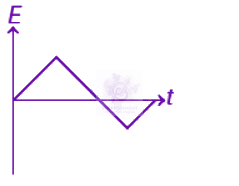
Two point charges A and B, having charges $+Q$ and $-Q$ respectively, are placed at certain distance apart and force acting between them is $F$. If $25%$ charge of $A$ is transferred to $B$, then the force between the charges becomes
Two parallel infinite line charges with linear charge densities $+\lambda C{m}^{-1}$ and $-\lambda C{m}^{-1}$ are placed at a distance of $2R$ in free space. What is the electric field mid-way between the two-line charges?
A cycle wheel of radius $0.5 \mathrm{~m}$ is rotated with constant angular velocity of $10 \mathrm{rad} / \mathrm{s}$ in a region of magnetic field of $0.1 \mathrm{~T}$ which is perpendicular to the plane of the wheel. The EMF generated between its centre and the rim is
A sphere encloses an electric dipole with charge $\pm 3 \times 10^{-6} \mathrm{C}$. What is the total electric flux across the sphere?
Two metal spheres, one of radius $\mathrm{R}$ and the other of radius $2 \mathrm{R}$ respectively have the same surface charge density $\sigma$. They are brought in contact and separated. What will be the new surface charge densities on them?
A $800$ turn coil of the effective area $0.05 {m}^{2}$ is kept perpendicular to the magnetic field $5\times {10}^{-5} T.$ When the plane of the coil is rotated by ${90}^{o}$ around any of its coplanar axis in $0.1 s,$ the emf induced in the coil will be: