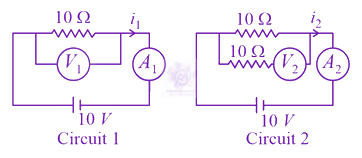
For an ideal voltmeter, resistance is infinite (RV=∞), so it will not draw any amount of current from the circuit and for ideal ammeter resistance is zero.
Then for the first figure R1=10Ω,RV=∞ and both are in a parallel arrangement, so
Req1=R11+RV1⇒Req1=101+∞1⇒Req=10Ω
and current in the first circuit is, i1=ReqV1=1010=1A
So, for the first circuit, ammeter and voltmeter readings are V1=10V,i1=1A, respectively.
For the second figure voltmeter and resistant of 10Ω are in series and also connected parallel to another resistant of 10Ω. So, equivalent resistant is
R′eq1=R11+R2+RV1⇒R′eq1=101+10+∞1=101+0=101⇒R′eq=10Ω
∴ Current in the circuit is, i2=Req′V2=1010=1A,
∴ Ammeter and voltmeter readings for the second circuit is V2=10V,i2=1A
∴ For both the circuit is
V1=V2=10V,i1=i2=1A