NEET UG 2015 — Electromagnetism
Physics Electromagnetism questions from NEET UG 2015.
Other Years
20 Electromagnetism Questions from 2015
$\text{A}$ , $\text{B}$ and $\text{C}$ are voltmeters of resistance $\text{R}$ , $\text{1}\text{.5 R}$ and $\text{3 R}$ respectively as shown in the figure. When some potential difference is applied between $\text{X}$ and $\text{Y}$ , the voltmeter readings are ${V}_{A}, {V}_{B}$ and ${V}_{C}$ respectively. Then: 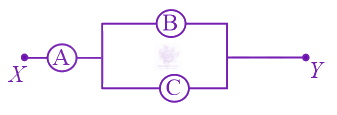
A resistance $\text{R}$ draws power $\text{P}$ when connected to an $\text{AC}$ source. If an inductance is now placed in series with the resistance, such that the impedance of the circuit becomes $\text{Z}$ , the power drawn will be:
The electric field in a certain region is acting radially outward and is given by $E=Ar$. A charge contained in a sphere of radius $\text{a}$ centred at the origin of the field will be given by
A radiation of energy $\text{E}$ falls normally on a perfectly reflecting surface. The momentum transferred to the surface is ($\text{C}$ = Velocity of light)
Two metal wires of identical dimensions are connected in series. If ${v}_{1}$ and ${v}_{2}$ are the conductivities of the metal wires respectively, the effective conductivity if the combination is:
Across a metallic conductor of non-uniform cross section a constant potential difference is applied. The quantity which remains constant along the conductor is:
A wire carrying current $\text{I}$ has the shape as shown in adjoining figure. Linear parts of the wire are very long and parallel to $\text{X}$ -axis while semicircular portion of radius $\text{R}$ is lying in $\text{Y}$ -$\text{Z}$ plane. Magnetic field at point $\text{O}$ is : 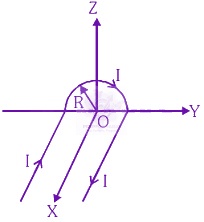
A conducting square frame of side $\text{a}$ and a long straight wire carrying current $\text{I}$ are located in the same plane as shown in the figure. The frame moves to the right with a constant velocity $\text{V}$. The e.m.f induced in the frame (when the centre of the frame is at a distance $x$ from the wire) will be proportional to : 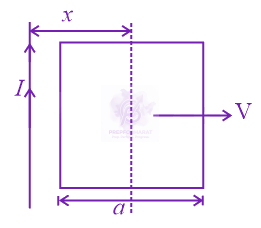
An electron moves on a straight line path XY as shown. The abcd is a coil adjacent to the path of electron. What will be the direction of current, if any, induced in the coil? 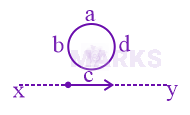
A potentiometer wire has length $\text{4 m}$ and resistance $8\Omega$ . The resistance that must be connected in series with the wire and an accumulator of e.m.f. $\text{2V}$ , so as to get a potential gradient $\text{1 mV}$ per cm on the wire is :
A circuit contains an ammeter, a battery of 30 v and a resistance 40.8 ohm all connected in series. If the ammeter has coil of resistance 480 ohm and a shunt of 20 ohm, the reading in the ammeter will be:
A parallel plate air capacitor of capacitance $C$ is connected to a cell of emf $V$ and then disconnected from it. A dielectric slab of dielectric constant $K$, which can just fill the air gap of the capacitor, is now inserted in it. Which of the following is incorrect?
A parallel plate air capacitor has capacity $\text{C}$, distance of separation between plates is $\text{d}$ and potential difference $\text{V}$ is applied between the plates. The force of attraction between the plates of the capacitor is
The energy of the em waves is of the order of $15\mathrm{keV}$. To which part of the spectrum does it belong?
An electron moving in a circular orbit of radius $r$ makes $n$ rotations per second. The magnetic field produced at the center has magnitude:
If potential(in $\mathrm{volts}$) in a region is expressed as $V(x,y,z)=6xy-y+2yz$, the electric field(in $N{C}^{-1}$) at point$(1,1,0)$ is
A series R-C circuit is connected to an alternating voltage source. Consider two situations: a. When capacitor is air filled. b. When capacitor is mica filled. Current through resistor is $i$ and voltage across capacitor is $V$ then:
A potentiometer wire of length $L$ and a resistance $r$ are connected in series with a battery of e.m.f. ${E}_{0}$ and a resistance ${r}_{1}$ . An unknown e.m.f. $E$ is balanced at a length $l$ of the potentiometer wire. The e.m.f. $E$ will be given by:
A rectangular coil of length $0.12\text{ m}$ and width $0.1\text{ m}$ having $50$ turns of wire is suspended vertically in a uniform magnetic field of strength $0.2$ $Weber/{m}^{2}$ . The coil carries a current of $2\text{A}$. If the plane of the coil is inclined at an angle of ${30}^{o}$ with the direction of the field, the torque required to keep coil in stable equilibrium will be:
A proton and an alpha particle both enter a region of uniform magnetic field B, moving at right angles to the field B. if the radius of circular orbits for both the particles is equal and the kinetic energy acquired by proton is 1 MeV, the energy acquired by the alpha particle will be: