Optics PYQ
NEET UG Physics — Optics previous year questions with solutions.
Browse by Year
Optics at a glance
Questions per year
122 across 24 yearsDifficulty mix
122 total- easy55 · 45%
- medium38 · 31%
- hard29 · 24%
Subtopic-wise weightage
Breakdown of the 118 Optics questions tagged to a subtopic, by year — darker cells mean more questions.
| Subtopic | Weightage | Total | 2025 | 2024 | 2023 | 2022 | 2021 | 2020 | 2019 | 2018 | 2017 | 2016 | 2015 | 2014 | 2013 | 2012 | 2011 | 2010 | 2008 | 2007 | 2006 | 2005 | 2004 | 2003 | 2002 |
|---|---|---|---|---|---|---|---|---|---|---|---|---|---|---|---|---|---|---|---|---|---|---|---|---|---|
| Ray Optics & Instruments | 69.5% | 82 | 2 | 3 | 8 | 5 | 4 | 5 | 5 | 3 | 3 | 6 | 4 | 2 | 3 | 6 | 4 | 3 | 4 | 2 | 2 | 1 | 3 | 2 | 2 |
| Wave Optics | 30.5% | 36 | 2 | 5 | 1 | 3 | 3 | 3 | 2 | 2 | 4 | 4 | 2 | 4 | 1 | ||||||||||
| All subtopics | 118 | 4 | 8 | 9 | 8 | 4 | 8 | 8 | 5 | 5 | 10 | 8 | 4 | 7 | 6 | 4 | 4 | 4 | 2 | 2 | 1 | 3 | 2 | 2 |
All Optics Questions (122)
The refractive index of glass is 1.5. The speed of light in glass is:
Two thin lenses of focal lengths f₁ = +20 cm and f₂ = -10 cm are in contact. The power of the combination is:
A microscope has an objective of focal length 2 cm , eyepiece of focal length 4 cm and the tube length of 40 cm . If the distance of distinct vision of eye is 25 cm , the magnification in the microscope is :
In a certain camera, a combination of four similar thin convex lenses are arranged axially in contact. Then the power of the combination and the total magnification in comparison to the power $(p)$ and magnification $(m)$ for each lens will be, respectively
The intensity of transmitted light when a polaroid sheet, placed between two crossed polaroids at $22.5^{\circ}$ from the polarization axis of one of the polaroid, is ( $\mathrm{I}_0$ is the intensity of polarised light after passing through the first polaroid):
An unpolarized light beam travelling in air is incident on a medium of refractive index 1.73 at Brewster's angle. Then -
If the monochromatic source in Young's double slit experiment is replaced by white light, then
A light ray enters through a right angled prism at point $P$ with the angle of incidence $30^{\circ}$ as shown in figure. It travels through the prism parallel to its base $B C$ and emerges along the face $A C$. The refractive index of the prism is: 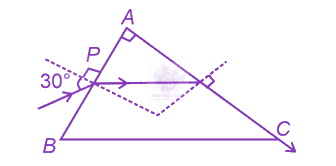
A small telescope has an objective of focal length 140 cm and an eye piece of focal length 5.0 cm . The magnifying power of telescope for viewing a distant object is:
A beam of unpolarized light of intensity $I_0$ is passed through a polaroid $A$, then through another polaroid $B$, oriented at $60^{\circ}$ and finally through another polaroid $C$, oriented at $45^{\circ}$ relative to $B$ as shown. The intensity of emergent light is: 
Interference pattern can be observed due to superposition of the following waves: A. $y=a \sin \omega t$ B. $y=a \sin 2 \omega t$ C. $y=a \sin (\omega t-\phi)$ D. $y=a \sin 3 \omega t$ Choose the correct answer from the options given below.
An unpolarised light beam strikes a glass surface at Brewster's angle. Then
Given below are two statements: Statement I : Image formation needs regular reflection and/or refraction. Statement II : The variety in colour of objects we see around us is due to the constituent colours of the light incident on them. In the light of the above statements, choose the most appropriate answer from the options given below :
Two slits in Young's double slit experiment are 1.5 mm apart and the screen is placed at a distance of 1 m from the slits. If the wavelength of light used is $600 \times 10^{-9} \mathrm{~m}$ then the fringe separation is
For Young's double slit experiment, two statements are given below: Statement $I$: If screen is moved away from the plane of slits, angular separation of the fringes remains constant. Statement $II$: If the monochromatic source is replaced by another monochromatic source of larger wavelength, the angular separation of fringes decreases. In the light of the above statements, choose the correct answer from the options given below:
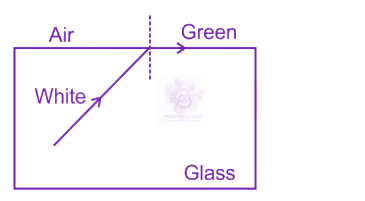 Which set of colours will come out in air for a situation shown in figure?
A horizontal ray of light is incident on the right-angled prism with prism angle $6^{\circ}$. If the refractive index of the material of the prism is 1.5 , then the angle of emergence will be 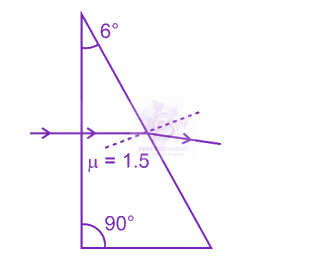
In the figure shown here, what is the equivalent focal length of the combination of lenses (Assume that all layers are thin)? 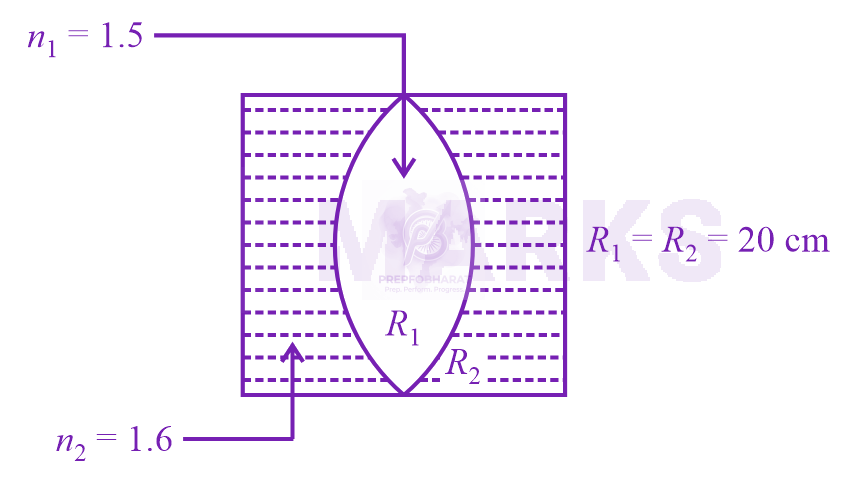
An object is mounted on a wall. Its image of equal size is to be obtained on a parallel wall with the help of a convex lens placed between these walls. The lens is kept at distance $x$ in front of the second wall. The required focal length of the lens will be
A lens is made up of 3 different transparent media as shown in figure. A point object $O$ is placed on its axis beyond $2 f$. How many real images will be obtained on the other side? 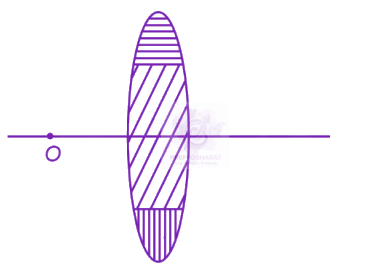
Light travels a distance$x$in time${t}_{1}$ in air and $10x$ in time ${t}_{2}$ in another denser medium. What is the critical angle for this medium?
$\varepsilon_0$ and $\mu_0$ are the electric permittivity and magnetic permeability of free space respectively. If the corresponding quantities of a medium are $2 \varepsilon_0$ and $1.5 \mu_0$ respectively, the refractive index of the medium will nearly be
Two thin lenses are of same focal lengths $f$, but one is convex and the other one is concave. When they are placed in contact with each other, the equivalent focal length of the combination will be:
The phenomenon of total internal reflection occurs when light travels from