Optics PYQ — Page 2
NEET UG Physics — Optics previous year questions with solutions.
All Optics Questions (122)
A light ray falls on a glass surface of refractive index $\sqrt{3}$, at an angle $60^{\circ}$. The angle between the refracted and reflected rays would be:
In a Young's double slit experiment, a student observes $8$ fringes in a certain segment of screen when a monochromatic light of $600\mathrm{nm}$ wavelength is used. If the wavelength of light is changed to $400\mathrm{nm}$, then the number of fringes he would observe in the same region of the screen is:
A biconvex lens has radii of curvature $20\mathrm{cm}$ each. If the refractive index of the material of the lens is $1.5$, the power of the lens is:
After passing through a polariser a linearly polarised light of intensity $\mathrm{I}$ is incident on an analyser making an angle of $30^{\circ}$ with that of the polariser. The intensity of light emitted from the analyser will be :
Two transparent media $A$ and $B$ are separated by a plane boundary. The speed of light in those media are $1.5\times {10}^{8}m{s}^{-1}$ and $2.0\times {10}^{8}m{s}^{-1}$, respectively. The critical angle for a ray of light for these two media is:
An astronomical refracting telescope is being used by an observer to observe planets in normal adjustment. The focal lengths of the objective and eye piece used in the construction of the telescope are $20 \mathrm{~m}$ and $2 \mathrm{~cm}$ respectively. Consider the following statements about the telescope: (a) The distance between the objective and eye piece is $20.02 \mathrm{~m}$ (b) The magnification of the telescope is $(-) 1000$ (c) The image of the planet is erect and diminished (d) The aperture of eye piece is smaller than that of objectie The correct statements are:
If the screen is moved away from the plane of the slits in a Young's double slit experiment, then the:
The power of a concave lens is
During a cloudy day, a primary and a secondary rainbow may be created, then the:
A point object is placed at a distance of $60\mathrm{cm}$ from a convex lens of focal length $30\mathrm{cm}$. If a plane mirror were put perpendicular to the principal axis of the lens and at a distance of $40\mathrm{cm}$ from it, the final image would be formed at a distance of : 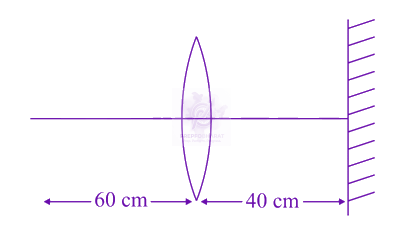
Find the value of the angle of emergence from the prism. Refractive index of the glass is $\sqrt{3}$. 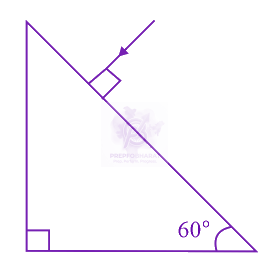
A lens of large focal length and large aperture is best suited as an objective of an astronomical telescope since:
A convex lens $A$ of focal length $20\mathrm{cm}$ and a concave lens $B$ of focal length $5\mathrm{cm}$ are kept along the same axis with a distance $d$ between them. If a parallel beam of light falling on $A$ leaves $B$ as a parallel beam, then the distance $d$ in $\mathrm{cm}$ will be :
If the critical angle for total internal reflection from a medium to vacuum is $45^{\circ},$ then velocity of light in the medium is,
The power of a biconvex lens is $10$ dioptre and the radius of curvature of each surface is $10\mathrm{cm}.$ Then the refractive index of the material of the lens is,
A ray is incident at an angle of incidence $i$ on one surface of a small angle prism (with angle of prism $A$) and emerges normally from the opposite surface. If the refractive index of the material of the prism is $\mu$, then the angle of incidence is nearly equal to:
Assume that light of wavelength $600 \mathrm{nm}$ is coming from a star. The limit of resolution of telescope whose objective has a diameter of $2 m$ is:
The Brewsters angle ${i}_{b}$ for an interface should be
In Young’s double slit experiment, if the separation between coherent sources is halved and the distance of the screen from the coherent sources is doubled, then the fringe width becomes:
An object is placed on the principal axis of a concave mirror at a distance of $1.5f$ ($f$ is the focal length). The image will be at,
Two coherent sources of light interfere and produce fringe patterns on a screen. For central maximum, the phase difference between the two waves will be
Two similar thin equi-convex lenses of focal length $f$ each are kept coaxially in contact with each other, such that the focal length of the combination is ${F}_{1}.$ When the space between the two lenses is filled with glycerin (which has the same refractive index ($\mu =1.5$) as that of glass), then the equivalent focal length is ${F}_{2}.$ The ratio ${F}_{1}:{F}_{2}$ will be
Angular width of the central maxima in the Fraunhoffer diffraction for $\lambda=6000 Å$ is $\theta_0$. When the same slit is illuminated by another monochromatic light, the angular width decreases by $30 \%$. The wavelength of this light is
Pick the wrong answer in the context with rainbow.