NEET UG 2015 — Optics
Physics Optics questions from NEET UG 2015.
Other Years
8 Optics Questions from 2015
For a parallel beam of monochromatic light of wavelength $\lambda$, diffraction is produced by a single slit whose width $\text{a}$ is of the order of the wavelength of the light. If $\text{D}$ is the distance of the screen from the slit, the width of the central maxima will be:
A beam of light consisting of red, green and blue colours is incident on a right-angled prism. The refractive index of the material of the prism for the above red, green and blue wavelengths are $1.39$, $1.44$and $1.47$ respectively. 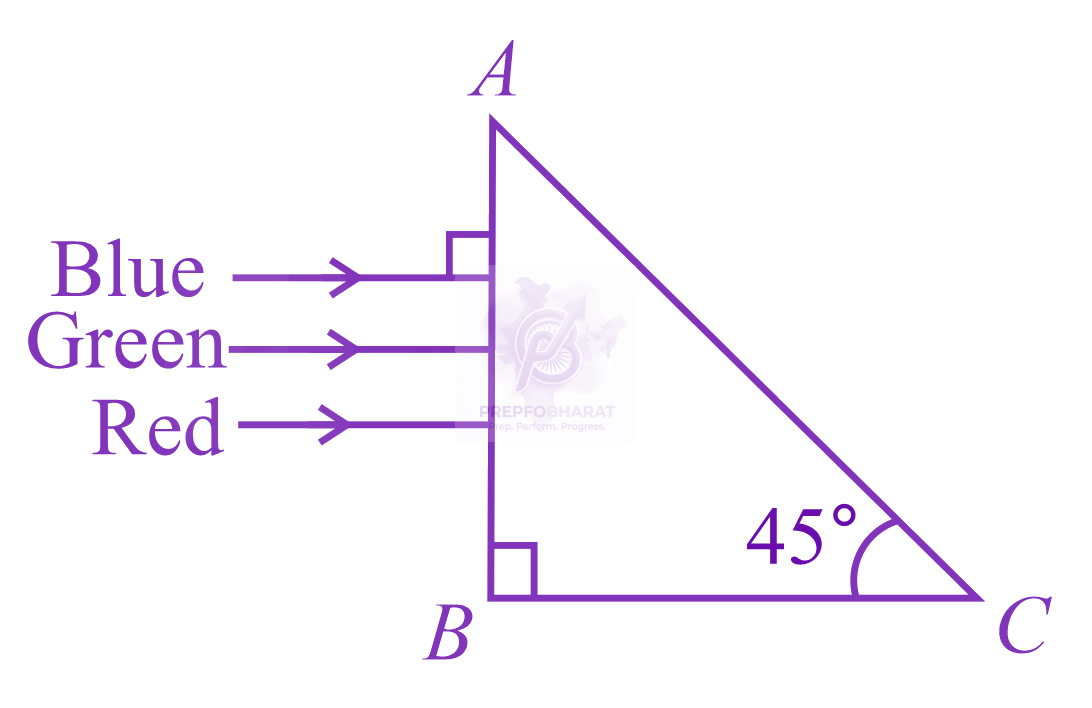 The prism will:
Two slits in Young's experiment have widths in the ratio 1 : 25. The ratio of intensity at the maxima and minima in the interference pattern, $\frac{{I}_{max}}{{I}_{min}}$ is:
In an astronomical telescope in normal adjustment a straight black line of the length $\text{L}$ is drawn on inside part of objective lens. The eye-piece forms a real image of this line. The length of this image is $l$ . The magnification of the telescope is:
Two identical thin Plano-convex glass lenses (refractive index $\text{1}\text{.5}$ ) each having radius of curvature of $\text{20 cm}$ are placed with their convex surfaces in contact at the center. The intervening space is filled with oil of refractive index $\text{1}\text{.7}$ The focal length of the combination is
In a double-slit experiment, the two slits are $1\mathrm{mm}$ apart and the screen is placed $1m$ away. A monochromatic light of wavelength $500\mathrm{nm}$ is used. What will be the width of each slit for obtaining ten maxima of double-slit within the central maxima of a single-slit pattern?
The refracting angle of a prism is $A$ , and refractive index of the material of the prism is $\mathrm{cot}(\frac{A}{2})$. The angle of minimum deviation is
At the first minimum adjacent to the central maximum of a single-slit diffraction pattern, the phase difference between the Huygen's wavelet from the edge of the slit and the wavelet from the midpoint of the slit is: