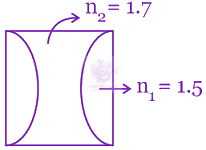
Len's maker's formula
f1=(μ−1)(R11−R21)
f11=(μ−1)201⇒(1.5−1)201=401
f11=401
For lens f11+f21=401+401=201
For concave f31=(1.7−1)(−R1−R1)=R−0.7×2
feq1=201+(R−0.7×2)
=201−201.4
feq=−0.420=−50cm
NEET UG 2015 — Physics Optics
Two identical thin Plano-convex glass lenses (refractive index 1.5 ) each having radius of curvature of 20 cm are placed with their convex surfaces in contact at the center. The intervening space is filled with oil of refractive index 1.7 The focal length of the combination is
Held on 30 Apr 2015 · Verified 9 Jul 2026.
−20cm
−25cm
−50cm
50cm
Sign in to track your attempts and accuracy.
Sign in to keep a private note on this question. Nothing you write is ever public.
Two thin lenses of focal lengths f₁ = +20 cm and f₂ = -10 cm are in contact. The power of the combination is:
The refractive index of glass is 1.5. The speed of light in glass is:
In a certain camera, a combination of four similar thin convex lenses are arranged axially in contact. Then the power of the combination and the total magnification in comparison to the power $(p)$ and magnification $(m)$ for each lens will be, respectively
A microscope has an objective of focal length 2 cm , eyepiece of focal length 4 cm and the tube length of 40 cm . If the distance of distinct vision of eye is 25 cm , the magnification in the microscope is :
The intensity of transmitted light when a polaroid sheet, placed between two crossed polaroids at $22.5^{\circ}$ from the polarization axis of one of the polaroid, is ( $\mathrm{I}_0$ is the intensity of polarised light after passing through the first polaroid):
Work through every NEET UG Optics PYQ, year by year.