NEET UG 2024 — Optics
Physics Optics questions from NEET UG 2024.
Other Years
8 Optics Questions from 2024
A small telescope has an objective of focal length 140 cm and an eye piece of focal length 5.0 cm . The magnifying power of telescope for viewing a distant object is:
A beam of unpolarized light of intensity $I_0$ is passed through a polaroid $A$, then through another polaroid $B$, oriented at $60^{\circ}$ and finally through another polaroid $C$, oriented at $45^{\circ}$ relative to $B$ as shown. The intensity of emergent light is: 
Interference pattern can be observed due to superposition of the following waves: A. $y=a \sin \omega t$ B. $y=a \sin 2 \omega t$ C. $y=a \sin (\omega t-\phi)$ D. $y=a \sin 3 \omega t$ Choose the correct answer from the options given below.
An unpolarised light beam strikes a glass surface at Brewster's angle. Then
Given below are two statements: Statement I : Image formation needs regular reflection and/or refraction. Statement II : The variety in colour of objects we see around us is due to the constituent colours of the light incident on them. In the light of the above statements, choose the most appropriate answer from the options given below :
Two slits in Young's double slit experiment are 1.5 mm apart and the screen is placed at a distance of 1 m from the slits. If the wavelength of light used is $600 \times 10^{-9} \mathrm{~m}$ then the fringe separation is
A light ray enters through a right angled prism at point $P$ with the angle of incidence $30^{\circ}$ as shown in figure. It travels through the prism parallel to its base $B C$ and emerges along the face $A C$. The refractive index of the prism is: 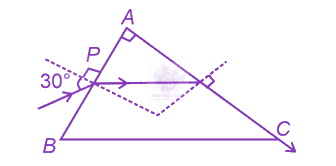
If the monochromatic source in Young's double slit experiment is replaced by white light, then