Thermodynamics PYQ
NEET UG Physics — Thermodynamics previous year questions with solutions.
Browse by Year
Thermodynamics at a glance
Questions per year
141 across 25 yearsDifficulty mix
141 total- easy71 · 50%
- medium44 · 31%
- hard26 · 18%
Subtopic-wise weightage
Breakdown of the 138 Thermodynamics questions tagged to a subtopic, by year — darker cells mean more questions.
| Subtopic | Weightage | Total | 2025 | 2024 | 2023 | 2022 | 2021 | 2020 | 2019 | 2018 | 2017 | 2016 | 2015 | 2014 | 2013 | 2012 | 2011 | 2010 | 2009 | 2008 | 2007 | 2006 | 2005 | 2004 | 2003 | 2002 |
|---|---|---|---|---|---|---|---|---|---|---|---|---|---|---|---|---|---|---|---|---|---|---|---|---|---|---|
| Laws of Thermodynamics | 39.9% | 55 | 2 | 2 | 3 | 2 | 3 | 1 | 2 | 3 | 5 | 5 | 2 | 5 | 3 | 3 | 1 | 4 | 2 | 1 | 1 | 2 | 1 | 1 | 1 | |
| Thermal Properties & Calorimetry | 38.4% | 53 | 1 | 1 | 1 | 2 | 4 | 2 | 2 | 5 | 2 | 2 | 3 | 3 | 3 | 4 | 4 | 3 | 1 | 2 | 1 | 2 | 5 | |||
| Kinetic Theory of Gases | 21.7% | 30 | 1 | 2 | 1 | 2 | 1 | 5 | 2 | 1 | 1 | 3 | 1 | 4 | 2 | 2 | 1 | 1 | ||||||||
| All subtopics | 138 | 4 | 4 | 4 | 5 | 2 | 10 | 7 | 5 | 5 | 11 | 10 | 5 | 12 | 6 | 3 | 6 | 8 | 8 | 4 | 3 | 4 | 3 | 3 | 6 |
All Thermodynamics Questions (141)
In an adiabatic process:
Two gases $A$ and $B$ are filled at the same pressure in separate cylinders with movable pistons of radius $r_A$ and $r_B$, respectively. On supplying an equal amount of heat to both the systems reversibly under constant pressure, the pistons of gas $A$ and $B$ are displaced by 16 cm and 9 cm , respectively. If the change in their internal energy is the same, then the ratio $\frac{r_A}{r_B}$ is equal to
A container has two chambers of volumes $V_1=2$ litres and $V_2=3$ litres separated by a partition made of a thermal insulator. The chambers contains $n_1=5$ and $n_2=4$ moles of ideal gas at pressures $p_1=1 \mathrm{~atm}$ and $p_2=2 \mathrm{~atm}$, respectively. When the partition is removed, the mixture attains an equilibrium pressure of :
An oxygen cylinder of volume 30 litre has 18.20 moles of oxygen. After some oxygen is withdrawn from the cylinder, its gauge pressure drops to 11 atmospheric pressure at temperature $27^{\circ} \mathrm{C}$. The mass of the oxygen withdrawn from the cylinder is nearly equal to : [Given, $R=\frac{100}{12} \mathrm{~J} \mathrm{~mol}^{-1} \mathrm{~K}^{-1}$, and molecular mass of $O_2=32,1 \mathrm{~atm}$ pressure $\left.=1.01 \times 10^5 \mathrm{~N} / \mathrm{m}\right]$
Three identical heat conducting rods are connected in series as shown in the figure. The rods on the sides have thermal conductivity $2 K$ while that in the middle has thermal conductivity $K$. The left end of the combination is maintained at temperature $3 T$ and the right end at $T$. The rods are thermally insulated from outside. In steady state, temperature at the left junction is $T_1$ and that at the right junction is $T_2$. The ratio $T_1 / T_2$ is 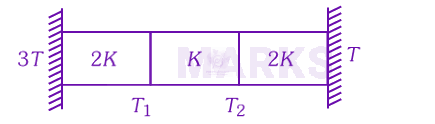
The equilibrium state of a thermodynamic system is described by A. Pressure B. Total heat C. Temperature D. Volume E. Work done
A thermodynamic system is taken through the cycle $a b c d a$. The work done by the gas along the path $b c$ is: 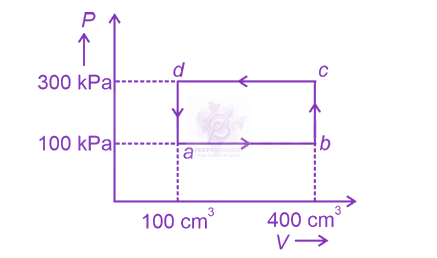
The following graph represents the $T$ - $V$ curves of an ideal gas (where $T$ is the temperature and $V$ the volume) at three pressures $P_1, P_2$ and $P_3$ compared with those of Charles's law represented as dotted lines. 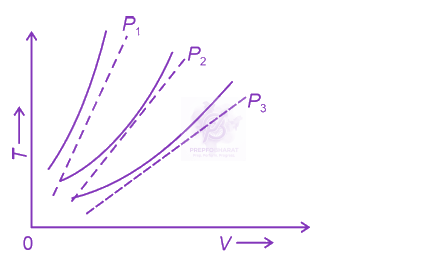 Then the correct relation is:
According to the law of equipartition of energy, the number of vibrational modes of a polyatomic gas of constant $\gamma=\frac{C_p}{C_v}$ is ( $C_P$ where $C_v$ are the specific heat capacities of the gas at constant pressure and constant volume, respectively):
For the given cycle, the work done during isobaric process is: 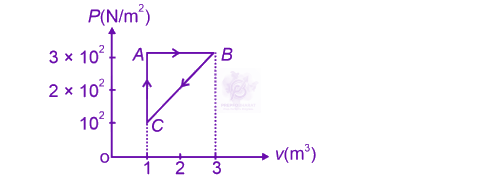
The temperature of a gas is $-50^{\circ}C$. To what temperature the gas should be heated so that the rms speed is increased by $3$ times?
A Carnot engine has an efficiency of $50%$ when its source is at a temperature $327^{\circ}C.$ The temperature of the sink is:
A container of volume $200 \mathrm{~cm}^3$ contains 0.2 mole of hydrogen gas and 0.3 mole of argon gas. The pressure of the system at temperature $200 \mathrm{~K}\left(R=8.3 \mathrm{~J} \mathrm{~K}^{-1} \mathrm{~mol}^{-1}\right)$ will be
The volume occupied by the molecules contained in $4.5\mathrm{kg}$ water at STP, if the intermolecular forces vanish away is
Three vessels of equal capacity have gases at the same temperature and pressure. The first vessel contains helium (monoatomic), the second contains fluorine (diatomic) and the third contains sulfur hexafluoride (polyatomic). The correct statement, among the following is:
Two rods one made of copper and other made of steel of the same length and same cross sectional area are joined together. The thermal conductivity of copper and steel are $385 \mathrm{~J} \mathrm{~s}^{-1} \mathrm{~K}^{-1} \mathrm{~m}^{-1}$ and $50 \mathrm{~J} \mathrm{~s}^{-1} \mathrm{~m}^{-1}$ respectively. The free ends of copper and steel are held at $100^{\circ} \mathrm{C}$ and $0^{\circ} \mathrm{C}$ respectively. The temperature at the junction is, nearly:
An ideal gas follows a process described by the equation $\mathrm{PV}^2=\mathrm{C}$ from the initial $\left(\mathrm{P}_1, \mathrm{~V}_1, \mathrm{~T}_1\right)$ to final ( $\left.\mathrm{P}_2, \mathrm{~V}_2, \mathrm{~T}_2\right)$ thermodynamic states, where $\mathrm{C}$ is a constant. Then:
An ideal gas undergoes four different processes from the same initial state as shown in the figure below. Those processes are adiabatic, isothermal, isobaric and isochoric. The curve which represents the adiabatic process among $1,2,3$ and $4$ is: 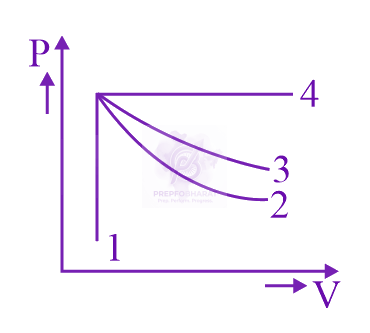
The first law of thermodynamics is based on
A cup of coffee cools from $90^{\circ}C$ to $80^{\circ}C$ in $t\mathrm{min}$, when the room temperature is $20^{\circ}C$. The time taken by a similar cup of coffee to cool from $80^{\circ}C\text{to}60^{\circ}C$ at a room temperature same at $20^{\circ}C$ is :
In an adiabatic process
Match Column - I and Column - II and choose the correct match from the given choices. <table class="pyq-table"><tbody><tr><td>Column - I</td><td>Column - II</td></tr><tr><td>(A) Root mean square speed of gas molecules</td><td>$(P)\frac{1}{3}nm{v}^{2}$</td></tr><tr><td>(B) Pressure exerted by ideal gas</td><td>$(Q)\sqrt{\frac{3RT}{M}}$</td></tr><tr><td>(C) Average kinetic energy of a molecule</td><td>$(R)\frac{5}{2}RT$</td></tr><tr><td>(D) Total internal energy of $1\mathrm{mol}$ of a diatomic gas</td><td>$(S)\frac{3}{2}{k}_{B}T$</td></tr></tbody></table>
An ideal gas equation can be written as, $P=\frac{\rho RT}{{M}_{0}}$ where $\rho$ and ${M}_{0}$ are respectively,
A cylinder contains hydrogen gas at pressure of $249\mathrm{kPa}$ and temperature ${27}^{o}C$. Its density is: $(R=8.3\mathrm{JK}{\mathrm{Mol}}^{-1}{K}^{-1})$