We know that PV=nRTP1=Vn1RT P2=Vn2RTPnet =P1+P2 =(n1+n2)VRT=(0.2+0.3)×200×10−68.3×200 =8.3×0.5×106=4.15×10⁶ Pa
A container of volume 200 ~cm^3 contains 0.2 mole of hydrogen gas and 0.3 mole of argon gas. The pressure of the system at temperature 200 ~K (R=8.3…
NEET UG 2023 — Physics Thermodynamics
2023mcqhard
A container of volume 200 cm3 contains 0.2 mole of hydrogen gas and 0.3 mole of argon gas. The pressure of the system at temperature 200 K(R=8.3 J K−1 mol−1) will be
Official previous-year question
Held on 30 Apr 2023 · Verified 9 Jul 2026.
Options
- A
4.15×10⁵ Pa
- B
4.15×10⁶ Pa
- C
6.15×10⁵ Pa
- D
6.15×10⁴ Pa
Did you get this right?
Sign in to track your attempts and accuracy.
Your note
Sign in to keep a private note on this question. Nothing you write is ever public.
NEET UG Thermodynamics in other years
More NEET UG Thermodynamics questions
In an adiabatic process:
2026easy
A container has two chambers of volumes $V_1=2$ litres and $V_2=3$ litres separated by a partition made of a thermal insulator. The chambers contains $n_1=5$ and $n_2=4$ moles of ideal gas at pressures $p_1=1 \mathrm{~atm}$ and $p_2=2 \mathrm{~atm}$, respectively. When the partition is removed, the mixture attains an equilibrium pressure of :
2025medium
An oxygen cylinder of volume 30 litre has 18.20 moles of oxygen. After some oxygen is withdrawn from the cylinder, its gauge pressure drops to 11 atmospheric pressure at temperature $27^{\circ} \mathrm{C}$. The mass of the oxygen withdrawn from the cylinder is nearly equal to : [Given, $R=\frac{100}{12} \mathrm{~J} \mathrm{~mol}^{-1} \mathrm{~K}^{-1}$, and molecular mass of $O_2=32,1 \mathrm{~atm}$ pressure $\left.=1.01 \times 10^5 \mathrm{~N} / \mathrm{m}\right]$
2025medium
Two gases $A$ and $B$ are filled at the same pressure in separate cylinders with movable pistons of radius $r_A$ and $r_B$, respectively. On supplying an equal amount of heat to both the systems reversibly under constant pressure, the pistons of gas $A$ and $B$ are displaced by 16 cm and 9 cm , respectively. If the change in their internal energy is the same, then the ratio $\frac{r_A}{r_B}$ is equal to
2025medium
Three identical heat conducting rods are connected in series as shown in the figure. The rods on the sides have thermal conductivity $2 K$ while that in the middle has thermal conductivity $K$. The left end of the combination is maintained at temperature $3 T$ and the right end at $T$. The rods are thermally insulated from outside. In steady state, temperature at the left junction is $T_1$ and that at the right junction is $T_2$. The ratio $T_1 / T_2$ is 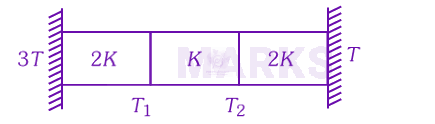
2025medium
Other Physics topics for NEET UG
Keep practicing Thermodynamics
Work through every NEET UG Thermodynamics PYQ, year by year.