NEET UG 2020 — Thermodynamics
Physics Thermodynamics questions from NEET UG 2020.
Other Years
10 Thermodynamics Questions from 2020
The efficiency of a Carnot engine depends upon
Two cylinders A and B of equal capacity are connected to each other via a stop cock. A contains an ideal gas at standard temperature and pressure. B is completely evacuated. The entire system is thermally insulated. The stop cock is suddenly opened. The process is:
The mean free path for a gas, with molecular diameter $d$ and number density $n$ can be expressed as:
Three stars $A,B,C$ have surface temperatures ${T}_{A},{T}_{B},{T}_{C}$ respectively. Star A appears bluish, star $B$ appears reddish and star $C$ yellowish. Hence,
The quantities of heat required to raise the temperature of two solid copper spheres of radii ${r}_{1}$ and ${r}_{2}({r}_{1}=1.5 {r}_{2})$ through $1 K$ are in the ratio:
The mean free path $l$ for a gas molecule depends upon diameter, $d$ of the molecule as:
The $P-V$ diagram for an ideal gas in a piston cylinder assembly undergoing a thermodynamic process is shown in the figure. The process is 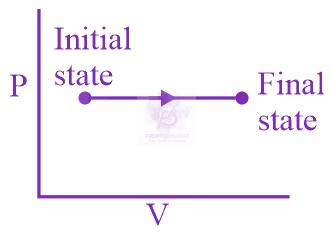
The average thermal energy for a mono-atomic gas is : (${k}_{B}$ is Boltzmann constant and $T$, absolute temperature)
A cylinder contains hydrogen gas at pressure of $249\mathrm{kPa}$ and temperature ${27}^{o}C$. Its density is: $(R=8.3\mathrm{JK}{\mathrm{Mol}}^{-1}{K}^{-1})$
An ideal gas equation can be written as, $P=\frac{\rho RT}{{M}_{0}}$ where $\rho$ and ${M}_{0}$ are respectively,