NEET UG 2018 — Thermodynamics
Physics Thermodynamics questions from NEET UG 2018.
Other Years
5 Thermodynamics Questions from 2018
The efficiency of an ideal heat engine working between the freezing point and boiling point of water, is
The power radiated by a black body is P and it radiates maximum energy at wavelength, ${\lambda }_{0}$. If the temperature of the black body is now changed so that it radiates maximum energy at wavelength $\frac{3}{4}{\lambda }_{0}$, the power radiated by it becomes nP. The value of n is
The Volume $(V)$ of a monoatomic gas varies with its temperature $(T)$, as shown in the graph. The ratio of work done by the gas, to the heat absorbed by it, when it undergoes a change from state $A$ to state $B$, is 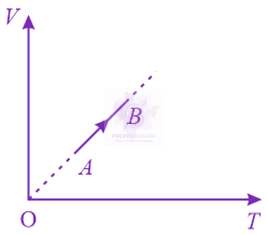
At what temperature will the rms speed of oxygen molecules becomes just sufficient for escaping from the Earth's atmosphere? (Given Mass of oxygen molecules $m=2.76\times {10}^{-26} kg$, Boltzmann's constant ${k}_{B}=1.38\times {10}^{-23} J {K}^{-1}$)
A sample of $0.1 \text{g}$ of water at ${100}^{ o}C$ and normal pressure $(1.013\times {10}^{5} N{ m}^{-2})$ requires $54 \text{cal}$ of heat energy to convert to steam at ${100}^{ o}C$. If the volume of the steam produced is $167.1 \text{cc,}$ the change in internal energy of the sample, is