NEET UG 2022 — Thermodynamics
Physics Thermodynamics questions from NEET UG 2022.
Other Years
6 Thermodynamics Questions from 2022
Two rods one made of copper and other made of steel of the same length and same cross sectional area are joined together. The thermal conductivity of copper and steel are $385 \mathrm{~J} \mathrm{~s}^{-1} \mathrm{~K}^{-1} \mathrm{~m}^{-1}$ and $50 \mathrm{~J} \mathrm{~s}^{-1} \mathrm{~m}^{-1}$ respectively. The free ends of copper and steel are held at $100^{\circ} \mathrm{C}$ and $0^{\circ} \mathrm{C}$ respectively. The temperature at the junction is, nearly:
An ideal gas follows a process described by the equation $\mathrm{PV}^2=\mathrm{C}$ from the initial $\left(\mathrm{P}_1, \mathrm{~V}_1, \mathrm{~T}_1\right)$ to final ( $\left.\mathrm{P}_2, \mathrm{~V}_2, \mathrm{~T}_2\right)$ thermodynamic states, where $\mathrm{C}$ is a constant. Then:
An ideal gas undergoes four different processes from the same initial state as shown in the figure below. Those processes are adiabatic, isothermal, isobaric and isochoric. The curve which represents the adiabatic process among $1,2,3$ and $4$ is: 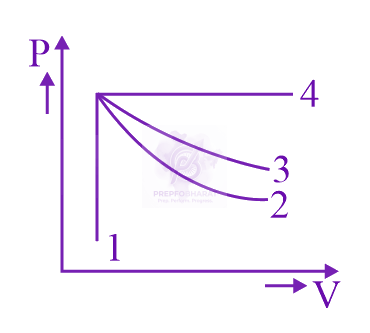
The first law of thermodynamics is based on
Three vessels of equal capacity have gases at the same temperature and pressure. The first vessel contains helium (monoatomic), the second contains fluorine (diatomic) and the third contains sulfur hexafluoride (polyatomic). The correct statement, among the following is:
The volume occupied by the molecules contained in $4.5\mathrm{kg}$ water at STP, if the intermolecular forces vanish away is