NEET UG 2013 — Thermodynamics
Physics Thermodynamics questions from NEET UG 2013.
Other Years
12 Thermodynamics Questions from 2013
In the given ( $V-T)$ diagram, what is the relation between pressures $p_1$ and $p_2$ ? 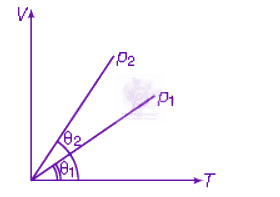
A piece of iron is heated in a flame. If first becomes dull red then becomes reddish yellow and finally turns to white hot. The correct explanation for the above observation is possible by using
The amount of heat energy required to raise the temperature of 1 g of helium at NTP, from $T_1 \mathrm{~K}$ to $T_2 \mathrm{~K}$ is
During an adiabatic process, the pressure of a gas is found to be proportional to the cube of its temperature. The ratio of $\frac{C_p}{C_v}$ for the gas is
In a vessel, the gas is at pressure $P$, if the mass of all the molecules is halved of their speed is double, then the resultant pressure will be :
A gas is taken through the cycle $A \rightarrow B \rightarrow C \rightarrow A$, as shown. What is the net work done by the gas? 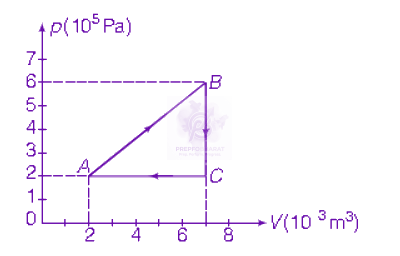
Two metal rods 1 and 2 of same lengths have same temperature difference between their ends. Their thermal conductivities are $K_1$ and $K_2$ and crosssectional areas $A_1$ and $A_2$ respectively. If the rate of heat conduction in 1 is four times that in 2 , then:
Which of the following relations does not give the equation of an adiabatic process, where terms have their usual meaning?
The density of water at $20^{\circ} \mathrm{C}$ in $998 \mathrm{~kg} / \mathrm{m}^3$ and at a $40^{\circ} \mathrm{C} 992 \mathrm{~kg} / \mathrm{m}^3$. The cocfficient of volume expansion of water is:
Two Carnot engines $\mathrm{A}$ and $\mathrm{B}$ are operated in series. The engine $A$ receives heat from the source at temperature $T_1$ and rejects the heat to the sink at temperature $T$. The second engine $\mathrm{B}$ receives the heat at temperature $\mathrm{T}$ and rejects to its sink at temperature $T_2$. For what value of $T$ the efficiencies of the two engines are equal:
The molar specific heats of an ideal gas at constant pressure and volume are denoted by $C_p$ and $C_V$ respectively. If $\gamma=\frac{C_p}{C_V}$ and $R$ is the universal gas constant, then $C_V$ is equal to
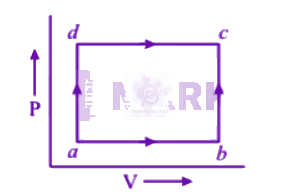
A system is taken from state a to state $c$ by two paths $a d c$ and $a b c$ as shown in the figure. The internal energy a is $U_2=10$ J. Along the path adc the amount of heat heat absorbed $\delta Q_1=50 \mathrm{~J}$ and the work obtained $\delta W_1=20 \mathrm{~J}$ whereas along the path $a b c$ the heat absorbed $\delta Q_2=36 \mathrm{~J}$. The amount of work along the path $a b c$ is: