Thermodynamics PYQ — Page 2
NEET UG Physics — Thermodynamics previous year questions with solutions.
All Thermodynamics Questions (141)
The average thermal energy for a mono-atomic gas is : (${k}_{B}$ is Boltzmann constant and $T$, absolute temperature)
The $P-V$ diagram for an ideal gas in a piston cylinder assembly undergoing a thermodynamic process is shown in the figure. The process is 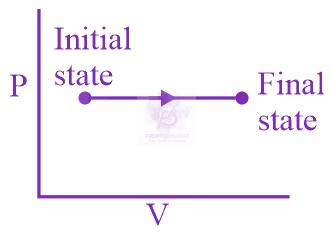
Two cylinders A and B of equal capacity are connected to each other via a stop cock. A contains an ideal gas at standard temperature and pressure. B is completely evacuated. The entire system is thermally insulated. The stop cock is suddenly opened. The process is:
The mean free path for a gas, with molecular diameter $d$ and number density $n$ can be expressed as:
Three stars $A,B,C$ have surface temperatures ${T}_{A},{T}_{B},{T}_{C}$ respectively. Star A appears bluish, star $B$ appears reddish and star $C$ yellowish. Hence,
The quantities of heat required to raise the temperature of two solid copper spheres of radii ${r}_{1}$ and ${r}_{2}({r}_{1}=1.5 {r}_{2})$ through $1 K$ are in the ratio:
The mean free path $l$ for a gas molecule depends upon diameter, $d$ of the molecule as:
The efficiency of a Carnot engine depends upon
A deep rectangular pond of surface area $\mathrm{A}$, containing water (density $=\rho$, specific heat capacity $=s$ ), is located in a region where the outside air temperature is a steady value at the $-26^{\circ} \mathrm{C}$. The thickness of the frozen ice layer in this pond, at a certain instant is $\mathrm{x}$. Taking the thermal conductivity of ice as $\mathrm{K}$, and its specific latent heat of fusion as L, the rate of increase of the thickness of ice layer, at this instant would be given by
Increase in temperature of a gas filled in a container will leads to
In which of the following processes, heat is neither absorbed nor released by a system?
An object kept in a large room having air temperature of $25^{\circ} \mathrm{C}$ takes 12 minutes to cool from $80^{\circ} \mathrm{C}$ to $70^{\circ} \mathrm{C}$. The time taken to cool for the same object from $70^{\circ} \mathrm{C}$ to $60^{\circ} \mathrm{C}$ would be nearly
1 g of water, of volume $1 \mathrm{~cm}^3$ at $100^{\circ} \mathrm{C}$ is converted into steam at same temperature under normal atmospheric pressure $=\left(\simeq 1 \times 10^5 \mathrm{~Pa}\right)$. The volume of steam formed equals $1671 \mathrm{~cm}^3$. If the specific latent heat of vaporisation of water is $2256 \mathrm{~J} / \mathrm{g}$, the change in internal energy is
A copper rod of $88 cm$ and an aluminum rod of unknown length have their increase in length independent of increase in temperature. The length of aluminum rod is $({\alpha }_{Cu}=1.7\times {10}^{-5}{K}^{-1} and {\alpha }_{\mathrm{Al}}=2.2\times {10}^{-5} {K}^{-1})$
The value of $\gamma\left(=\frac{C_p}{C_V}\right)$ for hydrogen, helium and another ideal diatomic gas $\mathrm{X}$ (whose molecules are not rigid but have an additional vibrational mode), are respectively equal to
A sample of $0.1 \text{g}$ of water at ${100}^{ o}C$ and normal pressure $(1.013\times {10}^{5} N{ m}^{-2})$ requires $54 \text{cal}$ of heat energy to convert to steam at ${100}^{ o}C$. If the volume of the steam produced is $167.1 \text{cc,}$ the change in internal energy of the sample, is
The efficiency of an ideal heat engine working between the freezing point and boiling point of water, is
The power radiated by a black body is P and it radiates maximum energy at wavelength, ${\lambda }_{0}$. If the temperature of the black body is now changed so that it radiates maximum energy at wavelength $\frac{3}{4}{\lambda }_{0}$, the power radiated by it becomes nP. The value of n is
The Volume $(V)$ of a monoatomic gas varies with its temperature $(T)$, as shown in the graph. The ratio of work done by the gas, to the heat absorbed by it, when it undergoes a change from state $A$ to state $B$, is 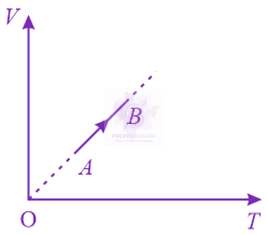
At what temperature will the rms speed of oxygen molecules becomes just sufficient for escaping from the Earth's atmosphere? (Given Mass of oxygen molecules $m=2.76\times {10}^{-26} kg$, Boltzmann's constant ${k}_{B}=1.38\times {10}^{-23} J {K}^{-1}$)
A gas mixture consists of $2$ moles of ${O}_{2}$ and 4 moles of $Ar$ at temperature $T$. Neglecting all vibrational modes, the total internal energy of the system is ($R$ is universal gas constant)
Thermodynamic processes are indicated in the following diagram. 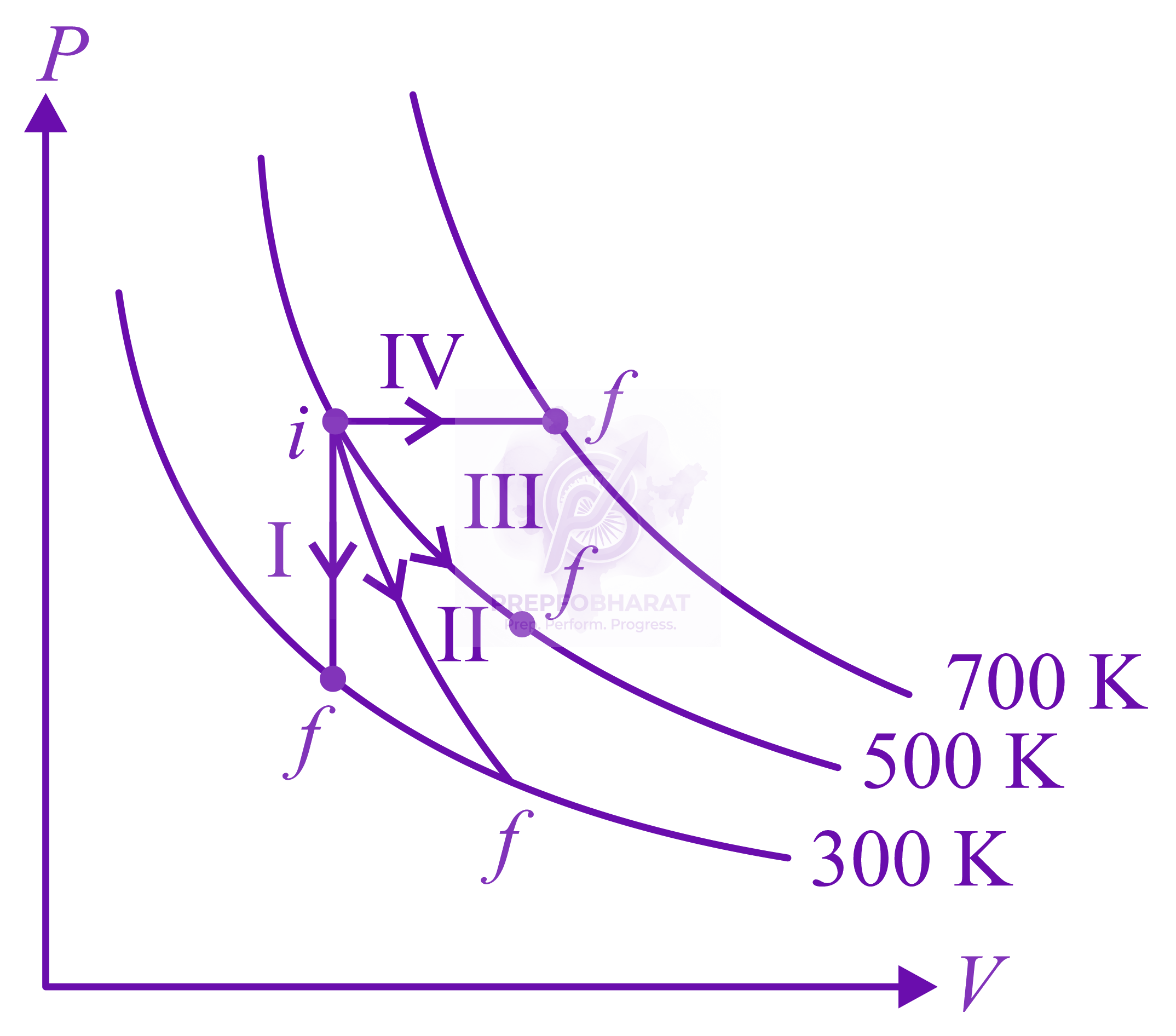 Match the following <table class="pyq-table"><tbody><tr><td>Column – 1</td><td>Column - 2</td></tr><tr><td>P. Process I</td><td>a. Adiabatic</td></tr><tr><td>Q. Process II</td><td>b. Isobaric</td></tr><tr><td>R. Process III</td><td>c. Isochoric</td></tr><tr><td>S. Process IV</td><td>d. Isothermal</td></tr></tbody></table>
A Carnot's engine having an efficiency of $\frac{1}{10}$ as heat engine, is used as a refrigerator. If the work done on the system is $10 J,$ the amount of energy absorbed from the reservoir at lower temperature is
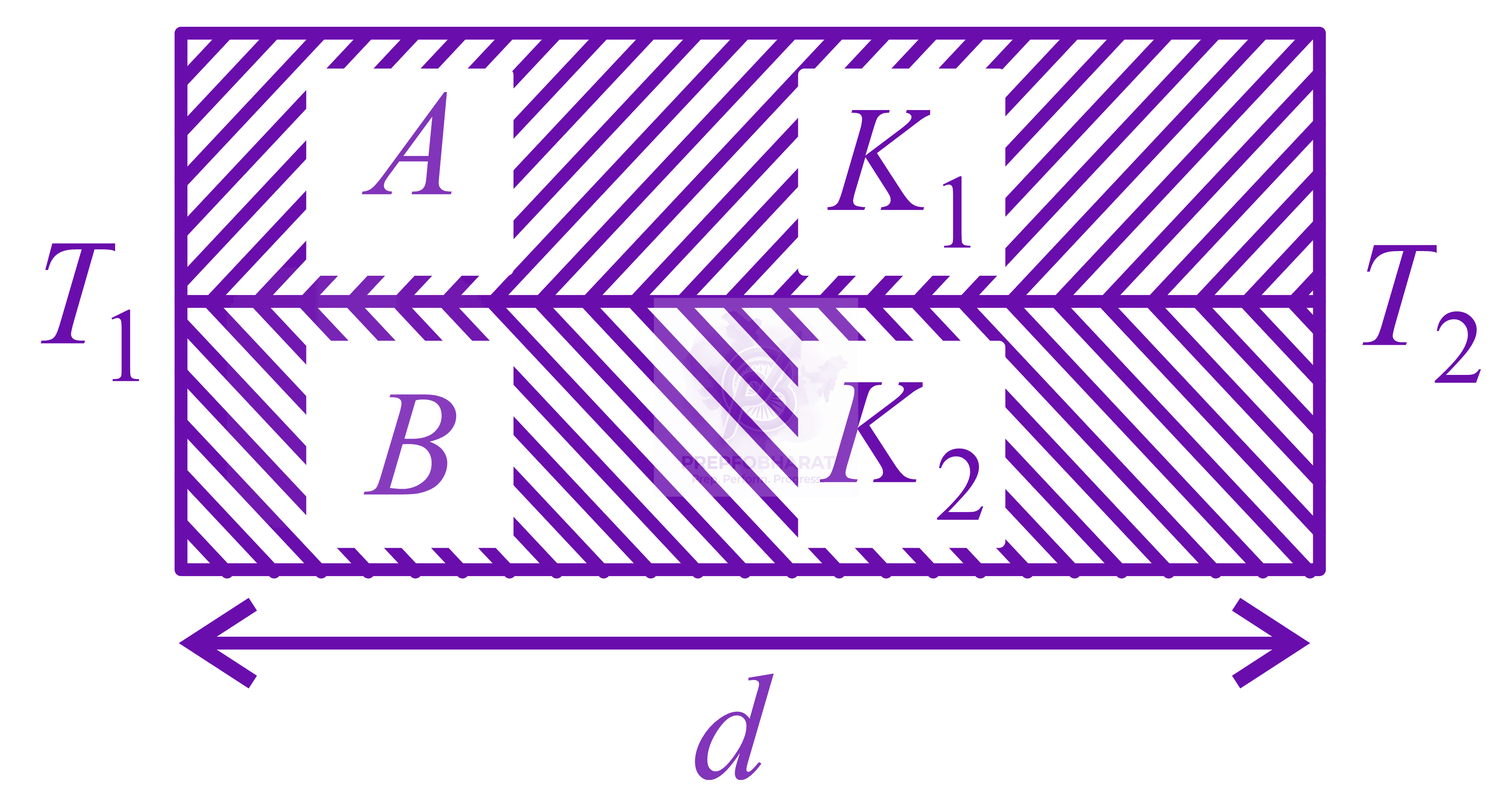
Two rods A and B of different materials are welded together as shown in figure. Their thermal conductivities are ${K}_{1}$ and ${K}_{2}$. The thermal conductivity of the composite rod will be