Thermodynamics PYQ — Page 3
NEET UG Physics — Thermodynamics previous year questions with solutions.
All Thermodynamics Questions (141)
A spherical black body with a radius of $12\mathrm{cm}$ radiates $450W$ power at $500K$. If the radius were halved and the temperature doubled, the power radiated in watt would be
A piece of ice falls from a height $h$ so that it melts completely. Only one-quarter of the heat produced is absorbed by the ice and all energy of ice gets converted into heat during its fall. The value of $h$ is: (Latent heat of ice is $3.4\times {10}^{5} {\text{J kg}}^{-1}$ and $g=10 {\text{N kg}}^{-1}$)
The molecules of a given mass of gas have RMS velocity of $200$ $m {s}^{-1}$ at ${27}^{o}C$ and $1.0\times {10}^{5} N {m}^{-2}$ pressure. When the temperature and pressure of the gas are respectively, ${127}^{o}C$ and $0.05\times {10}^{5} N {m}^{-2}$, the r.m.s. velocity of its molecules in $m {s}^{-1}$ is:
One mole of an ideal monatomic gas undergoes a process described by the equation $\text{P}{\text{V}}^{3}=$ constant. The heat capacity of the gas during this process is
The temperature inside a refrigerator is ${t}_{2}{ }^{o}C$ and the room temperature is ${t}_{1}{}^{o}C$. The amount of heat delivered to the room for each joule of electrical energy consumed ideally will be
Two identical bodies are made of a material for which the heat capacity increases with temperature. One of these is at ${100}^{ o}C$, while the other one is at ${0}^{ o}C$. If the two bodies are brought into contact, then assuming no heat loss, the final common temperature is
A given sample of an ideal gas occupies a volume, $V$ at a pressure, $P$ and absolute temperature, $T$. The mass of each molecule of the gas is $\text{m}$. Which of the following gives the density of the gas?
A black body is at a temperature of $\text{5760}\text{ K.}$ The energy of radiation emitted by the body at wavelength $\text{250}\text{ nm}$ is ${U}_{1}$, at wavelength $\text{500} \text{ nm}$ is ${U}_{2}$ and that at $\text{1000}\text{ nm}$ is ${U}_{3}$. Wien's constant, $b=2.88\times {10}^{6}\text{ nm K.}$ Which of the following is correct?
A body cools from a temperature $3T$ to $2T$ in $10$ minutes. The room temperature is $T$. Assume that Newton's law of cooling is applicable. The temperature of the body at the end of next $10$ minutes will be
A refrigerator works between ${4}^{o }C$ and ${30}^{o}C$. It is required to remove $\text{600}$ calories of heat every second in order to keep the temperature of the refrigerated space constant. The power required is: (Take $\text{1}$ cal = $\text{4}\text{.2}$ Joules)
Coefficient of linear expansion of brass and steel rods are ${\alpha }_{1}$ and ${\alpha }_{2}$. Lengths of brass and steel rods are ${l}_{1}$ and ${l}_{2}$, respectively. If $({l}_{2}-{l}_{1})$ is maintained the same at all temperatures, which one of the following relations holds good?
A gas is compressed isothermally to half its initial volume. The same gas is compressed separately through an adiabatic process until its volume is again reduced to half. Then:
Two vessels separately contain two ideal gases $A$ and $B$ at the same temperature, the pressure of $A$ being twice that of $B$. Under such conditions, the density of $A$ is found to be $\text{1.5}$ times the density of $B$. The ratio of molecular weights of $A$ and $B$ is
On observing light from three different stars $\text{P}$ , $\text{Q}$ and $\text{R}$ , it was found that intensity of violet colour is maximum in the spectrum of $\text{P}$ , the intensity of green colour is maximum in the spectrum of $\text{R}$ and the intensity of red colour is maximum in the spectrum of $\text{Q}$ . If ${T}_{p}, {T}_{Q}$ and ${T}_{R}$ are the respective absolute temperatures of $\text{P}$ , $\text{Q}$ and $\text{R}$ , then it can be concluded from the above observations that :
The coefficient of performance of a refrigerator is $5$. If the temperature inside the freezer is $-20^{\circ}C$, the temperature of the surrounding to which it rejects heat is:
The two ends of a metal rod are maintained at temperatures $100 ^{\circ}C$ and $110 ^{\circ}C$ . The rate of heat flow in the rod is found to be $4.0{\text{J s}}^{-1}$ . If the ends are maintained at temperatures $200 ^{\circ}C$ and $210 ^{\circ}C$ , the rate of heat flow will be:
The ratio of the specific heats $\frac{{C}_{P}}{{C}_{v}}= \gamma$ in terms of degrees of freedom (n) is given by:
An ideal gas is compressed to half of its initial volume by means of several processes. Which of the process results in the maximum work done on the gas?
A Carnot engine, having an efficiency of $\eta =\frac{1}{10}$ as heat engine, is used as a refrigerator. If the work done on the system is $10J$, the amount of energy absorbed from the reservoir at a lower temperature is:
$4.0 g$ of a gas occupies $22.4$ liters at NTP. The specific heat capacity of the gas at constant volume is $5.0 J{K}^{-1} mo{l}^{-1}$ . If the speed of sound in this gas at NTP is $952 m{s}^{-1}$ , then the heat capacity at constant pressure is (Take gas constant $R=8.3 J{K}^{-1} mo{l}^{-1}$ )
Figure below shows two paths that may be taken by a gas to go from a state A to a state C. 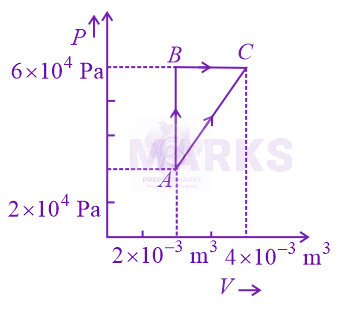 In process AB, 400 J of heat is added to the system and in process BC, 100 J of heat is added to the system. The heat absorbed by the system in the process AC will be:
One mole of an ideal diatomic gas undergoes a transition from $A$ to $B$ along a path $\mathrm{AB}$ as shown in the figure, 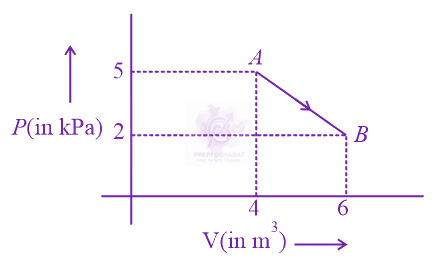 The change in internal energy of the gas during the transition is:
A monoatomic gas at a pressure $P,$ having a volume $V$ expands isothermally to a volume $2V$ and then adiabatically to a volume $16V.$ The final pressure of the gas is: (take $\gamma =5/3$)
Certain quantity of water cools from ${70 }^{o}C$ to ${60 }^{o}C$ in the first $5$ minutes and to ${54 }^{o}C$ in the next $5$ minutes. The temperature of the surroundings is: