Thermodynamics PYQ — Page 4
NEET UG Physics — Thermodynamics previous year questions with solutions.
All Thermodynamics Questions (141)
Steam at ${100 }^{o}C$ is passed into $20 g$ of water at ${10 }^{o}C.$ When water acquires a temperature of ${80}^{o}C,$ the mass of water present will be: [Take specific heat of water $=1 cal {g}^{-1 o}{C}^{-1}$ and latent heat of steam $=540 cal {g}^{-1}]$
The mean free path of molecules of a gas (radius ‘ $r$ ’) is inversely proportional to:
A thermodynamics system undergoes cyclic process $ABCDA$ as shown in Figure. The work done by the system in the cycle is: 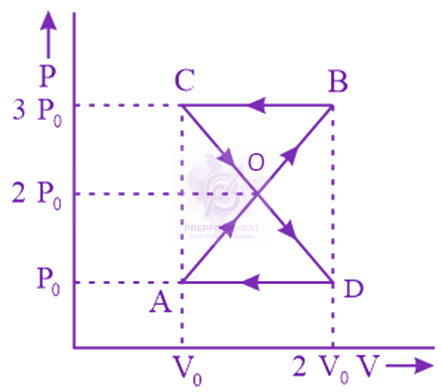
A system is taken from state a to state $c$ by two paths $a d c$ and $a b c$ as shown in the figure. The internal energy a is $U_2=10$ J. Along the path adc the amount of heat heat absorbed $\delta Q_1=50 \mathrm{~J}$ and the work obtained $\delta W_1=20 \mathrm{~J}$ whereas along the path $a b c$ the heat absorbed $\delta Q_2=36 \mathrm{~J}$. The amount of work along the path $a b c$ is: 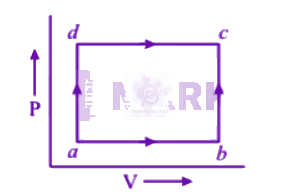
The molar specific heats of an ideal gas at constant pressure and volume are denoted by $C_p$ and $C_V$ respectively. If $\gamma=\frac{C_p}{C_V}$ and $R$ is the universal gas constant, then $C_V$ is equal to
Two Carnot engines $\mathrm{A}$ and $\mathrm{B}$ are operated in series. The engine $A$ receives heat from the source at temperature $T_1$ and rejects the heat to the sink at temperature $T$. The second engine $\mathrm{B}$ receives the heat at temperature $\mathrm{T}$ and rejects to its sink at temperature $T_2$. For what value of $T$ the efficiencies of the two engines are equal:
The density of water at $20^{\circ} \mathrm{C}$ in $998 \mathrm{~kg} / \mathrm{m}^3$ and at a $40^{\circ} \mathrm{C} 992 \mathrm{~kg} / \mathrm{m}^3$. The cocfficient of volume expansion of water is:
In the given ( $V-T)$ diagram, what is the relation between pressures $p_1$ and $p_2$ ? 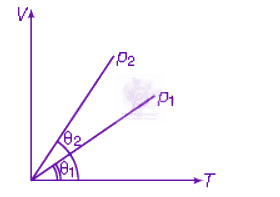
A piece of iron is heated in a flame. If first becomes dull red then becomes reddish yellow and finally turns to white hot. The correct explanation for the above observation is possible by using
The amount of heat energy required to raise the temperature of 1 g of helium at NTP, from $T_1 \mathrm{~K}$ to $T_2 \mathrm{~K}$ is
During an adiabatic process, the pressure of a gas is found to be proportional to the cube of its temperature. The ratio of $\frac{C_p}{C_v}$ for the gas is
In a vessel, the gas is at pressure $P$, if the mass of all the molecules is halved of their speed is double, then the resultant pressure will be :
A gas is taken through the cycle $A \rightarrow B \rightarrow C \rightarrow A$, as shown. What is the net work done by the gas? 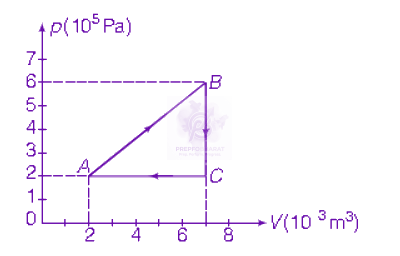
Two metal rods 1 and 2 of same lengths have same temperature difference between their ends. Their thermal conductivities are $K_1$ and $K_2$ and crosssectional areas $A_1$ and $A_2$ respectively. If the rate of heat conduction in 1 is four times that in 2 , then:
Which of the following relations does not give the equation of an adiabatic process, where terms have their usual meaning?
An ideal gas goes from state $A$ to state $B$ via three different processes as indicated in the $p-V$ diagram If $Q_1, Q_2, Q_3$ indicate the heat absorbed by the gas along the three processes and $\Delta U_1, \Delta U_2, \Delta U_3$ indicate the change in internal energy along the three processes respectively, then 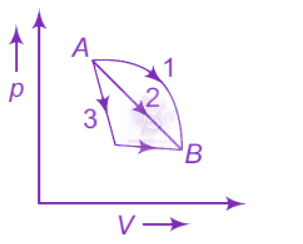
If the radius of a star is $R$ and it acts as a black body, what would be the temperature of the star, in which the rate of energy production is $Q$ ? ( $\sigma$ stands for Stefan's constant.)
One mole of an ideal gas goes from an initial state $A$ to final state $B$ via two processes. It first undergoes isothermal expansion from volume $V$ to $3 V$ and then its volume is reduced from $3 V$ to $V$ at constant pressure. The correct $p-V$ diagram representing the two processes is
Liquid oxygen at $50 \mathrm{~K}$ is heated to $300 \mathrm{~K}$ at constant pressure of 1 atm. The rate of heating is constant. Which one of the following graphs represents the variation of temperature with time?
A thermodynamic system is taken through the cycle $A B C D$ as shown in figure. Heat rejected by the gas during the cycle is 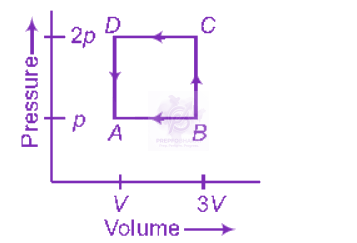
A slab of stone of area of $0.36 \mathrm{~m}^2$ and thickness $0.1 \mathrm{~m}$ is exposed on the lower surface to steam at $100^{\circ} \mathrm{C}$. A block of ice at $0^{\circ} \mathrm{C}$ rests on the upper surface of the slab. In one hour $4.8 \mathrm{~kg}$ of ice is melted. The thermal conductivity of slab is (Given latent heat of fusion of ice $=3.36 \times 10^5 \mathrm{~J} \mathrm{~kg}^{-1}$ )
A mass of diatomic gas $(\gamma=1.4)$ at a pressure of $2 \mathrm{~atm}$ is compressed adiabatically so that its temperature rise from $27^{\circ} \mathrm{C}$ to $927^{\circ} \mathrm{C}$. The pressure of the gas is final state is
During an isothermal expansion, a confined ideal gas does $150 \mathrm{~J}$ of work against its surroundings. This implies that
When $1 \mathrm{~kg}$ of ice at $0^{\circ} \mathrm{C}$ melts to water at $0^{\circ} \mathrm{C}$, the resulting change in its entropy, taking latent heat of ice to be $80 \mathrm{cal} /{ }^{\circ} \mathrm{C}$, is