NEET UG 2012 — Thermodynamics
Physics Thermodynamics questions from NEET UG 2012.
Other Years
6 Thermodynamics Questions from 2012
If the radius of a star is $R$ and it acts as a black body, what would be the temperature of the star, in which the rate of energy production is $Q$ ? ( $\sigma$ stands for Stefan's constant.)
One mole of an ideal gas goes from an initial state $A$ to final state $B$ via two processes. It first undergoes isothermal expansion from volume $V$ to $3 V$ and then its volume is reduced from $3 V$ to $V$ at constant pressure. The correct $p-V$ diagram representing the two processes is
Liquid oxygen at $50 \mathrm{~K}$ is heated to $300 \mathrm{~K}$ at constant pressure of 1 atm. The rate of heating is constant. Which one of the following graphs represents the variation of temperature with time?
A thermodynamic system is taken through the cycle $A B C D$ as shown in figure. Heat rejected by the gas during the cycle is 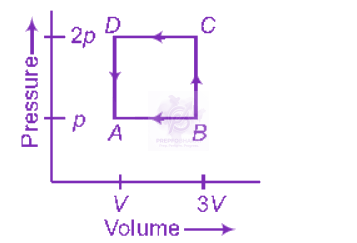
A slab of stone of area of $0.36 \mathrm{~m}^2$ and thickness $0.1 \mathrm{~m}$ is exposed on the lower surface to steam at $100^{\circ} \mathrm{C}$. A block of ice at $0^{\circ} \mathrm{C}$ rests on the upper surface of the slab. In one hour $4.8 \mathrm{~kg}$ of ice is melted. The thermal conductivity of slab is (Given latent heat of fusion of ice $=3.36 \times 10^5 \mathrm{~J} \mathrm{~kg}^{-1}$ )
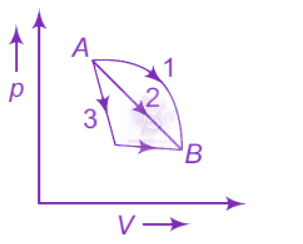
An ideal gas goes from state $A$ to state $B$ via three different processes as indicated in the $p-V$ diagram If $Q_1, Q_2, Q_3$ indicate the heat absorbed by the gas along the three processes and $\Delta U_1, \Delta U_2, \Delta U_3$ indicate the change in internal energy along the three processes respectively, then