NEET UG 2014 — Electromagnetism
Physics Electromagnetism questions from NEET UG 2014.
Other Years
12 Electromagnetism Questions from 2014
In a region the potential is represented by $V(x, y, z)=6x-8xy-8y+6yz,$ where $V$ is in volts and $x, y, z,$ are in meters. The electric force experienced by a charge of $2$ coulombs situated at point $(1, 1, 1)$ is:
In an ammeter $0.2%$ of main current passes through the galvanometer. If resistance of galvanometer is $G,$ the resistance of ammeter will be:
A potentiometer circuit has been set up for finding the internal resistance of a given cell. The main battery, used across the potentiometer wire, has an emf of $2.0 V$ and a negligible internal resistance. The potentiometer wire itself is $4 m$ long. When the resistance, $R,$ connected across the given cell, has values of. $(i)$ infinity $(ii) 9.5 \Omega$ The 'balancing lengths, on the potentiometer wire are found to be $3m$ and $2.85 m,$ respectively. The value of internal resistance of the cell is:
Following figures show the arrangement of bar magnets in different configurations. Each magnet has magnetic dipole $\vec{m}.$ Which configuration has highest net magnetic dipole moment?
Two identical long conducting wires $AOB$ and $COD$ are placed at right angle to each other, with one above other such that ‘ $O$ ’ is their common point for the two. The wires carry ${I}_{1}$ and ${I}_{2}$ currents, respectively. Point ‘ $I$ ’ is lying at distance ‘ $d$ ’ from ‘ $O$ ’ along a direction perpendicular to the plane containing the wires. The magnetic field at the point ‘ $P$ ’ will be:
A conducting sphere of radius $R$ is given a charge $Q.$ The electric potential and the electric field at the center of the sphere respectively are:
The resistance in the two arms of the meter bridge are $5 \Omega$ and $R\Omega ,$ respectively. When the resistance $R$ is shunted with an equal resistance, the new balance point is at $1.6{l}_{1}.$ The resistance ‘ $R$ ’ is: 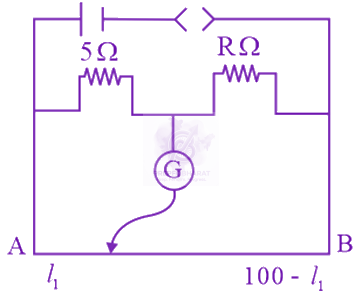
Two cities are $150 km$ apart. Electric power is sent from one city to another city through copper wires. The fall of potential per $km$ is $8$ volts and the average resistance per $km$ is $0.5 \Omega .$ The power loss in the wire is:
Light with an energy flux of $25\times {10}^{4} {Wm}^{-2}$ falls on a perfectly reflecting surface at normal incidence. If the surface area is $15 {cm}^{2},$ the average force exerted on the surface is:
A thin semicircular conducting ring $(PQR)$ of radius $r$ is falling with its plane vertical in a horizontal magnetic field $B,$ as shown in figure. The potential difference developed across the ring when its speed is $v,$ is: 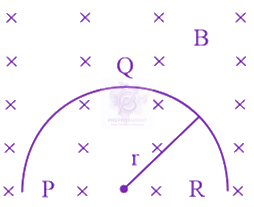
Two thin dielectric slabs of dielectric constants ${K}_{1}$ and ${K}_{2}({K}_{1}<{K}_{2})$ are inserted between plates of a parallel plate capacitor, as shown in the figure. The variation of electric field ‘ $E$ ’ between the plates with distance ‘ $d$ ’ as measured from plate $P$ is correctly shown by: 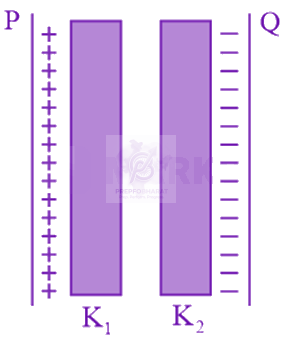
A transformer having efficiency of $90%$ is working on $200 V$ and $3 kW$ power supply. If the current in the secondary coil is $6 A$ the voltage across the secondary coil and the current in the primary coil respectively are: