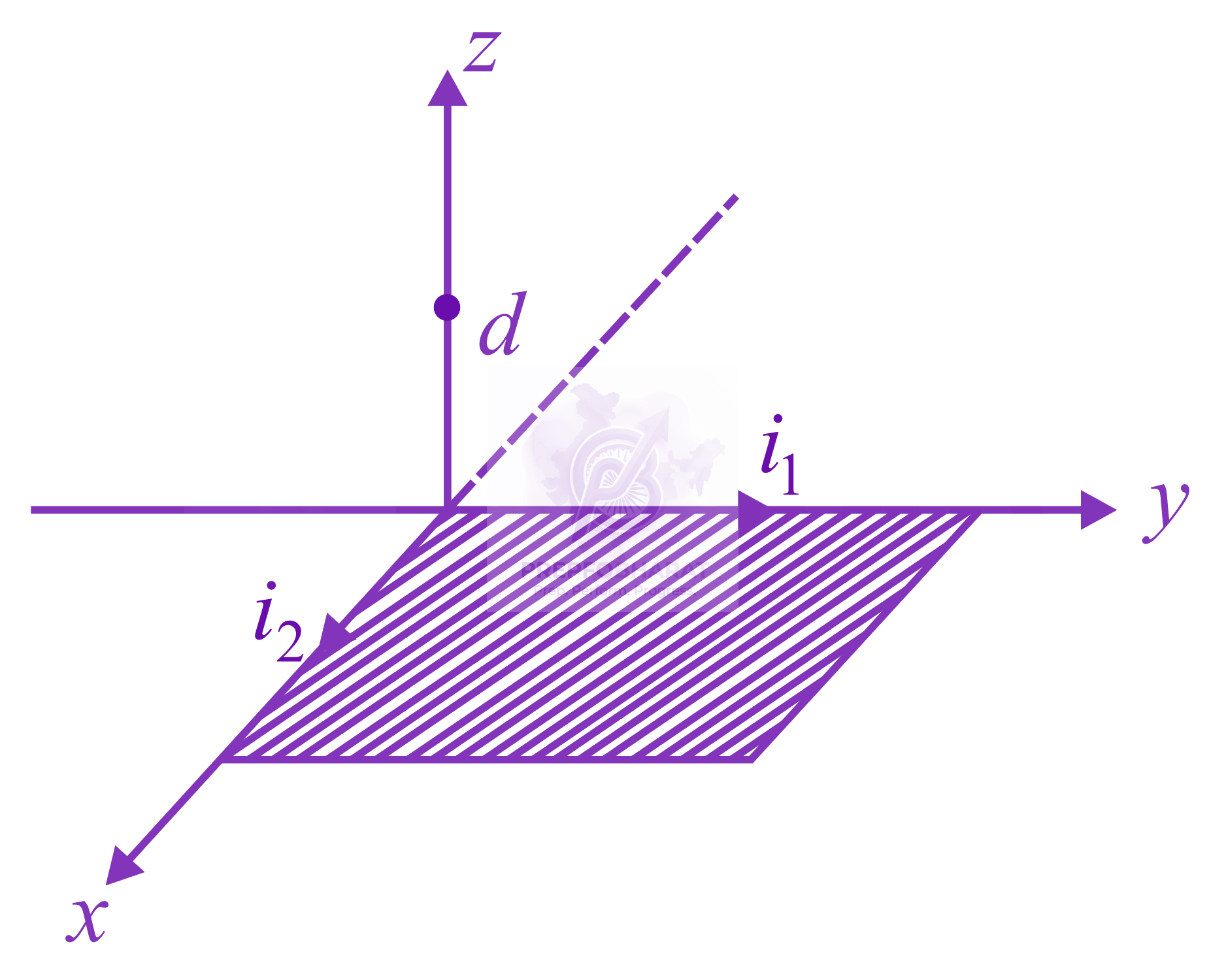
B due to wire (1)B1=(2πdμ0i1)i^
B due to wire (2)B2=(2πdμ0i2)(−j^)
∣Bnet∣=2πdμ0i12+i22
NEET UG 2014 — Physics Electromagnetism
Two identical long conducting wires AOB and COD are placed at right angle to each other, with one above other such that ‘ O ’ is their common point for the two. The wires carry I1 and I2 currents, respectively. Point ‘ I ’ is lying at distance ‘ d ’ from ‘ O ’ along a direction perpendicular to the plane containing the wires. The magnetic field at the point ‘ P ’ will be:
Held on 30 Apr 2014 · Verified 9 Jul 2026.
2πdμ0(I2I1)
2πdμ0(I1+I2)
2πdμ0(I12−I22)
2πdμ0(I12+I22)1/2
Sign in to track your attempts and accuracy.
Sign in to keep a private note on this question. Nothing you write is ever public.
Two point charges +2μC and -2μC are placed 10 cm apart. The electric field at the midpoint is:
A model for quantized motion of an electron in a uniform magnetic field $B$ states that the flux passing through the orbit of the electron is $n(h / e)$ where $n$ is an integer, $h$ is Planck's constant and $e$ is the magnitude of electron's charge. According to the model, the magnetic moment of an electron in its lowest energy state will be ( $m$ is the mass of the electron)
A 2 amp current is flowing through two different small circular copper coils having radii ratio $1: 2$. The ratio of their respective magnetic moments will be
Two identical charged conducting spheres $A$ and $B$ have their centres separated by a certain distance. Charge on each sphere is q and the force of repulsion between them is $F$. A third identical uncharged conducting sphere is brought in contact with sphere A first and then with B and finally removed from both. New force of repulsion between spheres $A$ and $B$ (Radii of $A$ and $B$ are negligible compared to the distance of separation so that for calculating force between them they can be considered as point charges) is best given as :
An electron (mass $9 \times 10^{-31} \mathrm{~kg}$ and charge $1.6 \times 10^{-19} \mathrm{C}$ ) moving with speed $\mathrm{c} / 100(\mathrm{c}=$ speed of light) is injected into a magnetic field $\vec{B}$ of magnitude $9 \times 10^{-4} \mathrm{~T}$ perpendicular to its direction of motion. We wish to apply an uniform electric field $\vec{E}$ together with the magnetic field so that the electron does not deflect from its path. Then (speed of light $\mathrm{c}=3 \times 10^8 \mathrm{~ms}^{-1}$ )
Work through every NEET UG Electromagnetism PYQ, year by year.