NEET UG 2008 — Electromagnetism
Physics Electromagnetism questions from NEET UG 2008.
Other Years
29 Electromagnetism Questions from 2008
Curie temperatures is the temperature above which
A thin conducting ring of radius $\mathrm{R}$ is given a charge $+\mathrm{Q}$. The electric field at the centre $\mathrm{O}$ of the ring due to the charge on the part $\mathrm{AKB}$ of the ring is $\mathrm{E}$. The electric field at the centre due to the charge on the part $\mathrm{ACDB}$ of the ring is 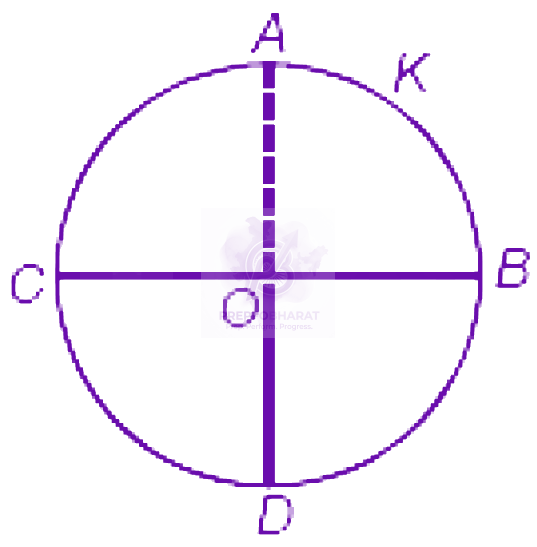
A particle mass $m$, charge $Q$ and kinetic energy $T$ enters a transverse uniform magnetic field of induction $\overrightarrow{\mathbf{B}}$. After 3 s the kinetic energy of the particle will be
The electric potential at a point in free space due to a charge $\mathrm{Q}$ coulomb is $\mathrm{Q} \times 10^{11}$ volts. The electric field at that point is
In an a.c. circuit the e.m.f. (e) and the current (i ) at any instant are given respectively by $$ \begin{aligned} & e=E_0 \sin \omega t \\ & i=I_0 \sin (\omega t-\phi) \end{aligned} $$ The average power in the circuit over one cycle of a.c. is
A closed loop PQRS carrying a current is placed in a uniform magnetic field. If the magnetic forces on segments $P S, S R$ and $R Q$ are $F_1, F_2$ and $F_3$ respectively and are in the plane of the paper and along the directions shown, the directions shown, the force on the segment $Q P$ is 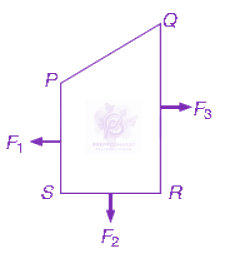
A particle of mass $\mathrm{m}$, charge $\mathrm{Q}$ and kinetic energy $\mathrm{T}$ enters a transverse uniform magnetic field of induction $\vec{B}$. After 3 seconds the kinetic energy of the particle will be
The energy required to charge a parallel plate condenser of plate separation $d$ and plate area of cross-section A such that the uniform electric field between the plates is E, is
The energy required to charge a parallel plate condenser of plate separation d and plate area of cross-section $A$ such that the uniform electric field between the plates is $E$, is
A cell can be balanced against $110 \mathrm{~cm}$ and $100 \mathrm{~cm}$ of potentiometer wire, respectively with and without being short circuited through a resistance of $10 \Omega$. Its internal resistance is
A thin conducting ring of radius $R$ is given a charge $+Q$. The electric field at the centre $O$ of the ring due to the charge on the part $A K B$ of the ring is $E$. The electric field at the centre due to the charge on the part $A C D B$ of the ring is 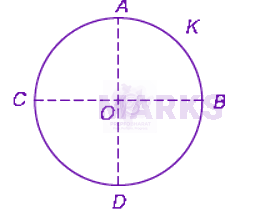
A galvanometer of resistance $50 \Omega$ is connected to a battery of $3 \mathrm{~V}$ along with a resistance of $2950 \Omega$ in series. A full scale deflection of 30 divisions is obtained in the galvanometer. In order to reduce this deflection to 20 divisions, the resistance in series should be
In the circuit shown, the current through the $4 \Omega$ resistor is $1 \mathrm{amp}$ when the points $P$ and $\mathrm{M}$ are connected to a d.c. voltage source. The potential difference between the points $M$ and $N$ is 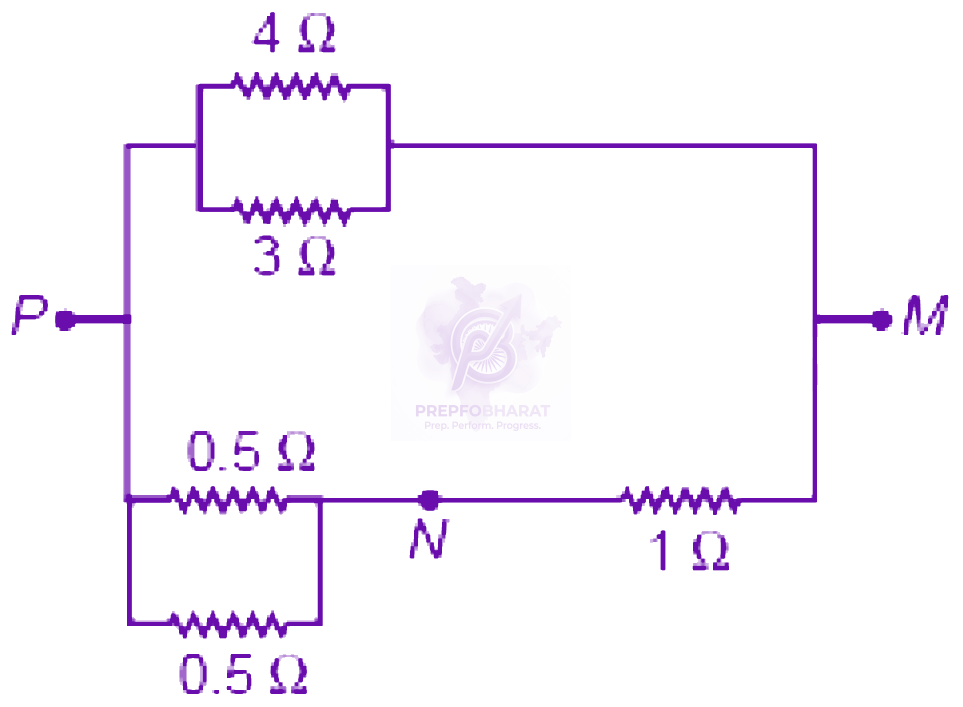
A cell can be balanced against $110 \mathrm{~cm}$ and $100 \mathrm{~cm}$ of potentiometer wire, respectively with and without being short circuited through a resistance of $10 \Omega$ Its internal resistance is
A long solenoid has 500 turns. When a current of 2 ampere is passed through it, the resulting magnetic flux linked with each turn of the solenoid is $4 \times 10^{-3} \omega \mathrm{b}$. The selfinductance of the solenoid is
A closed loop PQRS carrying a current is placed in a uniform magnetic field. If the magnetic forces on segments PS, SR and RQ are $F_1, F_2$ and $F_3$ respectively and are in the plane of the paper and along the directions shown, the force on the segment QP is
A circular disc of radius $0.2 \mathrm{~m}$ is placed in a uniform magnetic field of induction $\frac{1}{\pi}\left(\frac{W b}{m^2}\right)$ in such a way that its axis makes an angle of $60^{\circ}$ with $\overrightarrow{\mathbf{B}}$. The magnetic flux linked with the disc is
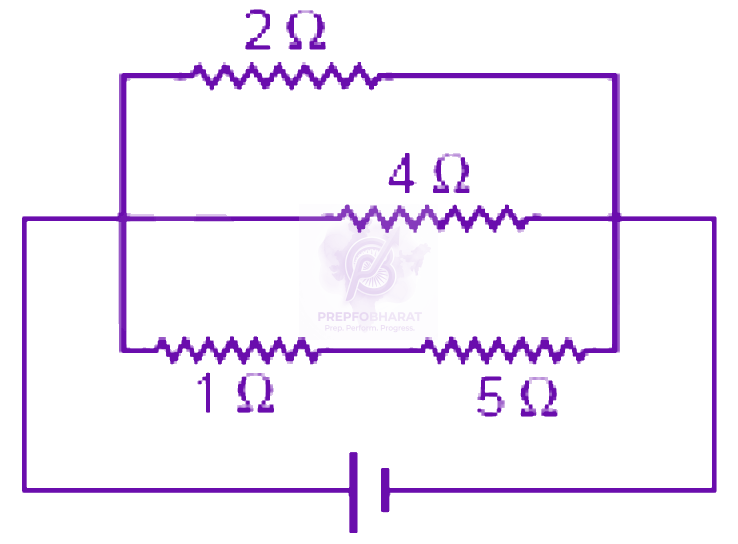
A current of 3 A flows through the $2 \Omega$ resistor shown in the circuit. The power dissipated in the $5 \Omega$ resistor is 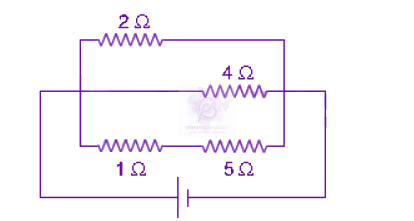
In an $A C$ circuit the emf (e) and the current (i) at any instant are given respectively by $e=E_0 \sin \omega t$ $i=I_0 \sin (\omega t-\phi)$ The average power in the circuit over one cycle of AC is
In the circuit shown, the current through the $4 \Omega$ resistor is $1 \mathrm{~A}$ when the points $P$ and $M$ are connected to a DC voltage source. The potential difference between the points $M$ and $N$ is 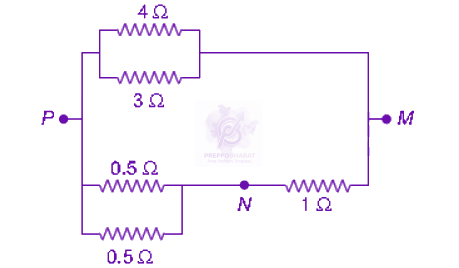
A wire of a certain material is stretched slowly by ten per cent. Its new resistance and specific resistance become respectively
The electric potential at a point in free space due to a charge $Q$ coulomb is $Q \times 10^{11} \mathrm{~V}$. The electric field at that point is
Curie temperature is the temperature above which
A wire of a certain material is stretched slowly by ten percent new resistance and specific resistance become respectively
The velocity of electromagnetic radiation in a medium of permittivity $\in_0$ and permeability $\mu_0$ is given by
The velocity of electromagnetic radiation in a medium of permittivity $\varepsilon_0$ and permeability $\mu_0$ is given by
A long solenoid has 500 turns. When a current of $2 \mathrm{~A}$ is passed through it, the resulting magnetic flux linked with each turn of the solenoid is $4 \times 10^{-3} \mathrm{~Wb}$. The self-inductance of the solenoid is
A circular disc of radius 0.2 meter is placed in a uniform magnetic field of induction linked with the disc is
A current of $3 \mathrm{amp}$. flows through the $2 \Omega$ resistor shown in the circuit. The power dissipated in the $5 \Omega$ resistor is