NEET UG 2009 — Electromagnetism
Physics Electromagnetism questions from NEET UG 2009.
Other Years
31 Electromagnetism Questions from 2009
A bar magnet having a magnetic movement of $2 \times 10^4 \mathrm{JT}^{-1}$ is free to rotate in a horizontal plane. A horizontal magnetic field $B=6 \times 10^{-4}$ $T$ exists in the space. The work done in taking the magnet slowly from a direction parallel to the field to a direction $60^{\circ}$ from the field is :
The magnetic force acting on a charged particle of charge $-2 \mu \mathrm{c}$ in a magnetic field of $2 \mathrm{~T}$ acting in $\mathrm{y}$ direction, when the particle velocity is $(2 \hat{\mathrm{i}}+3 \hat{\mathrm{j}}) \times 10^6 \mathrm{~ms}^{-1}$, is :
Three concentric spherical shells have radii a, b, and $\mathrm{c}(\mathrm{a} < \mathrm{b} < \mathrm{c})$ and have surface charge densities $\sigma,-\sigma$ and $\sigma$ respectively. If $V_A, V_B$ and $V_C$ denote the potentials of the three shells, then, for $c=a+b$, we have :
The electric potential at a point $(x, y, z)$ is given by $\mathrm{V}=-x^2 y-x z^3+4$ The electric field $\overrightarrow{\mathrm{E}}$ at that point is :
The mean free path of electrons in a metal is $4 \times 10^{-8} \mathrm{~m}$. The electric field which can give on an average $2 \mathrm{eV}$ energy to an electron in the metal will be in unit of $\mathrm{Vm}^{-1}$
A rectangular, a square, a circular and an elliptical loop, all in the $(x-y)$ plane, are moving out of a uniform magnetic field with a constant velocity, $\vec{v}=$ vi. The magnetic field is directed along the negative $z$-axis direction. The induced emf, during the passage of these loops, out of the field region, will not remain constant for
A conducting circular loop is placed in a uniform magnetic field $0.04 \mathrm{~T}$ with its plane perpendicular to the magnetic field. The radius of the loop starts shrinking at $2 \mathrm{mms}^{-1}$. The induced emf in the loop when the radius is $2 \mathrm{~cm}$ is
See the electrical circuit shown in this figure. Which of the following equations is a correct equation for it? 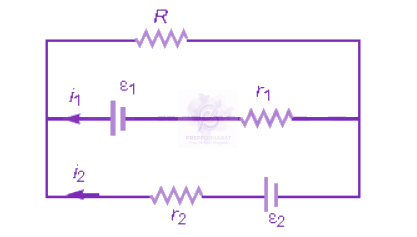
Power dissipated in an $L-C-R$ series circuit connected to an AC source of emf $\varepsilon$ is
The electric potential at a point $(x, y, z)$ is given by $$ V=-x^2 y-x z^3+4 $$ The electric field $\vec{E}$ at that point is
A student measures the terminal potential difference (V) of a cell (of emf $\varepsilon$ and internal resistance $r$ ) as a function of the current (I) flowing through it. The slope and intercept of the graph between $V$ and $I$, then respectively, equal
If a diamagnetic substance is brought near the north or the south pole of a bar magnet, it is
A rectangular, a square, a circular and an elliptical loop, all in the $(x-y)$ plane, are moving out of a uniform magnetic field with a constant velocity, $\vec{V}=v \cdot \hat{i}$. The magnetic field is directed along the negative z-axis direction. The induced emf, during the passage of these loops, come out of the field region, will not remain constant for :
The electric field part of an electromagnetic wave in a medium is represented by : $$ \begin{aligned} & \mathrm{E}_{\mathrm{x}}=0 \\ & \mathrm{E}_{\mathrm{y}}=2.5 \frac{\mathrm{N}}{\mathrm{C}} \cos \left[\left(2 \pi \times 10^6 \frac{\mathrm{rad}}{\mathrm{m}}\right) \mathrm{t}-\left(\pi \times 10^{-2} \frac{\mathrm{rad}}{\mathrm{s}}\right) \mathrm{x}\right] \end{aligned} $$ $E_z=0$. The wave is :
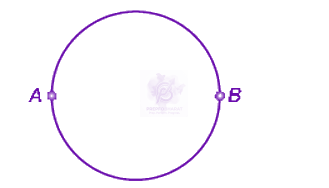
A wire of resistance $12 \mathrm{ohms}$ per metre is bent to form a complete circle of radius $10 \mathrm{~cm}$. The resistance between its two diametrically opposite points, A and B as shown in the figure, is : 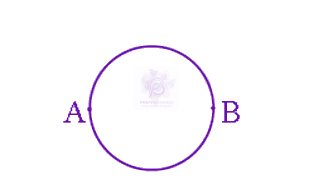
A galvanometer having a coil resistance of $60 \Omega$ shows full scale deflection when a current of 1.0 amp passes through it. It can be converted into an ammeter to read currents upto $5.0 \mathrm{amp}$ by :
A bar magnet having a magnetic moment of $2 \times 10^4 \mathrm{JT}^{-1}$ is free to rotate in a horizontal plane. A horizontal magnetic field $\mathrm{B}=6 \times 10^{-4} \mathrm{~T}$ exists in the space. The work done in taking the magnet slowly from a direction parallel to the field to a direction $60^{\circ}$ from the field is
A conducting circular loop is placed in a uniform magnetic field $0.04 \mathrm{~T}$ with its plane perpendicular to the magnetic field. The radius of the loop starts shrinking at $2 \mathrm{~mm} / \mathrm{s}$. The induced emf in the loop when the redius is $2 \mathrm{~cm}$ is :
Three capacitors each of capacitance $C$ and of breakdown voltage $V$ are joined in series. The capacitance and breakdown voltage of the combination will be
Power dissipated in an LCR series circuit connected to an a.c. source of emf $\varepsilon$ is :
A student measures the terminal potential difference (V) of a cell (of emf $\varepsilon$ and internal) resistance $r$ ) as a function of the current (I) flowing through it. The slope and intercept of the graph between $\mathrm{V}$ and $\mathrm{I}$, then respectively equal to :
Under the influence of a uniform magnetic field, a charged particle moves with constant speed $\mathrm{V}$ in a circle of radius $R$. The time period of rotation of the particle :
Three concentric spherical shells have radii $a, b$ and $c(a < b < c)$ and have surface charge densities $\sigma,-\sigma$ and $\sigma$ respectively. If $V_A, V_B$ and $V_C$ denote the potentials of the three shells, then for $c=a+b$, we have
Under the influence of a uniform magnetic field, a charged particle moves with constant speed $v$ in a circle of radius $R$. The time period of rotation of the particle
The electric field part of an electromagnetic wave in a medium is represented by \(\begin{aligned} & E_x=0 \\ & E_y=2.5 \mathrm{NC}^{-1} \cos \left[\left(2 \pi \times 10^6 \mathrm{rad} \mathrm{s}^{-1}\right) \mathrm{t}-\left(\pi \times 10^{-2} \mathrm{rad} \mathrm{m}^{-1}\right) \mathrm{x}\right] \\ & E_z=0\end{aligned}\) The wave is
A galvanometer having a coil resistance of $60 \Omega$ shows full scale deflection when a current of 1.0 A passes through it. It can be converted into an ammeter to read currents upto $5.0 \mathrm{~A}$ by
Three capacitors each of capacitance $C$ and of breakdown voltage $\mathrm{V}$ are joined in series. The capacitance and breakdown voltage of the combination will be :
The magnetic force acting on a charged particle of charge $-2 \mu \mathrm{C}$ in a magnetic field of $2 \mathrm{~T}$ acting in $y$ direction, when the particle velocity is $(2 \hat{\mathrm{i}}+3 \hat{\mathrm{j}}) \times 10^6 \mathrm{~ms}^{-1}$ is
See the electrical circuit shown in this figure. Which of the following equations is a correct equation for it? 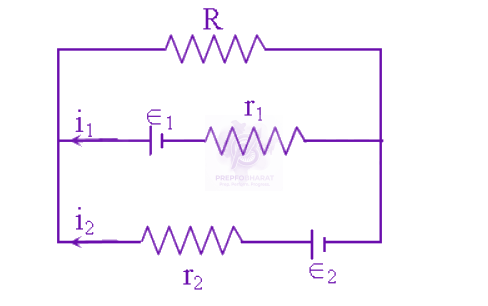
If a diamagnetic substance is brought near the north or the south pole of a bar magnet, it is :
A wire of resistance $12 \Omega \mathrm{m}^{-1}$ is bent to form a complete circle of radius $10 \mathrm{~cm}$. The resistance between its two diametrically opposite points, $A$ and $B$ as shown in the figure, is