NEET UG 2013 — Electromagnetism
Physics Electromagnetism questions from NEET UG 2013.
Other Years
22 Electromagnetism Questions from 2013
The primary winding of transformer when connected to a $d c$ battery of 10 Volt draws a current of $1 \mathrm{~mA}$. The number of turns of the primary and secondary windings are 50 and 100 respectively. The voltage in the secondary and the current drawn by the circuit in the secondary are respectively:
A current of $2.5 \mathrm{~A}$ flows through a coil of inductance $5 \mathrm{H}$. The magnetic flux linked with the coil is:
Two rods are joined to end, as shown. Both have a cross sectional area of 0.01 $\mathrm{cm}^2$. Each is 1 meter long. One rod is of copper with a resistivity of $17 \times 10^{-6}$ ohm-centimeter, the other is of iron with a resistivity of $10^{-5} \mathrm{ohm}$ centimeter. How much voltage is required to produce a current of 1 ampere in the rods? 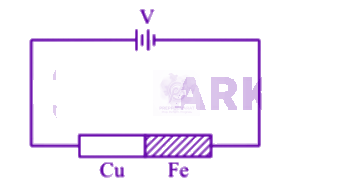
The resistances of the four arms $P, Q, R$ and $S$ in a Wheatstone's bridge are $10 \Omega, 30 \Omega, 30 \Omega$ and $90 \Omega$, respectively. The emf and internal resistance of the cell are $7 \mathrm{~V}$ and $5 \Omega$ respectively. If the galvanometer resistance is $50 \Omega$, the current drawn from the cell will be
A coil of self-inductance $L$ is connected in series with a bulb $B$ and an $A C$ source. Brightness of the bulb decreases when
An electric dipole of dipole moment $p$ is aligned parallel to a uniform electric field $E$. The energy required to rotate the dipole by $90^{\circ}$ is:
$A, B$ and $C$ are three points in a uniform electric field. The electric potential is 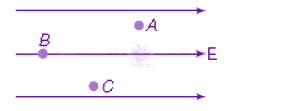
The internal resistance of a $2.1 \mathrm{~V}$ cell which gives a current of $0.2 \mathrm{~A}$ through a resistance of $10 \Omega$ is
A wire of resistance $4 \Omega$ is stretched to twice its original length. The resistance of stretched wire would be
Ten identical cells connected in series are needed to heat a wire of length one meter and radius ' $r$ ' by $10^{\circ} \mathrm{C}$ in time ' $t$ '. How many cells will be required to heat the wirc of length two meter of the same radius by the same temperature in time 'r'?
A wire loop is rotated in a magnetic field. The frequency of change of direction of the induced emf is
Two pith balls carrying equal charges are suspended from a common point by strings of equal length, the equilibrium separation between them is $r$. Now the strings are rigidly clamped at half the height. The equilibrium separation between the balls now become. 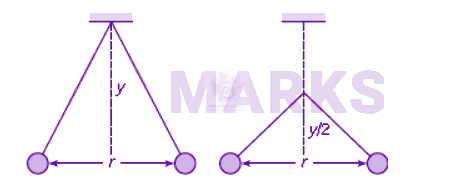
The condition under which a microwave oven heats up a food item containing water molecules most efficiently is
A charge ' $q$ ' is placed at the centre of the line joining two equal charges ' $Q$ '. The system of three charges will be in equilibrium if ' $q$ ' is equal to:
A current loop in a magnetic field
A $12 \mathrm{~cm}$ wire is given a shape of a right angled triangle $A B C$ having sides $3 \mathrm{~cm}$, $4 \mathrm{~cm}$ and $5 \mathrm{~cm}$ as shown in the figure. The resistance between two ends (AB, $B C, C A)$ of the respective sides are measured one by one by a multi-meter. The resistance will be in the ratio: 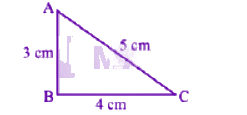
A circular $A B C D$ carrying a current ' $i$ ' is placed in a uniform magnetic field, if the magnetic force on the segment $A B$ is $\vec{F}$, the force on the remaining segment BCDA is: 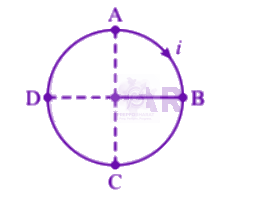
When a proton is released from rest in a room, it starts with an initial acceleration $a_0$ towards west. When it is projected towards north with a speed $v_0$ it moves with an initial acceleration $3 a_0$ towards west. The electric and magnetic fields in the room are
An electromagnetic wave of frequency $v=3.0 \mathrm{MHz}$ passes from vacuum into a dielectric medium with relative permittivity $\varepsilon=4.0$ Then:
A bar magnet of magnetic moment $M$ placed at right angles to a magnetic induction $B$. If a force $F$ is experienced by each pole of the magnet. The length of the magnet will be:
A bar magnet of length $l$ and magnetic dipole moment $M$ is bent in the form of an arc as shown in figure. The new magnetic dipole moment will be 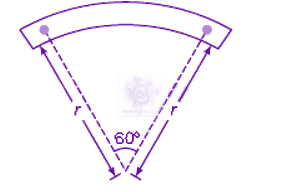
A long straight wire carries a certain current and produces a magnetic field $2 \times 10^{-4} \frac{\text { Weber }}{\mathrm{m}^2}$ at a perpendicular distance of $5 \mathrm{~cm}$ from the wire. An electron situated at $5 \mathrm{~cm}$ from the wire moves with a velocity $10^7 \mathrm{~m} / \mathrm{s}$ towards the wire along perpendicular to it. The force experienced by the electron will be (change on electron $1.6 \times 10^{-19} \mathrm{C}$ )