NEET UG 2010 — Electromagnetism
Physics Electromagnetism questions from NEET UG 2010.
Other Years
22 Electromagnetism Questions from 2010
Two parallel metal plates having charges $+Q$ and $-Q$ face each other at a certain distance between them. If the plates are now dipped in kerosene oil tank, the electric field between the plates will
A galvanometer has a coil of resistance $100 \Omega$ and gives a full scale deflection for $30 \mathrm{~mA}$ current. If it is to work as a voltmeter of $30 \mathrm{~V}$ range, the resistance required to be added will be
The electric field of an electromagnetic wave in free space is given by $\vec{E}=10 \cos \left(10^7 t+k x\right) \hat{j} V / m$, where $t$ and $x$ are in seconds and metres respectively. It can be inferred that (1) The wavelength $\lambda$ is $188.4 \mathrm{~m}$. (2) The wave number $k$ is $0.33 \mathrm{rad} / \mathrm{m}$. (3) The wave amplitude is $10 \mathrm{~V} / \mathrm{m}$. (4) The wave is propagating along.t $x$ direction Which one of the following pairs of statements is correct?
Two identical bar magnets are fixed with their centres at a distance $d$ apart. A stationary charge $Q$ is placed at $P$ in between the gap of the two magnets at a distance $D$ from the centre $O$ as shown in the figure 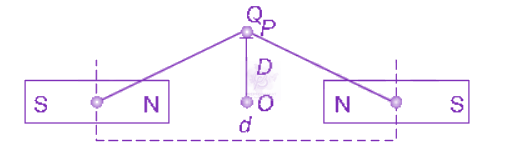 The force on the charge $Q$ is
Two positive ions, each carrying a charge $q$, are separated by a distance $d$. If $\mathrm{F}$ is the force of repulsion between the ions, the number of electrons missing from each ion will be ( $e$ being the charge on an electron)
A $220 \mathrm{~V}$ input is supplied to a transformer. The output circuit draws a current of $2.0 \mathrm{~A}$ at $440 \mathrm{~V}$. If the efficiency of the transformer is $80 \%$, the current drawn by the primary windings of the transformer is
A series combination of $n_1$ capacitors, each of value $\mathrm{C}_1$, is charged by a source of potential difference $4 \mathrm{~V}$. When another parallel combination of $n_2$ capacitors, each of value $C_2$, is charged by a source of potential difference $V$, it has the same (total) energy stored in it, as the first combination has. The value of $\mathrm{C}_2$, in terms of $\mathrm{C}_1$, is then
Consider the following two statements (A) Kirchhoff's junction law follows from the conservation of charge. (B) Kirchhoff's loop law follows from the conservation of energy. Which of the following is correct?
A potentiometer circuit is set up as shown. The potential gradient across the potentiometer wire, is $\mathrm{k}$ volt/cm and the ammeter, present in the circuit, reads 1.0 A when two way key is switched off. The balance points, when the key between the terminals (i) 1 and 2 (ii) 1 and 3 , is plugged in, are found to be at lengths $\mathrm{l}_1 \mathrm{~cm}$ and $\mathrm{l}_2 \mathrm{~cm}$ respectively. The magnitudes, of the resistors $\mathrm{R}$ and $\mathrm{X}$, in ohm, are then, equal, respectively, to 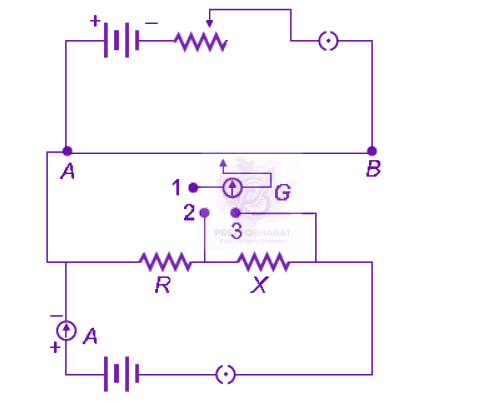
The magnetic moment of a diamagnetic atom is
A closely wound solenoid of 2000 turns and area of cross-section $1.5 \times 10^{-4} \mathrm{~m}^2$ carries a current of $2.0 \mathrm{~A}$. It is suspended through its centre and perpendicular to its length, allowing it to turn in a horizontal plane in a uniform magnetic field $5 \times 10^{-2} \mathrm{~T}$ making an angle of $30^{\circ}$ with the axis of the solenoid. The torque on the solenoid will be
Electromagnets are made of soft iron because soft iron has
A square current carrying loop is suspended in a uniform magnetic field acting in the plane of the loop. If the force on one arm of the loop is $\vec{F}$, the net force on the remaining three arms of the loop is
A conducting circular loop is placed in a uniform magnetic field, $B=0.025 \mathrm{~T}$ with its plane perpendicular to the loop. The radius of the loop is made to shrink at a constant rate of $1 \mathrm{mms}^{-1}$. The induced emf when the radius is $2 \mathrm{~cm}$, is
In the given circuit the reading of voltmeter $V_1$ and $V_2$ are $300 \mathrm{~V}$ each. The reading to the voltmeter $\mathrm{V}_3$ and ammeter $A$ are respectively 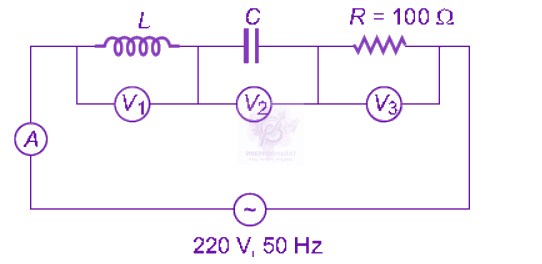
The electric field at a distance $\frac{3 R}{2}$ from the centre of a charged conducting spherical shell of radius $R$ is $E$. The electric field at a distance $\frac{R}{2}$ from the centre of the sphere is
A square surface of side $L$ metre in the plane of the paper is placed in a uniform electric field $E$ (volt/m) acting along the same place at an angle $\theta$ with the horizontal side of the square as shown in figure. The electric flux linked to the surface in unit of $V-m$, is 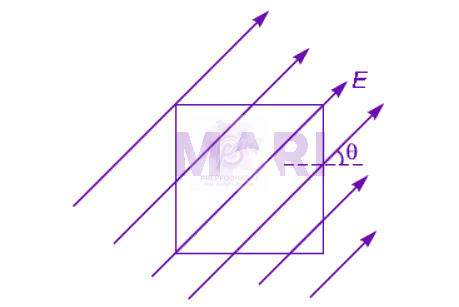
A particle having a mass of $10^{-2} \mathrm{~kg}$ carries a charge of $5 \times 10^{-8} \mathrm{C}$. The particle is given an initial horizontal velocity of $10^5 \mathrm{~ms}^{-1}$ in the presence of electric field $\vec{E}$ and magnetic field $\vec{B}$. To keep the particle moving in a horizontal direction, it is necessary that (1) $\vec{B}$ should be perpendicular to the direction of velocity and $\vec{E}$ should be along the direction of velocity. (2) Both $\vec{B}$ and $\vec{E}$ should be along the direction of velocity. (3) Both $\vec{B}$ and $\vec{E}$ are mutually perpendicular and perpendicular to the direction of velocity. (4) $\vec{B}$ should be along the direction of velocity and $\vec{E}$ should be perpendicular to the direction of velocity. Which one of the following pairs of statements is possible?
A condenser of capacity $C$ is charged to a potential difference of $V_1$. The plates of the condenser are then connected to an ideal inductor of inductance $L$. The current through the inductor when the potential difference across the condenser reduces to $V_2$ is
A current loop consists of two identical semicircular parts each of radius $R$, one lying in the $x-y$ plane and the other in $x-z$ plane. If the current in the loop is $i$. The resultant magnetic field due to the two semicircular parts at their common centre is
A thin ring of radius $R$ metre has charge $q$ coulomb uniformly spread on it. The ring rotates about its axis with a constant frequency of $f$ revolution/s. The value of magnetic induction in $\mathrm{Wb} \mathrm{m}^{-2}$ at the centre of the ring is
Which of the following statement is false for the properties of electromagnetic waves?