NEET UG 2005 — Electromagnetism
Physics Electromagnetism questions from NEET UG 2005.
Other Years
14 Electromagnetism Questions from 2005
If the magnetic dipole of an atom of diamagnetic material, paramagnetic material are denoted by $\mu_d, \mu_p$ and $\mu_f$ respectively, then:
When a wire of uniform cross section $a$, length $l$ and resistance $R$ is into a complete circle, resistance between any two of diametrically opposite point will be:
In a circuit $\mathrm{L}, \mathrm{C}$ and $\mathrm{R}$ are connected in series with an alternating voltage source of frequency $f$. The current leads the voltage by $45^{\circ}$. The value of $\mathrm{C}$ is:
A 5-ampere fuse wire can withstand a maximum power of 1 watt in the circuit. The resistance of the fuse wire is :
As per the diagram a point charge $+q$ is placed at the origin $\mathrm{O}$. Work done in taking another point charge $-\mathrm{Q}$ from the point $\mathrm{A}$ [coordinate $(0, a)$ ] to another point $\mathrm{B}$ [coordinates $(a, 0)$ ] along the straight path $\mathrm{AB}$ is: 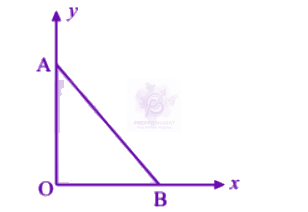
A very long straight wire carries a current I. At the instant when a charge $+Q$ at point $\mathrm{P}$ has velocity $\bar{v}$ as shown the force on the charge is: 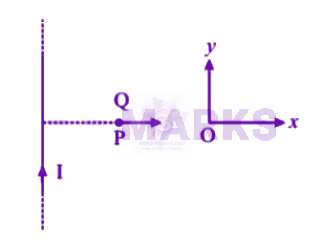
A coil in the shape of an equilateral triangle of side $l$ is suspended between the pole of a permanent magnet such that $B$ is in plane of the coil. If due to current $i$ in the triangle a torque $\tau$ acts on it, the side $l$ of the triangle is:
If $\lambda_v, \lambda_x$ and $\lambda_m$ represent the wavelength of visible light, X-rays and microwaves respectively, then:
Two charge $q_1$ and $q_2$ are placed $30 \mathrm{~cm}$ apart, as shown in the figure. A third charge $q_3$ is moved along the are of a circle of radius $40 \mathrm{~cm}$ from $\mathrm{C}$ to $\mathrm{D}$. The change in the potential energy of the system is \(\frac{q_3 k}{4 \pi \in_0}\), where $k$ is: 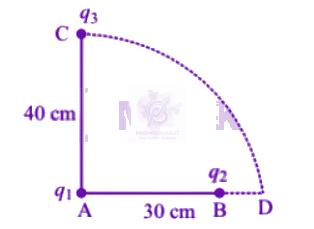
An electron moves in a circular orbit with a uniform speed $v$. It produces a magnetic field $B$ at the centre of the circle. The radius of the circle is proportional to:
Two batteries, one of emf 18 volts and internal resistance $2 \Omega$ and the other of emf 12 volts and internal resistance $1 \Omega$, are connected as shown. The voltmeter $V$ will record a reading of: 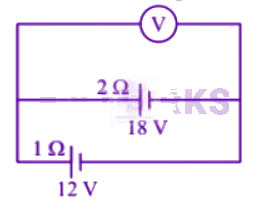
As a result of change in the magnetic flux linked to the closed loop as shown in the figure, an e.m.f. $V$ volt is induced in the loop. The work done (joules) in taking a charge $Q$ coulomb once along the loop is: 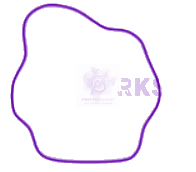
For the network shown in the figure the value of the current $i$ is: 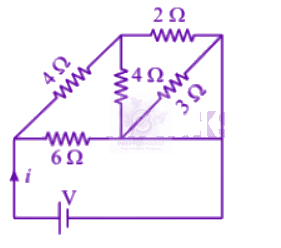
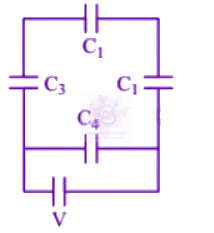
A network of four capacitors capacity equal $C_1=C, C_2=2 C, C_3=3 C$ and $C_4=$ $4 C$ are conducted to a battery as shown in the figure. The ratio of the change on $C_2$ and $C_4$ is: