Work done is equal to zero because the potential of A and B are the same =4πϵ01aq 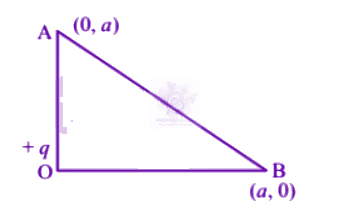
No work done if a particle does not change its potential energy. i.e. initial potential energy = final potential energy.
NEET UG 2005 — Physics Electromagnetism
As per the diagram a point charge +q is placed at the origin O. Work done in taking another point charge −Q from the point A [coordinate (0,a) ] to another point B [coordinates (a,0) ] along the straight path AB is: 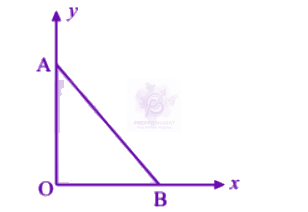
Held on 30 Apr 2005 · Verified 9 Jul 2026.
zero
(4πε0qQa21)⋅2a
(4πε0−qQa21)⋅2a
(4πε0qQa21)⋅2a
Sign in to track your attempts and accuracy.
Sign in to keep a private note on this question. Nothing you write is ever public.
Two point charges +2μC and -2μC are placed 10 cm apart. The electric field at the midpoint is:
A wire of resistance R is cut into 8 equal pieces. From these pieces two equivalent resistances are made by adding four of these together in parallel. Then these two sets are added in series. The net effective resistance of the combination is :
A constant voltage of 50 V is maintained between the points A and B of the circuit shown in the figure. The current through the branch CD of the circuit is :- 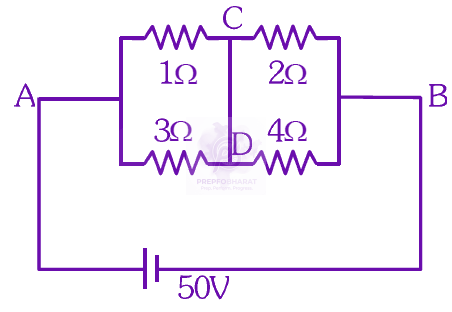
A parallel plate capacitor made of circular plates is being charged such that the surface charge density on its plates is increasing at a constant rate with time. The magnetic field arising due to displacement current is :
AB is a part of an electrical circuit (see figure). The potential difference " $\mathrm{V}_{\mathrm{A}}-\mathrm{V}_{\mathrm{B}}$ ", at the instant when current $\mathrm{i}=2 \mathrm{~A}$ and is increasing at a rate of $1 \mathrm{amp} / \mathrm{second}$ is : 
Work through every NEET UG Electromagnetism PYQ, year by year.