CUET UG 2025 — Algebra
Mathematics Algebra questions from CUET UG 2025.
Other Years
744 Algebra Questions from 2025
A function $f: \mathbb{R} \rightarrow \{x \in \mathbb{R}: -1 < x < 1\}$ is defined as $f(x) = \frac{x}{1+|x|}$, then $f$ is:
If the roots of the equation x² - 5x + k = 0 are in the ratio 2:3, then the value of k is:
If $\vec{a}$ is a unit vector perpendicular to both the vectors $\vec{b} = \hat{j} + \hat{2k}$ and $\vec{c} = \hat{i} + 2\hat{j}$, then $\hat{a}$ is equal to
If A is a square matrix such that $A^2 = A$ and I is the identity matrix of same order as A, then the value of $(A-2I)^2 - (2A + I)^2 + 11A$ is:
The graph given below represents which of the following function? 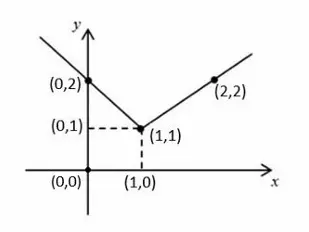
The position vector of a point which divides the line joining the points with position vectors $(\vec{a} - 2\vec{b})$ and $(2\vec{a} + \vec{b})$ externally in the ratio 2:1, is
Which of the following are the properties of Normal Distribution function f(x) and Normal probability curve: (A) The probability of success remains the same in each trial and the number of trials is small in number. (B) The curve is bell-shaped and is symmetrical about the mean. (C) If set of n trials are repeated N times, then frequency f(r) of r successes is given by f(r) = N.p(r) = N$e^{-m\frac{m^r}{r!}}$, r=0,1,2,... (D) As x increases numerically, f(x) decreases rapidly and the maximum value of f(x) occurs at x=μ(mean) Choose the correct answer from the options given below:
In a linear programming problem, the constraints on decision variables $x$ and $y$ are $y-2x \leq 0$, $y \geq 0$, $0 \leq x \leq 5$. The feasible region of the above problem:
If A and B are symmetric matrices of order 3 x 3 then the matrix $2AB - BA$ is:
Five dice are thrown simultaneously. If the occurrence of an even number in a single dice is considered a success, then the probability of at most 3 successes is
If $\begin{vmatrix} 1 & \cos \theta & 0 \\ \sin \theta & 1 & \cos \theta \\ |\cos \theta & 1 & -\sin \theta| \end{vmatrix} = A\sin \theta + B\cos \theta + C\sin \theta\cos \theta$ then:
If $C_{ij}$ represents the cofactor of element $a_{ij}$ of the matrix $A = \begin{bmatrix} 2 & -1 & 3 \\ 1 & 2 & 0 \\ 4 & 1 & 5 \end{bmatrix}$ then the value of $C_{23} + C_{31} - C_{22}$ is
If $\vec{a}$, $\vec{b}$, $\vec{c}$ are unit vectors such that $\vec{a} \cdot \vec{b} = \vec{a} \cdot \vec{c} = 0$, and the angle between $\vec{b}$ and $\vec{c}$ is $\frac{\pi}{6}$, then
Let box I contains 3 black and 4 white balls, box II contains 2 black and 2 white balls, box III contains 4 black and 3 white balls. A box is selected at random and then a ball is randomly drawn from the selected box. If the color of the ball is black then the probability that the ball is drawn from box III, is:
Which of the following functions from $\mathbb{Z}$ to $\mathbb{Z}$ is a bijective function? (where $\mathbb{Z}$ is set of integers)
The feasible region corresponding to the linear constraints of a Linear Programming Problem (LPP) is represented by the shaded region in the given figure. Which of the following is not a constraint to the given LPP? 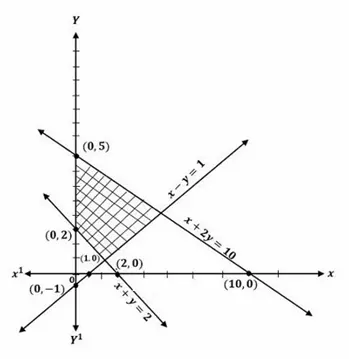
If A and B are independent events such that $P(A|B) = \frac{1}{3}$ and $P(B) = \frac{1}{2}$, then the value of $P(A \cap B)$ is equal to
If A is an invertible symmetric matrix, then A⁻¹ is
The matrix $A = \begin{bmatrix}0 & 0 & 5\\0 & 5 & 0\\5 & 0 & 0\end{bmatrix}$ is a (A) Diagonal matrix (B) Scalar matrix (C) Square matrix (D) Symmetric matrix Choose the correct answer from the options given below:
Match List-I with List-II | List-I | List-II | | --- | --- | | Matrix Product | Order of resultant matrix | | --- | --- | | (A) $[a_{ij}]_{2 \times 3} \times [b_{ij}]_{3 \times 4}$ | (I) $2 \times 4$ | | (B) $[a_{ij}]_{2 \times 1} \times [b_{ij}]_{1 \times 3}$ | (II) Not possible | | (C) $[a_{ij}]_{3 \times 2} \times [b_{ij}]_{3 \times 2}$ | (III) $3 \times 3$ | | (D) $[a_{ij}]_{3 \times 3} \times [b_{ij}]_{3 \times 3}$ | (IV) $2 \times 3$ | Choose the correct answer from the options given below:
The function $f: \mathbb{R} \rightarrow [-1, 1]$ defined by $f(x) = \cos x$ is:
For a linear programming problem, the feasible region is shown in the figure by shaded portion, then linear constraints are 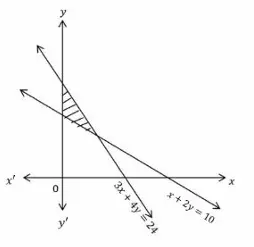
Let the matrix $A = [a_{ij}]_{3\times3}$ be defined by $a_{ij} = \begin{cases} 2i + 3j, & i < j \\ 5, & i = j \\ 3i - 2j, & i > j \end{cases}$ The number of elements in the matrix A which are greater than 7, is:
Let $A$ be a non singular matrix of order $n \times n$, Then $|\text{adj }(3A)|$ is equal to:
Which of the following statements are correct? (A) If A is a square matrix, then $|A^2| = |A|^2$. (B) If A and B are square matrices of the same order, then det (AB) = det (A) + det (B). (C) If A is a square matrix of order 3 and $|A|=2$, then the value of $|-3A|$ is 54. (D) If the matrix $\begin{bmatrix} 5 -x & x -1 \\ 3 &5 \end{bmatrix}$ is singular, then the value of x is 7/2. Choose the correct answer from the options given below:
If the matrix $A = \begin{bmatrix} 1 & 3 \\ 2 & 1 \end{bmatrix}$, then the value of det $(A^2 - 2A)$ is equal to
The value of $\begin{vmatrix} 7! & 8! & 9! \\ 8! & 9! & 10! \\ 9! & 10! & 11! \end{vmatrix}$ is:
If $\begin{bmatrix} 1 & 3 \\ 2 & 4 \end{bmatrix} \begin{bmatrix} 3 & 5 \\ -1 & 3 \end{bmatrix} = \begin{bmatrix} m & 14 \\ 2 & n \end{bmatrix}$, then $m + n$ is equal to
If $A = \begin{bmatrix} -1 & 2 & 3x \\ 2y & 4 & -1 \\ 6 & -1 & 0 \end{bmatrix}$ is a symmetric matrix, then the value of $2x - y$ is:
The system of equations $x + y + z = 4$ $x + 2y + 3z = 12$ $x + 3y + \lambda z = \mu$ has a unique solution if
If $A = \begin{bmatrix} a & 1 & -1 \\ 0 & b & 4 \\ 4 & 4 & c \end{bmatrix}$ and $abc = 12$, $b = 4a$, then the value of $|A(adjA)|$ is:
Match List-I with List-II | List-I | List-II | | --- | --- | | (A) A square matrix $P$ is said to be non-singular if | (I) $\vert P\vert = 0$ | | (B) A square matrix $P$ is said to be singular if | (II) $P P^T$ is symmetric | | (C) If a matrix $P$ is both symmetric and skew-symmetric, then | (III) $\vert P\vert \neq 0$ | | (D) If $P$ is a square matrix, then | (IV) $P$ is a null matrix | Choose the correct answer from the options given below:
If $\vec{a}, \vec{b}, \vec{c}$ are three mutually perpendicular unit vectors, then $|\vec{a} + \vec{b} + \vec{c}|$ is equal to
If $A = \begin{bmatrix} a & 4 & -5 \\ d & b & -6 \\ 5 & e & c \end{bmatrix}$ is a skew symmetric matrix, then value of $a + b + c + d + e$ is equal to
Let $A = [a_{ij}]$ is given by $A = \begin{bmatrix} 1 & -1 & 2 \\ 3 & 4 & -5 \\ 2 & -1 & 3 \end{bmatrix}$. Then the matrix $B = [b_{ij}]$, where $b_{ij}$ = Minor of $a_{ij}$ is:
For the objective function Z=-4x + 6y subject to the constraints 3x + 2y ≥ 5, 7x + 2y ≤ 9, x ≥ 0, y ≥ 0, the maximum value of Z occurs at $(a, b)$ and the minimum value of Z occurs at $(p, q)$ then the value of $\frac{a}{p} + \frac{b}{q}$ is:
If the matrix $\begin{bmatrix}2 & -1 & 3\\ \lambda & 0 & 7\\-1 & 1 & 4\end{bmatrix}$ is not invertible, then value of $\lambda$ is
It is known that 3% of plastic bags manufactured in a factory are defective. Using the Poisson distribution on a sample of 100 bags, the probability of at most one defective bag is:
If $A = \begin{bmatrix}1 & -1 \\ 2 & -1\end{bmatrix}$, $B = \begin{bmatrix}a & 1 \\ b & -1\end{bmatrix}$ and $(A + B)^2 = A^2 + B^2$ then
Let $A = \begin{bmatrix} 2 & -1 & 3 \\ 1 & 2 & -1 \\ 4 & 1 & 2 \end{bmatrix}$. $M_{ij}$ and $A_{ij}$ respectively denote the minor and cofactor of an element $a_{ij}$ of matrix $A = [a_{ij}]$ (A) $M_{23} = 6$ (B) $A_{22} = -8$ (C) $A_{13} = 7$ (D) $M_{32} = -5$ Choose the correct answer from the options given below:
If $\vec{p}$ and $\vec{q}$ are two unit vectors such that $|\vec{p} + \vec{q}| = \sqrt{2}$, then which of the following are correct? (A) $|\vec{p}| = |\vec{q}| = 1$ (B) $\vec{p}$ and $\vec{q}$ are orthogonal vectors (C) $\vec{p}$ and $\vec{q}$ are collinear vectors (D) $(4\vec{p} - \vec{q}).(2\vec{p} + \vec{q}) = 7$ Choose the correct answer from the options given below:
Let $A = [a_{ij}]$ be a square matrix, where $a_{ij} = \begin{cases} 0, & \text{when } i = j \\ 1, & \text{otherwise} \end{cases}$. If |adj A| = |A|², then which of the following statements are correct? (A) A is a skew symmetric matrix. (B) A is a non-singular matrix. (C) A is a square matrix of order 4. (D) A is a symmetric matrix. Choose the correct answer from the options given below:
If $A = \begin{bmatrix}1 & 2\\ 0 & 3\end{bmatrix}$ then $|A. adj A|$ is
If $A = \begin{bmatrix} 4 & 3 \\ 2 & -1 \\ 1 & 0 \end{bmatrix}$ and $B^T = \begin{bmatrix} 1 & 2 & 3 \\ 2 & 1 & -1 \end{bmatrix}$, then $A - B$ is equal to
If $A = \begin{bmatrix} 0 & l & -3 \\ -2 & 0 & 1 \\ m & -1 & 0 \end{bmatrix}$ is a skew symmetric matrix, then
Consider the function $f: \mathbb{R} \rightarrow \mathbb{R}$ defined by $f(x) = \frac{x}{x^2+1}$ then
If $A = \begin{bmatrix} 2 & -1 & 0 \\ 1 & 1 & 2 \\ -1 & 0 & 1 \end{bmatrix}$, then which of the following statement(s) is/are correct? (A) A is singular matrix (B) |3A| = 135 (C) |adj A| = 125 (D) $|A^{-1}| = \frac{1}{5}$ Choose the correct answer from the options given below:
The mean of the number of heads in the two tosses of a coin is
The probability that a leap year selected at random will have 53 Mondays is
If $P$, $Q$ and $R$ are three singular matrices given by $P = \begin{bmatrix} 2 & 3a \\ 4 & 3 \end{bmatrix}$, $Q = \begin{bmatrix} b & 5 \\ 2a & 6 \end{bmatrix}$ and $R = \begin{bmatrix} a^2 + b^2 - c & 1 - c \\ c + 1 & c \end{bmatrix}$, then the value of $(2a + 6b + 17c)$ is
If $A = \begin{bmatrix} 1 & 2 & 3 \\ -4 & -5 & -2 \end{bmatrix}$, $B = \begin{bmatrix} 2 & -3 \\ 4 & -5 \\ 2 & -1 \end{bmatrix}$ and $BA = [b_{ij}]$, then $(b_{23} - b_{31})$ is equal to
If the corner points of the bounded feasible region for a linear programming problem (LPP) are (0, 2), (3, 0), (6, 0), (6, 8) and (0,5), then which of the following are correct for the objective function $Z = 4x + 6y$? (A) The minimum value of the objective function occurs at (0, 2) and (3, 0) only. (B) The minimum value of the objective function occurs at the mid-point of the line segment joining the points (0, 2) and (3, 0) only. (C) The minimum value of the objective function occurs at every point of the line segment joining the points (0, 2) and (3, 0). (D) The difference between the maximum value and minimum value of the objective function is 60. Choose the correct answer from the options given below:
If $\vec{a} = 2\hat{j} - \hat{k}$, $\vec{b} = 2\hat{i} - 3\hat{j} + \hat{k}$ and $\vec{c} = -\hat{i} + \hat{k}$ are three vectors, then the area (in sq. units) of the parallelogram whose diagonals are $(\vec{b} + \vec{c})$ and $(\vec{a} + \vec{c})$ is
Let a pair of dice be thrown and the random variable X be the sum of the numbers that appear on the two dice. Match List-I with List-II | List-I | List-II | |---|---| | **X** | **Probability, P(X)** | | (A) 4 | (I) $\frac{1}{6}$ | | (B) 5 | (II) $\frac{5}{36}$ | | (C) 6 | (III) $\frac{1}{12}$ | | (D) 7 | (IV) $\frac{1}{9}$ | Choose the correct answer from the options given below:
If the system of equations $x - 3y + 5z = 3$ $x - 2y + 4z = 4$ $2x - 7y + \lambda z = 5$ has infinite number of solutions, then the value of $\lambda$ is:
For the matrix $A = \begin{bmatrix} 2 & -1 & -1 \\ 0 & 2 & 3 \\ 1 & -2 & 1 \end{bmatrix}$, which of the following statements are correct? (A) The order of the matrix is 3 × 3 (B) |A| = 21 (C) $|adj\ A| = 225$ (D) A is skew symmetric matrix Choose the correct answer from the options given below:
If the matrix $A = \begin{bmatrix} x & 2 & y \\ -2 & 0 & 3 \\ -1 & z & 0 \end{bmatrix}$ is skew-symmetric, then the value of $2x - 3y + 5z$ is equal to
Let $A = \begin{bmatrix} 152 & 105 & 3 \\ 149 & 25 & 35 \\ 2 & 1 & 0 \end{bmatrix}$. If $A_{ij}$ denotes the co-factor of an element $a_{ij}$ of the matrix A, then the value of $a_{11}A_{21} + a_{12}A_{22} + a_{13}A_{23}$ is equal to
The probability that A hits a target is $\frac{1}{5}$ and the probability that B hits it is $\frac{2}{3}$. The probability that the target will be hit if both A and B shoot at it independently is:
A die is rolled in such a way that an even number is twice likely to occur as an odd number. If the die is rolled twice, then the mean of the number of perfect squares in two tosses is:
The inverse of the matrix $A = \begin{bmatrix} \frac{1}{2} & 0 & 0 \\ 0 & \frac{1}{4} & 0 \\ 0 & 0 & \frac{1}{8} \end{bmatrix}$ is
If $A^{-1}$ exists for the matrix $A = \begin{bmatrix} 1 & \lambda & -1 \\ -1 & 1 & 0 \\ \lambda & 1 & 1 \end{bmatrix}$ then
If $A = \begin{bmatrix} 2 & -3 & 4 \\ -3 & 5 & x \\ 4 & 3 & 0 \end{bmatrix}$ is a symmetric matrix and $B = \begin{bmatrix} 0 & 2 & -10 \\ -2 & z & 6 \\ y & -6 & 0 \end{bmatrix}$ is a skew-symmetric matrix, then the value of $(xy + yz + zx)$ is
If a person rides his motorbike $x$ km at 30 km per hour, he has to spend ₹ 3 per kilometer on petrol. If he rides $y$ km at a faster speed of 40 km per hour, the petrol cost increases to ₹ 4 per kilometer. If he has ₹ 100 to spend on petrol and wishes to find the maximum distance he can travel within one hour, then linear programming problem (LPP) formulation is:
If $A = \begin{bmatrix} 0 & 0 & \sqrt{7} \\ 0 & \sqrt{7} & 0 \\ \sqrt{7} & 0 & 0 \end{bmatrix}$, then $|\text{adj } A|$ is equal to
The inverse of the matrix $\begin{bmatrix} 4 & 0 & 0 \\ 0 & 5 & 0 \\ 0 & 0 & 6 \end{bmatrix}$ is
If $\begin{bmatrix} ab & cd \\ a+c & b+d \end{bmatrix} = \begin{bmatrix} 2 & -3 \\ 4 & 1 \end{bmatrix}$ where $a$, $b$, $c$, $d$ are integers, then which of the following are true? (A) $a + d = 0$ (B) $b + d = 3$ (C) $b + d = 1$ (D) $c + d = 2$ Choose the **correct** answer from the options given below:
A die is thrown 6 times. If getting an odd number is a success, then the probability of at least 5 successes is
If $\begin{bmatrix} x-y & 0 \\ x+y & 1 \end{bmatrix}$ is an identity matrix and $\begin{bmatrix} x & y \\ z & x \end{bmatrix}$ is a singular matrix then:
If $\vec{a} + \vec{b} + \vec{c} = \vec{0}$ and $|\vec{a}| = 5, |\vec{b}| = 3, |\vec{c}| = 7$, then the acute angle between $\vec{a}$ and $\vec{b}$ is
The value of $\begin{vmatrix} x & x+y & x+y+z \\ 2x & 3x+2y & 4x+3y+2z \\ 3x & 6x+3y & 10x+6y+3z \end{vmatrix}$ is
If $A = \begin{bmatrix} 0 & a & 2 \\ -2 & 0 & b \\ -2 & 2 & c \end{bmatrix}$ is a skew symmetric matrix, then the value of $(a + b + c)^3$ is
If the vectors $\vec{a} = 3\hat{i} - p\hat{j} + 5\hat{k}$ and $\vec{b} = -6\hat{i} + 14\hat{j} + q\hat{k}$ are collinear, then the value of p and q are:
The value of $\left|\begin{array}{cc}\log_5 10 & 2 \\[4pt] 2 & \log_{10} 5\end{array}\right|$ is
If $A = \begin{bmatrix} 2 & 0 & 3 \\ -1 & 1 & 3 \\ 0 & -4 & 0 \end{bmatrix}$, then the value of det (2A) is
Let the matrix $A = \begin{bmatrix} 2 & 3 \\ 1 & 4 \end{bmatrix}$. Then which of the following are true? (A) adj $A = \begin{bmatrix} 4 & -3 \\ -1 & 2 \end{bmatrix}$ (B) det $(A) = 5$ (C) det (adjA) = 25 (D) If $A^3 = \begin{bmatrix} a & b \\ c & d \end{bmatrix}$, then $a + b = c + d$ Choose the correct answer from the options given below:
If $A = \begin{bmatrix} 0 & 1 & -3 \\ -1 & 0 & 5 \\ 3 & -5 & 0 \end{bmatrix}$, then the value of $|A^{2025}|$ is
If the matrix $\begin{bmatrix}3 & 2a & -5\\4 & 0 & b\\-5 & 3 & 10\end{bmatrix}$ is symmetric, then the value of $5a + 2b$ is
The vector equation of the line passing through points $A(3,4,-7)$ and $B(1,-1,6)$ is
If $A = \begin{bmatrix} 1 & 1 \\ 0 & 1 \end{bmatrix}$, then the value of $A^{20}$ is:
Let $A = \begin{bmatrix} 2 & -3 & 4 \\ 0 & 1 & 5 \\ -4 & 2 & 3 \end{bmatrix}$ and $a_{ij}$ be any element of matrix A, i, j ∈ {1,2,3}, then which of the following are TRUE? (A) Minor of $a_{23} = 16$ (B) Minor of $a_{23} = -8$ (C) Cofactor of $a_{23} = -16$ (D) Cofactor of $a_{23} = 8$ (E) Cofactor of $a_{13} = 4$ Choose the correct answer from the options given below:
Let $\vec{a} = \hat{i} + 4\hat{j} $, $\vec{b} = 4\hat{j} + \hat{k}$ and $\vec{c} = \hat{i} - 2\hat{k}$. If $\vec{d}$ is a vector perpendicular to both $\vec{a}$ and $\vec{b}$ such that $\vec{c} \cdot \vec{d} = 16$, then $|\vec{d}|$ is equal to
If $A = \begin{bmatrix} 3 & 1 \\ -1 & 2 \end{bmatrix}$ then $A^2 - 5A$ is equal to (where I is identity matrix of order 2)
If $A = \begin{bmatrix} 7 & 3 \\ 5 & -7 \end{bmatrix}$ be such that $A^{-1} = kA$, then $k$ equals
If $A = \begin{bmatrix} 1 & 0 \\ 0 & -1 \end{bmatrix}$ and $B = \begin{bmatrix} 0 & 1 \\ 1 & 0 \end{bmatrix}$ then the matrix AB is equal to
If $\vec{a}$ is a non-zero vector, then always
The relation R in $\mathbb{R}$ (set of real numbers) is defined by $R = \{(a,b): a \leq b^3\}$, then R is
If matrix $A_p = \begin{bmatrix} p(p+1) \\ p(p-1) \end{bmatrix}_{p \in N} \ $(where N is the set of natural numbers), then the value of $|A_1| + |A_2| + |A_3| + ... + |A_{2025}|$ is:
If $\begin{bmatrix} 1 & 2 & 1\end{bmatrix}$ $\begin{bmatrix}1 & 2 & 0 \\ 2 & 0 & 1 \\ 1 & 0 & 2 \end{bmatrix} \begin{bmatrix} 0 \\ 2 \\ x\end{bmatrix} = 0, $then value of x is
If A and B are invertible matrices of same order, then which one of the following is NOT true?
Let $A$ and $B$ are square matrices of order 3 such that $A + B = \begin{bmatrix} 2 & -2 & -4 \\ -1 & 3 & 4 \\ 1 & -2 & -3 \end{bmatrix}$. If $A$ is a symmetric matrix, then the value of $|B|$ is
If $\begin{bmatrix} x-y & t \\ 2x-y & w \end{bmatrix} = \begin{bmatrix} -1 & 2 \\ 0 & 1 \end{bmatrix}$, then $2x + y + 3t + w$ is equal to
If $A$ is a skew-symmetric matrix of order 5, then $|adjA|$ is equal to
If $\vec{a}, \vec{b}$ and $\vec{c}$ are three unit vectors such that $\vec{a} + 2\vec{b} - 3\vec{c} = \vec{0}$, then the value of $2\vec{a}.\vec{b} - 6\vec{b}.\vec{c} - 3\vec{c}.\vec{a}$ is
A letter is known to have come either from KOLKATA or TATANAGAR. On the envelope just two consecutive letters TA are visible. The probability that letter has come from TATANAGAR is
Let A be a square matrix of order 2 such that $\begin{bmatrix} 2 & 1 \\ 3 & 2 \end{bmatrix} A \begin{bmatrix} -3 & 2 \\ 5 & -3 \end{bmatrix} = \begin{bmatrix} 1 & 0 \\ 0 & 1 \end{bmatrix}$, then A is:
Let a relation R = {(a, b) : a is a factor of b, a, b $\in$ N}. Then, R is ______.
For a square matrix $A$ of order 3, if $|A| = 2$, then $|adj\ 2A| =$
If $X$ is a normal variate with mean 12 and standard deviation 4, then $P[X \ge 20]$ is: [Given that: $P[0 \le Z \le 2] = 0.4772]$
A fair coin is tossed 100 times. The probability of getting head an odd number of times is
If $\vec{a}, \vec{b}$ and $\vec{c}$ are three vectors such that $\vec{a} + \vec{b} + \vec{c} = \vec{0}$, $|\vec{a}| = 7$, $|\vec{b}| = 3$ and $|\vec{c}| = 5$, then angle between $\vec{b}$ and $\vec{c}$ is
Two events A and B will be independent, then
if $A = \begin{bmatrix}1 & 0\\3 & 1\end{bmatrix}$ and $A^4 = \begin{bmatrix}1 & 0\\k & 1\end{bmatrix}$ then value of $k$ is
The matrix $X$ in the equation $AX = B$, such that $A = \begin{bmatrix} 1 & 3 \\ 0 & 2 \end{bmatrix}$ and $B = \begin{bmatrix} 1 & -1 \\ 0 & 2 \end{bmatrix}$ is given by
The value of $\begin{vmatrix} 2^x & 1 & 6^x \\ 4^x & 1 & 3^x \\ 2^x & 1 & 6^x \end{vmatrix}$, where $x \neq 0$ is:
Match List-I with List-II | List-I | List-II | |---|---| | (A) Corner point of a feasible region | (I) The line segment joining any two arbitrary points of the region always lies entirely within the region | | (B) Bounded feasible region | (II) can not be enclosed within a circle | | (C) Unbounded feasible region | (III) can be enclosed within a circle | | (D) Convex region | (IV) Is a point of intersection of two boundary lines in the feasible region | Choose the correct answer from the options given below:
If the matrix $\begin{bmatrix} 0 & 1 & 4x\ \\ -1 & 0 & -5 \\ 2 & 5 & y \end{bmatrix}$ is skew-symmetric, then
The minimum value of $z = 3x + 2y$ subjected to the constraints $2x + y \geq 7, x + 2y \geq 8, x, y \geq 0$ is
Consider the LPP: Maximize $z = 5x + 3y$ subject to $3x + 5y \leq 15$, $5x + 2y \leq 10$, $x,y \geq 0$. The optimal feasible solution occurs at
Let L be the set of all lines in a plane and R be the relation on set L defined by $R = \{(L_1, L_2): L_1 \perp L_2\}$ Then R is (A) an equivalence Relation (B) a symmetric Relation (C) not a transitive Relation (D) a reflexive Relation Choose the correct answer from the options given below:
If $\vec{a} = \hat{i} + \hat{k}$, $\vec{b} = \hat{j} - \hat{k}$ and $\vec{c} = \hat{i} + \hat{j} + \hat{k}$ such that $\vec{r} \times \vec{b} = \vec{c} \times \vec{b}$ and $\vec{r} \cdot \vec{a} = 0$, then $\vec{r}$ is:
If the objective function $z = px + qy$ has its maximum value at the points (2, 1) and (0, 6), then the relationship between p and q is:
If $A = \begin{bmatrix}0 & x^2-6 & -3\\-x & 0 & -8\\x^2-2x & 8 & 0\end{bmatrix}$ is a skew symmetric matrix, then the value(s) of x is/ are - (A) 3 (B) -3 (C) -2 (D) -1 Choose the correct answer from the options given below:
Consider the following L.L.P. Minimize z = 30x - 30y + 1800; subject to x + y ≤ 30, x ≤ 15, y ≤ 20, x + y ≥ 15 and x, y ≥ 0. Then it attains its optimal value at the point
A bag contains 4 red and 6 black balls. Two balls are drawn in succession without replacement. The probability that the first is red and the second is black is
Let A be a 3 × 7 matrix, then each column of A contains:
A random variable X has the following probability distribution | X | 0 | 1 | 2 | 3 | 4 | 5 | |---|---|---|---|---|---|---| | P(X) | 0.1 | k | 0.2 | 2k | 0.3 | k | Then P (X < 3) is
The value of $\begin{vmatrix} 1 & x & y \\ 1 & x+y & y \\ 1 & x & x+y \end{vmatrix}$ is
Let x denote the number of doublets in three throws of a pair of dice with the following probability distribution. | x | 0 | 1 | 2 | 3 | |---|---|---|---|---| | P(x) | $\frac{25}{72}k$ | $\frac{15}{72}k$ | $\frac{3}{72}k$ | $\frac{1}{360}k$ | If value of k is equal to $\frac{m}{n} \cdot \gcd(m,n) = 1$, then $m + n$ is equal to
Match List-I with List-II An urn contains 4 white and 3 red balls. In a random draw of three balls, the probability of | List-I | List-II | |---|---| | (A) No red ball is | (I) $\frac{12}{35}$ | | (B) Only 1 red ball is | (II) $\frac{1}{35}$ | | (C) Exactly 2 red balls is | (III) $\frac{4}{35}$ | | (D) no white ball is | (IV) $\frac{18}{35}$ | Choose the correct answer from the options given below:
If $3\begin{bmatrix} x & y \\ z & w \end{bmatrix} = \begin{bmatrix} x & 6 \\ -1 & 2w \end{bmatrix} + \begin{bmatrix} 4 & x + y \\ z + w & 3 \end{bmatrix}$, then the values of $x, y, z$ and $w$ are
If the optimal value of the objective function $z = px + y$ of an L.P.P occurs at two corner points (2, 11) and (4, 5) of its bounded feasible region, then its optimal value is
The value of $\begin{vmatrix} x^2 - x + 1 & x - 1 \\ x + 1 & x + 1 \end{vmatrix}$ is equal to:
If we take 8 identical slips of paper and write the number 0 on one of them, the number 1 on three of the slips, the number 2 on three of the slips and the number 3 on one of the slips. These slips are folded, put in a box and roughly mixed. One slip is drawn at random from the box. If X is the random variable denoting the number written on the drawn slip, the variance of X is:
If $|\vec{a}| = 10$, $|\vec{b}| = 2$ and $\vec{a} \cdot \vec{b} = 12$, then value of $|\vec{a} \times \vec{b}|$ is :
If A and B are symmetric matrices of the same order, then
Match List-I with List-II | List-I | List-II | |---|---| | (A) Angle between î and -ĵ is | (I) $\frac{\pi}{6}$ | | (B) Angle between 2î + k̂ and 10î + 5k̂ is | (II) $\frac{\pi}{4}$ | | (C) Angle between î and î + ĵ is | (III) 2π | | (D) Angle between √3ĵ - k̂ and ĵ is | (IV) $\frac{\pi}{2}$ | Choose the correct answer from the options given below:
The solution set of inequality $3x + 5y < 4$ is
If the area of a triangle with vertices $(-3,0)$, $(3, 0)$ and $(0, k)$ is 9 sq. units, then k equals
If A is a square matrix of order 3 such that $|A| = 3$, then $|adj(adj A)|$ is equal to:
If the matrix $A = \begin{bmatrix} \alpha & \beta & \gamma \\ 0 & 0 & 2 \\ 3 & -2 & 0 \end{bmatrix}$ is a skew symmetric matrix, then the value of $(\alpha + \beta + \gamma)^2$ is:
If $x \neq y \neq z$ then $\begin{vmatrix} 1 & x & x^2 \\ 1 & y & y^2 \\ 1 & z & z^2 \end{vmatrix}$ is equal to
If $\begin{vmatrix} 2x & 5 \\ 8 & x \end{vmatrix} = \begin{vmatrix} 3 & 0 \\ 4 & -8 \end{vmatrix}$, then value(s) of x is/are
The solution set of the inequation $4x + 3y > 5$ is
The corner points of the bounded feasible region for an LPP are (0,4), (4,4), (6,6), (0,12). If the objective function is $Z = px + qy, p > 0, q > 0$, then the condition on p and q so that maximum of Z occurs at (6,6) and (0,12) is
Let $A = \begin{bmatrix} 0 & 2\alpha+1 \\ \ 1& \beta \end{bmatrix}$ and $B = \begin{bmatrix} b_{ij}\end{bmatrix}$ be a skew symmetric matrix of order 2 such that $b_{12} = 1$. If $AB = I_2$ where $I_2$ is identity matrix of order 2, then
Which of the following terms are associated with a linear programming problem? (A) Constraints (B) Independent events (C) Feasible region (D) Objective function Choose the correct answer from the options given below:
Match List-I with List-II | List-I | List-II | |---|---| | (A) The vectors $\lambda\hat{i}$ $ + \hat{j} + 2\hat{k}$ and $\vec{i} + \lambda\hat{j} + \hat{k}$ are perpendicular if λ is equal to | (I) 1 | | (B) The vectors $3\hat{i} + 6\hat{j} - \hat{k}$ and $2\hat{i} + 4\hat{j} - \lambda\hat{k}$ are collinear if λ is equal to | (II) -1 | | (C) The number of vectors of unit-length which are perpendicular to both the vectors $\vec{a}$ = $\hat{i} + \hat{j} + 2\hat{k}$ and $\vec{b}$ = $3\hat{i} - \hat{j} + 5\hat{k}$ is | (III) 2/3 | | (D) If $\lvert \vec{a} \rvert = 1$ and $\vec{a} + \vec{b} = \vec{0}$, then $\lvert \vec{b} \rvert$ is equal to | (IV) 2 | Choose the correct answer from the options given below:
For independent events $A_1, A_2, A_3, ..., A_n$ if $P(A_i) = \frac{1}{i+1}$, $i = 1, 2, 3, ..., n$, then the probability that none of the events occur is:
Consider the following L.P.P. Minimize z = 400x + 300y subject to 100x + 200y ≥ 12000, 300x + 400y ≥ 20000, 200x + 100y ≥ 15000 and x, y ≥ 0. Then
The area of a triangle whose vertices are $(x_1, y_1), (x_2, y_2)$ and $(x_3, y_3)$ is given by the absolute value of
If, in a pair of consecutive positive integers, both numbers are greater than 5 and their sum is less than 23, then the number of such pairs are:
If $\frac{1}{x^2} - \frac{1}{x} > 0$, then $x$ lies in the interval
If $A$ is a square matrix such that $A^2 = A$ and $I$ is the identity matrix of the same order as $A$, then $(I + 2A)^2 - 5A$ is equal to
If $A = \begin{bmatrix}2 & 3 & 1 \\ 2 & -1 & 0\end{bmatrix}$ and $B^T = \begin{bmatrix}4 & 4 \\ 6 & -2 \\ 2 & 0\end{bmatrix}$, then $4A + B$ is
A furniture trader deals in only two items - chairs and tables. He has Rs. 50,000 to invest and a space to store almost 35 items. A chair costs him Rs. 1000 and a table costs him Rs. 2000. The trader earns a profit of Rs. 150 and Rs. 250 on a chair and a table, respectively. Choose the correct option among following that describes the given linear programming problem (LPP) to maximize the profit ( where x and y are the number of chairs and tables that trader buys and sells)?
If $A = \{1, 2, 3, 4, ..., n\}$ and $B = \{x, y\}$, then the number of surjections from A to B is
The corner points of the bounded feasible region of the LPP: Maximize $z = x + y$ subject to constraints $2x + 5y \leq 100$, $8x + 5y \leq 200$, $x \geq 0$, $y \geq 0$ are
The corner points of a bounded feasible region determined by the following system of linear inequalities $x + 3y \leq 60, x + y \geq 10$, $x \leq y$, $x \geq 0$, $y \geq 0$ are (0,10), (5,5), (15, 15) and (0, 20). Let $z = 2px + qy$, $p, q > 0$. If maximum of z occurs at both (15, 15) and (0, 20), then the relation between p and q is
The corner points of the bounded feasible region determined by a set of constraints in an LPP are $P(0, 5)$, $Q(3, 5)$, $R(5, 0)$ and $S(4, 1)$. If the objective function is $z = ax + 2by$, where, $a, b > 0$, then the condition on $a$ and $b$ such that the maximum value of $z$ occurs at $Q$ and $S$ is
If the objective function for a linear programming problem (LPP) is $Z = 4x + 5y$ and the corner points of the bounded feasible region are (9, 0), (4, 3), (2, 5), and (0,8), then the minimum value of Z is:
A random variable X follow Poisson distribution such that P(X=1) = 2P(X=2) , then P(X=0) is
A die is tossed once. If the random variable X is defined as $X = \begin{cases} 1, & \text{if the die result in an odd number} \\ -1, & \text{if the die result in an even number} \end{cases}$, then the variance of X is
The probability distribution of a random variable X is given by | X | 0 | 1 | 2 | |---|---|---|---| | P(X) | $1 - 7a^2$ | $\frac{1}{2}a + \frac{1}{4}$ | $a^2$ | If $a > 0$, then $P(0 < x \leq 2)$ is equal to
If the difference between mean and variance of a Binomial distribution is 1 and the difference of their squares is 5, then the probability of success is
If $A = \begin{bmatrix} 5 & 3 \\ 2 & 4 \end{bmatrix}$, then the matrix $A^2 - 6A + 14$ I is (where I is an identity matrix of order 2)
If $A = [a_{ij}]$ be square matrix of order 3, such that $a_{ij} = i + j$, $\forall i, j$ then which of the following are correct? (A) A is a skew-symmetric matrix. (B) A is a non-singular matrix. (C) The inverse of A does not exist. (D) A is a symmetric matrix. Choose the correct answer from the options given below:
If $A = \begin{bmatrix} 1 & 5 \\ 7 & 12 \end{bmatrix}, B = \begin{bmatrix} 9 & 1 \\ 7 & 8 \end{bmatrix}$ and C are three matrices such that $3A + 5B + 2C = 0$, then the matrix C is equal to
The corner points of the bounded feasible region determined by the system of linear constraints are (15,0), (40,0), (4,18) and (6, 12). If objective function is Z = 30x + 20y, then the sum of the maximum and the minimum values of Z is
A function $f: \mathbb{R} \rightarrow \mathbb{R}$ defined by $f(x) = \frac{x}{x^2+1}$ is (where $\mathbb{R}$ is a set of real number)
If $M = \begin{bmatrix} 2 \\ -1 \\ 3 \end{bmatrix}$ and $N = [7 \quad 1 \quad -4]$, then $(MN)^T$ will be equal to:
The value of $\begin{vmatrix} 1 & bc & bc(b+c) \\ 1 & ca & ca(c+a) \\ 1 & ab & ab(a+b) \end{vmatrix}$ is
If $\vec{a}$ is any vector, then $|\vec{a} \times \hat{i}|^2 + |\vec{a} \times \hat{j}|^2 + |\vec{a} \times \hat{k}|^2$ is equal to
Match List-I with List-II Let A & B are two events such that P(A)=0.8, P(B)=0.5, P(B|A)=0.4 | List-I | List-II | | :--- | :--- | | (A) $P(A \cap B)$ | (I) 0.2 | | (B) $P(A \mid B)$ | (II) 0.32 | | (C) $P(A \cup B)$ | (III) 0.64 | | (D) $P(A')$ | (IV) 0.98 | Choose the correct answer from the options given below:
If the system of equations $kx + y + z = 0$, $x + ky - z = 0$, $x - y + z = 0$ has a non-zero solution, then the possible values of $k$ are:
Let f: $\mathbb{R} \rightarrow \mathbb{R}$ be defined as $f(x) = 10x$. Then (Where $\mathbb{R}$ is the set of real numbers)
A die is tossed 6 times and getting "1 or 5" is considered a success. The probability of getting at least one success in six tosses is:
The region represented by the system of inequalities $x, y \geq 0, y \leq 6, x + y \leq 3$
If $A$ is a $3 \times 3$ matrix such that $|adj A| = 9$ and $|kA^{-1}| = 9$, then the value of $k$ are:
A random variable X has the following probability distribution | X | 0 | 1 | 2 | 3 | 4 | 5 | 6 | 7 | 8 | |---|---|---|---|---|---|---|---|---|---| | P(X) | a | 3a | 5a | 7a | 9a | 11a | 13a | 15a | 17a | Then the values of 'a' and P(0 < X < 5) respectively are
Match List-I with List-II | List-I | List-II | |---|---| | (Matrix A) | (Determinant of adj A) | | (A) $\begin{bmatrix} 2 & 1 \\ -1 & 2 \end{bmatrix}$ | (I) 3 | | (B) $\begin{bmatrix} 3 & 4 \\ 3 & 6 \end{bmatrix}$ | (II) 6 | | (C) $\begin{bmatrix} 3 & 7 \\ -2 & -4 \end{bmatrix}$ | (III) 5 | | (D) $\begin{bmatrix} 4 & 3 \\ 3 & 3 \end{bmatrix}$ | (IV) 2 | Choose the correct answer from the options given below:
The corner points of the bounded feasible region associated with the LPP: Maximize $Z=px+qy$, $p,q>0$ are $(0, 0)$, $(3.5, 0)$, $\left(\frac{112}{59}, \frac{135}{59}\right)$ and $(0, 3)$. If the optimum value of Z occurs at both $\left(\frac{112}{59}, \frac{135}{59}\right)$ and $(0, 3)$, then
For the system $\begin{bmatrix} 2 & -3 \\ -4 & 6 \end{bmatrix} \begin{bmatrix} x \\ y \end{bmatrix} = \begin{bmatrix} 5 \\ -10 \end{bmatrix}$ which of the following statements are correct? (A) The system has no solution. (B) The system is consistent. (C) It has infinitely many solutions. (D) It has a unique solution. Choose the correct answer from the options given below:
The probabilities of occurrance of two events A and B are 0.45 and 0.20 respectively. The probability of their simultaneous occurrence is 0.06. The probability that neither A nor B occurs is
The area (in sq.units) of a triangle formed by vertices O, A and B where $\vec{OA} = \hat{i} + 2\hat{j} + 3\hat{k}$ and $\vec{OB} = -3\hat{i} - 2\hat{j} + \hat{k}$ is
Let P and Q be any two invertible matrices of the same order. Then Match **List-I** with **List-II** | List-I | List-II | |---|---| | **Matrix** | **Equivalent matrix** | | (A) $(P Q)^{-1}$ | (I) $Q^{-1}P$ | | (B) $(P^{-1}Q)^{-1}$ | (II) $Q P^{-1}$ | | (C) $(P Q^{-1})^{-1}$ | (III) $Q^{-1}P^{-1}$ | | (D) $(P^{-1}Q^{-1})^{-1}$ | (IV) Q P | Choose the **correct** answer from the options given below:
A couple has 3 children each child is equally likely to be a boy or a girl. The probability that the eldest child is a girl given that they have atleast one boy is:
For the system of linear equations $x + y + z = 5000$ $6x + 7y + 8z = 35800$ $6x + 7y - 8z = 7000$ the values of x, y and z are:
A bag contain 8 blue and 12 green balls. Two balls are drawn in succession without replacement. The probability that first is blue and second is green is
If a matrix P is both symmetric and skew-symmetric, then
The area of triangle with vertices P, Q, R is given by (where $\vec{AB}$ = position vector of point B – position vector of point A)
A random variable X has the following probability distribution: | X | 0 | 1 | 2 | 3 | |---|---|---|---|---| | P(X) | 0.1 | 0.2 | 0.3 | 0.4 | The variance of the X will be:
Suppose X has Poisson distribution such that $3 P(X=1) = 2 P(X=2)$ then $P(X>0)$ is:
If $A = \begin{bmatrix} a & a & a \\ o & a & a \\ o & o & a \end{bmatrix}$, then $|adj A|$ is equal to
If $|\vec{a} - \vec{r}| = |\vec{a}| = |\vec{r}| = 1$, then angle between $\vec{a}$ and $\vec{r}$ is
If the system of equations $x + 2y + 3z = 10$ $-x + y + \lambda z = 20$ $2x + 3y + \lambda z = 0$ does not possess a unique solution, then $\lambda$ is equal to
If A and B are matrices of same order, then $(AB^T - BA^T)$ is always
Let $R = \{(L_1, L_2): L_1 \perp L_2\ $ where $L_1, L_2 \in L$ (set of straight line in a plane)}, then
If E and F are independent events associated with an experiment, then which one of the following statements is correct?
If $\begin{bmatrix} 1 & 3 & 9 \\ 1 & x & x^2 \\ 4 & 6 & 9 \end{bmatrix}$ is singular matrix, where $x \in \mathbb{N}$ (where N set of natural number), then x is equal to
If $\vec{a}, \vec{b}$ and $\vec{c}$ be vectors such that $\vec{a} + \vec{b} + \vec{c} = \vec{0}$, $|\vec{a}| = 3$, $|\vec{b}| = 5$ and $|\vec{c}| = 7$, then the angle between $\vec{a}$ and $\vec{b}$ is
The corner points of the bounded feasible region determined by the system of linear constraints are (0, 0), (5, 0), (3, 4) and (0, 5). Let $Z = px + qy$ where $p, q > 0$. Condition on p and q so that the maximum of Z occurs at both (5, 0) and (3, 4) is
The length of line segment joining the points with position vectors $2\hat{i} - 2\hat{j} + 3\hat{k}$ and $5\hat{i} + 2\hat{j} + 3\hat{k}$ is
The probability distribution of a ramdom variable $X$ is: $P(X=x)=\begin{cases}kx^2,& x=1,2,3\\2kx,&x=4,5,6\\0,&\text{otherwise}\end{cases}$ Where $K$ is a constant Match List-I with List-II | List-I | List-II | |---|---| | (A) $k$ | (I) 7/22 | | (B) $P(X \geq 4)$ | (II) 1/44 | | (C) $P(X < 4)$ | (III) 95/22 | | (D) $E[X]$ | (IV) 15/22 | Choose the correct answer from the options given below:
Mean and variance of a binomial distribution are 6 and 2 respectively. The probability of 2 successes will be
Which of the region shown in the given figures represents the feasible region bounded by the following constraints? $4x + y \geq 80$, $2x + y \geq 60$, $x + y \leq 80$, $x \geq 0$, $y \geq 0$ 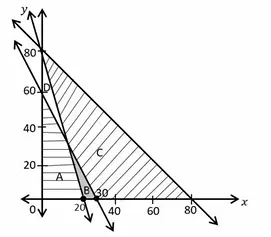
The minimum value of $Z = 2x + y$ subjected to $x + y \geq 10, 2x + 3y \leq 26, x, y \geq 0$ is
About linear programming problem (LPP), which of the following statements are correct? (A) In a LPP, the linear inequalities or restrictions on the variables are called linear constraints. (B) If the feasible region for an LPP is unbounded, then the maximum or minimum value of the objective function $Z = ax + by$ never exists. (C) The feasible region for an LPP is always convex. (D) The common region determined by all the linear constraints of an LPP is called the feasible region. Choose the correct answer from the options given below:
A player participates in 3 matches against three teams T₁, T₂ and T₃.The probability of winning a match against teams T₁, T₂ and T₃ are 0.2, 0.3 and 0.9 respectively. If 'wins' can be regarded as independent events, then the probability that he (A) wins all the 3 matches is 0.054 (B) wins no match is 0.054 (C) wins exactly two matches is 0.348 (D) wins exactly one match is 0.542 Choose the correct answer from the options given below:
An objective function $z = ax + by$ is maximum at points (15,15) and (0, 20). If $a, b \geq 0$ and $ab = 27$, then the maximum value of the objective function is
Which of the given values of $x$ and $y$ make the following pair of matrices equal ? $\begin{bmatrix}2x-1 & 4\\y-1 & 3+2x\end{bmatrix}$ and $\begin{bmatrix}0 & y-2\\5 & 4\end{bmatrix}$
A linear programming problem is as follows: Minimize $z = 2x + 3y$ Subject to the constraints $x \ge 3, x \le 9, y \ge 0, x - y \ge 0, x + y \le 14$. The feasible region has 5 corner points including
If $A = \begin{bmatrix} 1 & 1 & 1 \\ 1 & 0 & 2 \\ x & 1 & 1 \end{bmatrix}$ and $A^{-1} = \frac{1}{4}\begin{bmatrix} -2 & 0 & y \\ 5 & -2 & -1 \\ 1 & 2 & -1 \end{bmatrix}$, then values of x and y, are:
In a linear programming problem(LPP), the maximum value of the objective function $Z = 2x + 5y$ subjected to the constraints: $2x + 3y ≤ 6$ $2x + y ≤ 4$ $x, y ≥ 0$ is
If $x, y$ and $z$ are real number such that $x + y + z = 0$, then value of $\begin{vmatrix}3x & -x+y & -x+z\\x-y & 3y & z-y\\x-z & y-z & 3z\end{vmatrix}$ is
The corner points of the bounded feasible region determined by the system of linear inequalities are $(0,0)$, $(4,0)$, $(2,4)$ and $(0,5)$. If maximum value of $z = ax + by$, where $a,b > 0$, occurs at both $(2,4)$ and $(4,0)$ then
The probability distribution of a random variable x is given below. | x | 0 | 1 | 2 | 3 | |---|---|---|---|---| | P(x) | k/3 | k/2 | k/4 | k/7 | Then the value of k is
If X is a random variable with probability distribution as given below: | X | 0 | 1 | 2 | 3 | |---|---|---|---|---| | P(X) | k | 2k | k | 3k | Then, the variance of the distribution is
The minimum value of $\begin{vmatrix}2 & 2 & 2 \\ 2 & 2+x & 2 \\ 2 & 2 & 2+x\end{vmatrix}$, $x \in R$ is
Let A and B be two events. Then which of the following statements are TRUE? (A) $P(B|A) = \frac{P(A \cap B)}{P(A)}$, provided $P(A) \neq 0$ (B) $P(B') = 1 + P(B)$ (C) $P(A \cup B) = P(A) + P(B) + P(A \cap B)$ (D) $P(A \cap B) = P(A).P(B)$ If A and B are independent events Choose the correct answer from the options given below:
Let $f: \mathbb{R} \to \mathbb{R}$ be defined as $f(x) = 100x + 1$, where $\mathbb{R}$ is a set of real numbers, then
If P and Q are non-singular square matrices of the same order, then $(PQ^{-1})^{-1}$ equals
Let $A = [a_{ij}]_{3 \times 3}$ such that $|A| = -5$. Then the value of $\det(5A)$ is equal to
The integral value of k for which the system of linear equations $kx + y + 2z = 0$, $ky = x - 3z$ and $2x + y + kz = 0$ has a non-zero solution is
If matrix $A = \begin{bmatrix} x & 2 & 3 \\ a & y & -5 \\ b & c & 0 \end{bmatrix}$ is a skew-symmetric matrix, then (A) $x + y + c = 5$ (B) $c = 5$ (C) $a + b + c = 0$ (D) $a + b - c = 10$ Choose the correct answer from the options given below:
Three bad eggs are mixed with 7 good ones. If two eggs are drawn one by one without replacement, then the probability distribution of the number (X) of bad eggs drawn is: | X | 0 | 1 | 2 | |---|---|---|---| | P(X) | 1/4 | 1/2 | 1/4 | | X | 0 | 1 | 2 | |---|---|---|---| | P(X) | 15/61 | 20/61 | 26/61 | | X | 0 | 1 | 2 | |---|---|---|---| | P(X) | 7/15 | 7/15 | 1/15 | | X | 0 | 1 | 2 | |---|---|---|---| | P(X) | 1/8 | 1/4 | 5/8 |
If A is an invertible matrix of order 2, then $\det(( {adj } A)^{-1})$ is equal to
If $A = \begin{bmatrix} 3 & -2 \\ 4 & -2 \end{bmatrix}$, $I = \begin{bmatrix} 1 & 0 \\ 0 & 1 \end{bmatrix}$ and $A² = KA - 2I$, then the value of K is
A problem in Mathematics is given to two students X and Y whose chances of solving it are $\frac{1}{3}$ and $\frac{1}{4}$ respectively. The probability that only X solves the problem, is:
If $y$ is normal distribution random variable with mean $\mu = 10$ and standard deviation $\sigma = 2$. $z$ is standard normal variable and $F(Z)$ is cumulative distribution function, then which of the following are true? [Given that $F(1.5) = 0.9332$, $F(3) = 0.9986$, $F(2.25) = 0.9878$ and $F(1) = 0.8413$] (A) $P(X < 13) = 0.9332$ (B) $P(X > 16) = 0.9986$ (C) $P(12 < X < 14.5) = 0.1465$ (D) $P(X > 8) = 0.8413$ Choose the correct answer from the options given below:
The value of $\begin{vmatrix}265 & 240 & 219 \\ 240 & 225 & 198 \\ 219 & 198 & 181\end{vmatrix}$ is
Which of the following statements are true? (A) The vector joining the points P(2, 3, 0) and Q(-1,-2,-4) directed from P to Q is $\vec{PQ} = -3\hat{i} - 5\hat{j} - 4\hat{k}$ (B) Projection of a vector $\vec{a}$ on other vector $\vec{b}$ is $\frac{\vec{a}.\vec{b}}{|\vec{a}|}$ (C) If $\vec{a} = \hat{i} - 2\hat{j} + \hat{k}$ and $\vec{b} = -2\hat{i} + 4\hat{j} + 5\hat{k}$ then $\vec{a} + \vec{b} = -\hat{i} + 2\hat{j} + 6\hat{k}$ (D) If $\theta$ is the angle between $\vec{a}$ and $\vec{b}$ then $\cos \theta = \frac{\vec{a}.\vec{b}}{|\vec{a}||\vec{b}|}$ Choose the correct answer from the options given below:
The probability of a man hitting a target is 1/2. How many times must he fire so that the probability of hitting the target at least once is more than 90%?
If a random variable X has the following probability distribution: | X | 0 | 1 | 2 | 3 | |---|---|---|---|---| | P(X) | K | K/2 | K/4 | K/8 | then, Match List-I with List-II | List-I | List-II | |---|---| | (A) The value of K is | (I) 2/15 | | (B) P(0 < X < 2) is | (II) 1/15 | | (C) P(1 < X < 3) is | (III) 8/15 | | (D) P(X > 2) is | (IV) 4/15 | Choose the correct answer from the options given below:
If $a, b$ and $c$ are positive real numbers, then Match List-I with List-II | List-I | List-II | |---|---| | (Expression) | (The Least value of the expression) | | (A) $(a + b)(b + c)(c + a)$ | (I) $8abc$ | | (B) $(a + b + c)(ab + bc + ca)$ | (II) $9a^2b^2c^2$ | | (C) $(a^2b + b^2c + c^2a)(ab^2 + bc^2 + ca^2)$ | (III) $9abc$ | | (D) $(a + b)^2(b + c)^2(c + a)^2$ | (IV) $64a^2b^2c^2$ | Choose the correct answer from the options given below:
If $A = \begin{bmatrix} 5 & 6 \\ 3 & 2 \end{bmatrix}$ then which of the following is correct? (A) $|A|$ is positive (B) $|adj\ A| = -8$ (C) Cofactor of 3 is 6 (D) $|2A| = -32$ Choose the **correct** answer from the options given below:
Let $AX = B$ be a system of three linear equations in three variables. Then the system has (A) a unique solutions if $|A| = 0$ (B) a unique solutions if $|A| \neq 0$ (C) no solutions if $|A| = 0$ and (adj A) $B \neq 0$ (D) infinitely many solutions if $|A| = 0$ and (adj A)$B = 0$ Choose the correct answer from the options given below:
If $a$, $b$ and $c$ are distinct prime numbers then the value of $\begin{vmatrix} a-b & b-c & c-a \\ b-c & c-a & a-b \\ c-a & a-b & b-c \end{vmatrix}$ is equal to
The solution of $\frac{7x+12}{x-9} < 4$; $ \neq 9$ is:
If $A$ is a square matrix and $I$ is an identity matrix of same order such that $A^2 = A$, then $(2I + A)^2 - 5A$ is
If the minimum value of the objective function $Z = ax + by$ of an LPP occurs at two points $(3, 5)$ and $(5, 3)$, then
If $A$ and $B$ square matrices of order 3 such that $|A| = -1$, $|B| = 5$, then the value of $|2AB|$ is:
The projection of the vector $5\hat{i} + \hat{j} - 3\hat{k}$ on the vector $\hat{i} + 2\hat{j} - 3\hat{k}$ is
In a Binomial distribution, the probability of getting a success is $\frac{3}{4}$ and the variance is $\frac{3}{8}$ then the probability of no success is:
The solution set of the inequality $\frac{2x+3}{x-1} < 0$ is:
Which of the following are correct? (A) If A and B are symmetric matrices such that AB = BA, then AB is symmetric. (B) If A and B are symmetric matrices of the same order, then (A+B) is a symmetric matrix. (C) If A and B are symmetric matrices of the same order, then (AB-BA) is a symmetric matix. (D) If A and B are symmetric matrices of the same order, then (AB+BA) is a skew symmetric matrix Choose the correct answer from the options given below:
If the feasible region of an LPP is bounded and the corresponding objective function is $z = 5x - 9y$, then the objective function attains:
Let $\vec{a} = \hat{i} + \hat{j} + \hat{k}$ and $\vec{b} = \hat{i} + \hat{2j} + 3\hat{k}$ then a unit vector perpendicular to both vectors $(\vec{a} + \vec{b})$ and $(\vec{a} - \vec{b})$ is equal to
The maximum value of the objective function $z = 10x + 15y$ of an L.P.P. subjected to the constraints $2x + 4y \leq 8$, $3x + y \leq 6$, $-x - y \geq -4$, $x \geq 0$, $y \geq 0$ is:
A problem in mathematics is given to three students whose chances of solving it are 1/2, 1/3, 1/4 respectively. The probability that the problem is solved is
Match List-I with List-II Where ℝ is set of real numbers | List-I | List-II | |---|---| | (A) f: ℝ → ℝ s.t f(x) = x⁴ is | (I) one-one, Into | | (B) f: ℝ → [0, ∞) s.t f(x) = x⁴ is | (II) many-one, into | | (C) f: [0, ∞) → ℝ s.t f(x) = x⁴ is | (III) one-one, onto | | (D) f: [0, ∞) → [0, ∞) s.t f(x) = x⁴ is | (IV) many-one, onto | Choose the correct answer from the options given below:
If $f(x) = \begin{vmatrix} 0 & x-1 & x-2 \\ x+1 & 0 & x-3 \\ x+2 & x+3 & 0 \end{vmatrix}$, then the value of $f(0)$ is equal to:
A bag contains 4 red and 6 green balls. A ball is drawn at random. Its colour is noted and is returned to the bag. One additional ball of the colour drawn is put in the bag. Again a ball is then drawn from the bag. The probability of this ball to be of green colour is
Let A, B, C be three events. If the probability of occurring exactly one out of A and B is $\frac{3}{5}$, exactly one of B and C is $\frac{1}{5}$, exactly one of C and A is $\frac{3}{5}$ and that of occurring of three events is $\frac{4}{25}$, then the probability of occurring at least one of them is
If a computer code is correctly programmed, it gives 90% acceptable results. But if it is not correctly programmed, it gives only 40% acceptable results. From previous experience, it is observed that only 80% of codes are correctly programmed. If after a certain programming, the code gives 2 acceptable results, then the approximate probability that the code is correctly programmed is
A vector of magnitude 9, which is perpendicular to both the vectors $(4\hat{i} - \hat{j} + 8\hat{k})$ and $(-\hat{j} + \hat{k})$ is
The relation R on the set of real numbers defined by $R = \{(a, b): a \leq b^2\}$ is
If A speaks truth in 75% cases and B speaks truth in 80% cases, then the probability that they contradict each other in a statement, is:
Let $f: \mathbb{R}$ -> $\mathbb{R}$ be a function defined as $f(x) = x^4$. Which one of the following is true?
If $\begin{bmatrix} 1 & 0 \\ b & 5 \end{bmatrix} + 2\begin{bmatrix} a & 0 \\ 1 & -2 \end{bmatrix} = I$, where $I$ is a unit matrix of order 2, then the value of $(a - b)$ is:
Match List-I with List-II Let $f: A \rightarrow B$ be a function given by $f(x) = x^2$ | List-I | List-II | |---|---| | **Domain and Co-domain** | **Kind** | | (A) $A = \mathbb{R}$ and $B = \mathbb{R}$ | (I) $f$ is both one-one and onto | | (B) $A = \mathbb{R}$ and $B = [0, \infty]$ | (II) $f$ is one-one but not onto | | (C) $A = B = [0, \infty]$ | (III) $f$ is not one-one but onto | | (D) $A = [0, \infty]$ and $B = \mathbb{R}$ | (IV) $f$ is neither one-one nor onto | Choose the correct answer from the options given below:
A manufacturing unit makes two models, 'classic' and 'supreme' of the scooter. Each piece of the classic model requires 9 labour hours for assembling and 1 labour hour for finishing. Each piece of supreme model requires 12 labour hours for assembling and 3 labour hour for finishing. For assembling and finishing, the maximum labour hours available are 180 and 30 respectively. The company makes a profit of ₹ 10000 on each piece of the classic model and ₹ 15000 on each piece of the supreme model. Which of the following options describes the given Linear Programming Problem (LPP) to maximize the profit Z (Max Z) (where x and y are the number of pieces of the classic model and the supreme model respectively)?
If $A = [a_{ij}]_{3×3}$ where $a_{ij} = \begin{cases} (-1)^{i+j} - 1, & i = j \\ (-1)^{i+j}, & i \neq j \end{cases}$ then the value of $A + A^T$ is:
Let $\vec{a}$ and $\vec{b}$ are unit vectors. If $\sqrt{3}\vec{a} - \vec{b}$ is a unit vector, then the angle between $\vec{a}$ and $\vec{b}$ is
In a game, a person is paid Rs. 2 if he gets all heads or all tails when three coins are tossed, and he will pay Rs. 2 if either one or two heads show. What can he expect to win on an average per game?
A and B are two independent events. The probability that both events A and B occur is $\frac{1}{6}$ and the probability that neither of them occur is $\frac{1}{3}$. If P(A) = x, P(B) = y then the value of x+y is.
Suppose that A, B and C are matrices of order $m \times n$, $n \times 5$ and $5 \times q$ respectively. The restriction on $m$, $n$ and $q$ so that AB-BC is defined are
The corner points of the bounded feasible region determined by the system of linear constraints are $(0,8)$, $(4,4)$, $(12,12)$, $(0,20)$. Let $z = px + qy$, where $p, q > 0$. Condition on $p$ and $q$ so that the maximum of $z$ occurs at both the points $(12,12)$, $(0,20)$ is
The random variable X can take values 0, 1, 2. If $P(X=0)=P(X=1)=\alpha$, and $E(X^2)=E(X)$, then which of the following are correct? (A) $E(X) = 2-3\alpha$ (B) $E(X^2) = 4+7\alpha$ (C) $\alpha = \frac{1}{2}$ (D) $\alpha = \frac{1}{5}$ Choose the **correct** answer from the options given below:
A pair of dice is thrown until the sum of numbers appeared is a perfect square or a non-perfect square sum appeared five times in succession. If random variable $X$ denotes the number of non perfect square sums appeared, then $P(X > 0)$ is
Which one of the following represents the correct feasible region determined by the following constraints $x - y \geq 5$, $5x - 5y \leq 16$
The projection of the vector $\vec{a} = \hat{i} + 2\hat{j} - 3\hat{k}$ on the vector $2\hat{i} + 6\hat{j} + 3\hat{k}$ is
If $\begin{bmatrix}2x+1 & 5x \\ 0 & y^2+1\end{bmatrix} = \begin{bmatrix}x+3 & 10 \\ 0 & 26\end{bmatrix}$ then the possible values of x + y are:
If two dice are rolled 12 times and getting a total greater than 4 is considered as a success, then which of the following statements are correct? (A) The probability of getting a total greater than 4 in a single throw of the pair of dice is 5/6. (B) Mean = 10 (C) Variance = 3/5 (D) The probability of getting a total less than or equal to 4 in a single throw of the pair of dice is 1/6. Choose the correct answer from the options given below:
If A is a square matrix of order $3 \times 3$ and $|A| = 4$. The value of $|(adjA).A|$ is
Given that $\vec{a} = -3\hat{i} - 6\hat{j} + 4\hat{k}$, $\vec{b} = 9\hat{i} - λ\hat{j} - 12\hat{k}$. If $\vec{a} \times \vec{b} = \vec{0}$, then the value of λ is
The probability distribution of a random discrete variable is given | X | -1 | 0 | 1 | 2 | 3 | |---|---|---|---|---|---| | P(X) | 0.1 | $p$ | 0.3 | $q$ | $r$ | If it is known that P(X=1) is the mean of P(X=0) and P(X=2). Then the value of r is :
Assume that R is a relation on the set Z of integers and it is given by $(x, y) \in R \Leftrightarrow |x - y| \leq 1$. Then, R is
A and B are two sets such that $n(A) = 5$ and $n(B) = 7$. The number of one-one functions from A to B is
If $\vec{a}$ and $\vec{b}$ are two vectors such that $|\vec{a}| = 10, |\vec{b}| = 2$ and $\vec{a} \cdot \vec{b} = 12$, then $|\vec{a} \times \vec{b}|$ is equal to
Let $A = [a_{ij}]$ be a square matrix of order 2 with elements either 0 or 1. Then the difference between the possible number of singular and non-singular matrices is
If $A = \begin{bmatrix} 1 & 0 & 0 \\ 0 & -1 & 0 \\ 0 & 0 & 1 \end{bmatrix}$ then $A^{-1}$ is equal to
Which one of the following inequalities is redundant for the shaded feasible region (ABCDA) shown below? 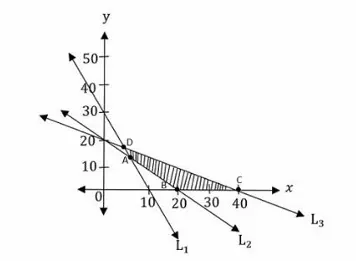
The value(s) of $K$, for which the system of linear equations $2x + y + z = 1, x + Ky - z = \frac{3}{2}$ and $3y - 5z = 9$ does not possess a unique solution is
If A (3, 2), B (1, -1) and C (2, 1) are three vertices of a parallelograms ABCD, then its area (in sq.units) is equal to
In 5 trials of binomial distribution, the probability of 3 successes is 4 times the probability of 2 successes. The probability of success in each trial is:
A coin is tossed and a die is thrown. The probability that the outcome will be a tail on the coin or a number greater than 3 on the die is
If $\vec{a}$ and $\vec{b}$ are two unit vectors and $\vec{a} + \vec{b}$ is also unit vector, the magnitude of $\vec{a} - \vec{b}$ is
The number of all possible matrices of order $2 \times 3$ with each entry 0 or 1 is
If A is a skew-symmetric matrix, then which of the following statements is **NOT** true? (A) A is singular if order of A is odd (B) A is non-singular (C) $A^{2025}$ is a skew-symmetric matrix (D) $A^{2025}$ is a symmetric matrix (E) all diagonal elements of A are zeros Choose the correct answer from the options given below:
If $\vec{a} \cdot \vec{b} = \vec{a} \cdot \vec{c}$, $\vec{a} \times \vec{b} = \vec{a} \times \vec{c}$ and $\vec{a} \neq {0}$, then the vector $\vec{b}$ in equal to.
If the points (a₁, b₁), (a₂, b₂) and (a₁ + a₂, b₁ + b₂) are collinear, then
The values of $\lambda$ for which the system of equation $x + 2y + z = 14, - x + y + z = 10, x + \lambda y + z = 2$ has unique solution is
The corner points of a bounded feasible region are (0, 5), (6, 1), (17, 2) and (4, 29). If the maximum value of objective function $z = px + qy$ where $p$ and $q > 0$ occurs at two points (17, 2) and (4, 29), then the relation between $p$ and $q$ is:
If $\begin{bmatrix}3 & 1\\2 & 1\end{bmatrix}A\begin{bmatrix}2 & 1\\1 & 1\end{bmatrix} = \begin{bmatrix}1 & 1\\0 & 1\end{bmatrix}$, then matrix 'A' is
Probability that a man speaks truth is $\frac{3}{4}$. He throws a die and reports that it is a six. The probability that it is actually a six is
The domain of $y = \cos^{-1}(x^2 - 4)$ is
The probability distribution of the random variable X is given by | X | 0 | 1 | 2 | 3 | |---|---|---|---|---| | P(X) | 0.2 | k | 2k | 2k | The variance of the random variable X is
If A is a square matrix of order 3 and |A| = -5, then |3A| is equal to
If A and B are any two events such that P(B) = P(A and B), then which of the following is correct
Match List-I with List-II | List-I | List-II | | --- | --- | | (Inequality) | (Solution Set) | | --- | --- | | (A) $2x - 3 < x + 2 \le 3x + 5, x \in \mathbb{R}$ | (I) $x \in (-1, \infty)$ | | (B) $\vert 2x + 3\vert < 7, x \in \mathbb{R}$ | (II) $x \in (-\infty, 120]$ | | (C) $\frac{1}{2}\left(\frac{3}{5}x + 4\right) \ge \frac{1}{3}(x - 6), x \in \mathbb{R}$ | (III) $x \in (-5, 2)$ | | (D) $\frac{\vert x + 1\vert }{x + 1} > 0, x \in \mathbb{R} - \{-1\}$ | (IV) $x \in \left[-\frac{3}{2}, 5\right)$ | Choose the correct answer from the options given below:
If A is a square matrix of order 3 such that $A( {adj } A) = \begin{bmatrix} -2 & 0 & 0 \\ 0 & -2 & 0 \\ 0 & 0 & -2 \end{bmatrix}$, then $|A|$ is equal to
The feasible region of a LPP is bounded. The corresponding objective function is Z= 6x - 7y. Then objective function attains:
The maximum value of $z$ for the linear programing problem maximize $z = x + y$ subject to the constraints $x + 4y \leq 8, 2x + 3y \leq 12, 3x + y \leq 9, x \geq 0, y \geq 0$ is:
Let $\vec{a} = \hat{i} + \hat{j}$, $\vec{b} = \hat{i} - \hat{j}$ and $\vec{c} = \hat{i} + \hat{j} + \hat{k}$. If $\hat{m}$ is a unit vector perpendicular to both $\vec{a}$ and $\vec{b}$, then $|\vec{c}.\hat{m}|$ is equal to
If the area of a triangle whose vertices are (-1, 3), (1, -5) and (k, 2) where $k > 0$ is 30 sq. units, then the value of k is
Let A be any square matrix of order 3 and $B = \begin{bmatrix} 0 & -4 & 2 \\ 4 & 0 & 3 \\ -2 & -3 & 0 \end{bmatrix}$. Then the matrix $ABA^T$ is a
The solution set of the linear inequation $|4x - 3| \leq \frac{3}{4}$ is:
A and B throw a die alternatively till one of them gets 3 or 6 and wins the game. If B starts the game, then the probability of winning the game by A is
Which of the following is NOT correct?
If $A = \begin{bmatrix} 2 & -1 & -2 \\ 0 & 2 & -1 \\ 3 & -5 & 0 \end{bmatrix}$, then the value of det (adj (2A)) is:
The maximum value of $z = 5x + 7y$ subjected to constraints $x + y \leq 5$, $x \geq 0$, $y \geq 0$ is:
Let $A = \begin{bmatrix} 1 & \sin \theta & 1 \\ -\sin \theta & 1 & \sin \theta \\ -1 & -\sin \theta & 1 \end{bmatrix}$, where $0 \leq \theta \leq 2\pi$. Then which of the following are true? (A) $|A| = 2 + 2 \sin^{2} \theta$ (B) $|A| = 2 + \sin^{2} \theta$ (C) minimum value of $|A|$ is $1$ (D) maximum value of $|A|$ is $4$ Choose the correct answer from the options given below:
If $x, y, z$ are non-zero numbers, then the inverse of matrix $A = \begin{bmatrix}x & 0 & 0 \\ 0 & y & 0 \\ 0 & 0 & z\end{bmatrix}$ is
If A is square matrix of order 3 × 3 and |adj A| = 64, then the value of |5A| is
The following system of equations $2x - y + 3z = 5, 3x + 2y - z = 7, 4x + 5y - \lambda z = \mu$ is consistent. Then
Let $A = [a_{ij}]_{2 \times 4}$ and $B = [b_{ij}]_{4 \times 2}$, then $|3AB|$ is equal to
Match List-I with List-II Let A and B be any two events | List-I | List-II | | --- | --- | | (A) $P(A')$ | (I) $\frac{P(A \cap B)}{P(A)}; P(A) \neq 0$ | | (B) $P(\phi)$ | (II) $\frac{P(A \cap B)}{P(B)}; P(B) \neq 0$ | | (C) $P(A\vert B)$ | (III) $1 - P(A)$ | | (D) $P(B\vert A)$ | (IV) 0 | Choose the correct answer from the options given below:
If $\left|\begin{matrix} x & 8 \\ 4 & x \end{matrix}\right| = \left|\begin{matrix} 6 & 2 \\ 18 & 6 \end{matrix}\right|$, then $x$ is/are equal to
Let $\begin{vmatrix} 3 & y \\ x & 1 \end{vmatrix} = \begin{vmatrix} 3 & 2 \\ 4 & 1 \end{vmatrix}$ and $x, y$ are natural numbers, then the number of solutions for the system is:
The probability distribution function of a normal variate with mean $\mu$ and variance $\sigma^2$ is given by: $f(x) = \frac{1}{\sigma\sqrt{2\pi}}e^{-\frac{1}{2}(\frac{x-\mu}{\sigma})^2}$, $-\infty < x < \infty$, $-\infty < \mu < \infty$, $\sigma > 0$ If $y = f(x)$ be the normal probability curve, then which of the following is correct? (A) The normal curve is symmetrical about the line $x = \mu$. (B) Mean, median and mode of the distribution coincide. (C) Y- axis is an asymptote to the normal curve. (D) If x increases numerically, $f(x)$ decreases rapidly. Choose the correct answer from the options given below:
For the linear programming problem (LPP): Maximize $Z = x + 1.5y$, subject to constraints, $x + 2y \leq 40$, $2x + y \leq 40$, $x + y \leq 25$, $x \geq 0$, $y \geq 0$. Which of the following is NOT correct?
The number of all possible matrices of order 3 with each entry either 0 or 1 is:
If $A$ and $B$ are square matrices of the same order, then which of the following statements are correct? (A) $|A^{-1}| = |A|^{-1}$ (B) $adj(A) = |A|A^{-1}$ (C) $(A + B)^{-1} = B^{-1} + A^{-1}$ (D) $(AB)^{-1} = B^{-1}A^{-1}$ Choose the correct answer from the options given below:
Match List-I with List-II | List-I (Matrix A) | List-II (Determinant of Adjoint of A) | |---|---| | (A) $\begin{bmatrix} 3 & 1 \\ 4 & 2 \end{bmatrix}$ | (I) 9 | | (B) $\begin{bmatrix} 5 & -1 \\ 4 & 2 \end{bmatrix}$ | (II) 8 | | (C) $\begin{bmatrix} 6 & -1 \\ 2 & 1 \end{bmatrix}$ | (III) 14 | | (D) $\begin{bmatrix} 4 & 1 \\ 3 & 3 \end{bmatrix}$ | (IV) 2 | Choose the correct answer from the options given below:
If the events A and B are independent, then which of the following statements are true? (A) P(A'B) = [1-P(A)] P(B) (B) A and B are mutually exclusive (C) P(A) = P(B) (D) P(A'B') = [1-P(A)] [1-P(B)] Choose the correct answer from the options given below:
If $A^T = \begin{bmatrix} -2 & 3 \\ 1 & 2 \end{bmatrix}$ and $B = \begin{bmatrix} -1 & 0 \\ 1 & 2 \end{bmatrix}$, then the matrix $(A + 2B)^T$ is
A letter is known to have come from either TATAPUR or from CHAKRATA. On the envelope, only two letters 'TA' are visible consecutively. The probability that the letter has come from CHAKRATA is:
The corner points of the bounded feasible region determined by the system of linear constraints are $(0, 0)$, $(5, 0)$, $(6, 5)$, $(6, 8)$, $(4, 10)$, $(0, 8)$. Let $Z = 3x - 4y$ be the objective function. The minimum value of Z occurs at
Let A be a square matrix of order n, then which of the following are TRUE? (A) $|adj A| = |A|^{n-1}$ (B) $|A. adj A| = |A|^n$ (C) $A. (adj A) = |A|$ (D) $|KA| = K|A|$ (E) $|A^{-1}| = \frac{1}{|A|}, |A| \neq 0$ Choose the correct answer from the options given below:
Let X denotes the number of doublets obtained in 3 throws of a pair of dice. Match **List-I** with **List-II** | List-I | List-II | |---|---| | (A) $P(X = 0)$ | (I) $\frac{1}{216}$ | | (B) $P(X = 1)$ | (II) $\frac{15}{216}$ | | (C) $P(X = 2)$ | (III) $\frac{75}{216}$ | | (D) $P(X = 3)$ | (IV) $\frac{125}{216}$ | Choose the correct answer from the options given below:
A random variable X has the following probability distribution: | X | -2 | -1 | 0 | 1 | 2 | 3 | |---|---|---|---|---|---|---| | P(X) | 0.1 | 0.2 | k | 0.3 | 2k | 0.1 | then which of the following are TRUE? (A) $k=0.1$ (B) $P(X < 1) = 0.4$ (C) $P(X < 2) = 0.7$ (D) $P(0 < X < 3) = 0.5$ Choose the correct answer from the options given below:
A vector $\vec{a}$ of magnitude $3\sqrt{2}$ making an angle of $\frac{\pi}{3}$ with $\hat{i}$, $\frac{\pi}{4}$ with $\hat{j}$ and an actue angle $\theta$ with $\hat{k}$, is
The corner points of the feasible region determined by a system of linear constraints are $(0, 0)$, $(0, 40)$, $(20, 40)$, $(60, 20)$, $(60, 0)$. If the objective function is $z = 4x + 3y$, then which one of the following is true?
The number of equivalence relation on the set $\{1, 2, 3\}$ containing $(1, 2)$ and $(2, 1)$ is
Which of the following statements are correct? (A) If $\vec{a}$ and $\vec{b}$ represent the adjacent sides of a triangle, then its area is $\frac{1}{2}|\vec{a} \times \vec{b}|$ (B) If $\vec{a}$ and $\vec{b}$ represent the adjacent sides of a parallelogram, then its area is $|\vec{a} \times \vec{b}|$ (C) $|\vec{a} \times \vec{b}| = |\vec{a}| |\vec{b}| \cos\theta$ (D) If $\vec{a}$ and $\vec{b}$ represent the 'diagonals' of a parallelogram, then its area is $\frac{1}{2}|\vec{a} \times \vec{b}|$ Choose the correct answer from the options given below:
Consider the LPP: Max $Z = 5x + 3y$ subject to $3x + 5y \leq 15, 5x + 2y \leq 10, x \geq 0, y \geq 0$ Match **List-I** with **List-II** | List-I | List-II | |---|---| | (A) Objective function | (I) $3x + 5y \geq 15$ | | (B) One constraint | (II) $x, y \geq 0$ | | (C) Non-negative restrictions | (III) $Z = 5x + 3y$ | | (D) Point $(1, 2)$ does not lie in the region | (IV) $3x + 5y \leq 15$ | Choose the correct answer from the options given below:
If $\hat{i},\hat{j}$ and $\hat{k}$ are unit vectors along co-ordinates axes OX, OY and OZ respectively, then which of the following is/are true? (A) $\hat{i} \times \hat{i} = \vec{0}$ (B) $\hat{i} \times \hat{k} = \hat{j}$ (C) $\hat{i} \cdot \hat{i} = 1$ (D) $\hat{i} \cdot \hat{j} = 0$ Choose the correct answer from the options given below:
The area (in sq. units) of the triangle whose vertices are $(0, 0)$, $(a, 0)$, $(0, b)$, is equal to
Let $A = \begin{bmatrix} 2 & 3 \\ 1 & 2 \end{bmatrix}$ and $B = \begin{bmatrix} 4 & -6 \\ -2 & 4 \end{bmatrix}$ (A) $\det(A^T) = 1$ (B) $AB = I$, where $I$ is the identity matrix of order 2. (C) $A^{-1} = \begin{bmatrix} 2 & -3 \\ -1 & 2 \end{bmatrix}$ (D) adj $(B) = \begin{bmatrix} 4 & 2 \\ 6 & 4 \end{bmatrix}$ Choose the correct answer from the options given below:
Two cards are drawn successively with replacement from a well-shuffled deck of 52 cards. The probability distribution of number of aces is given by:
The solution of the system of equations $2x + \frac{1}{2}y - z = 1$, $2y = 3$, $x + 2z = 4$ is:
If A and B are independent events and $P(A) = \frac{1}{2}$ $P(B) = \frac{1}{3}$, then Match List-I with List-II | List-I | List-II | |---|---| | (A) $P(A \cap B)$ | (I) $\frac{1}{2}$ | | (B) $P(\bar{A})P(B) + P(A)P(\bar{B})$ | (II) $\frac{1}{3}$ | | (C) $P(A \mid B) + P(B \mid A)$ | (III) $\frac{1}{6}$ | | (D) $P(A \cap \bar{B})$ | (IV) $\frac{5}{6}$ | Choose the correct answer from the options given below:
Let A and B be 3×3 matrices such that $A \neq B$. If $A^3 = B^3$ and $A^2B = B^2A$, then the determinant of $A^2 + B^2$ is:
The maximum value of the determinant of the matrix $\begin{bmatrix} 1 & 1 & 1 \\ 1 & 1+\sin x & 1 \\ 1+\cos x & 1 & 1 \end{bmatrix}$ is: (where $x$ is real)
Let $|\vec{a}| = 5, |\vec{b}| = 2$ and $\vec{a}\cdot\vec{b} = 6$, then the value of $|\vec{a} \times \vec{b}|$ is equal to
For any vector $\vec{a}$, the value of $|\vec{a} \times \hat{i}|^2 + |\vec{a} \times \hat{j}|^2 + |\vec{a} \times \hat{k}|^2$ is equal to:
If the objective function z = 4x + 3y has maximum value on a line joining points (3, a) and (b, 2) where a > 0, b > 0 such that a - b = 2, then the maximum value of z is:
If the random variable X has the following probability distribution: | X | 0 | 1 | 2 | otherwise | |---|---|---|---|---| | P(X) | k | 3k | 5k | 0 | Match List-I with List-II | List-I | List-II | |---|---| | (A) k | (I) $\frac{13}{9}$ | | (B) E (X) | (II) $\frac{4}{9}$ | | (C) P (X ≤ 1) | (III) $\frac{8}{9}$ | | (D) P (1 ≤ X ≤ 2) | (IV) $\frac{1}{9}$ | Choose the correct answer from the options given below: 1. (A) - (II), (B) - (I), (C) - (IV), (D) - (III) 2. (A) - (IV), (B) - (I), (C) - (II), (D) - (III) 3. (A) - (IV), (B) - (II), (C) - (I), (D) - (III) 4. (A) - (III), (B) - (II), (C) - (I), (D) - (IV)
The domain of the function $y = \sin^{-1}(x-1) + \cos^{-1}\sqrt{x-1}$ is:
If $\vec{a} = 2\hat{i} - 3\hat{j} + \hat{k}$ and $\vec{b} = 2\hat{i} + \hat{j} - \hat{k}$, then which of the following statements is/are correct? (A) $\vec{a}$ and $\vec{b}$ are collinear (B) $\vec{a}$ and $\vec{b}$ are perpendicular (C) Angle between $\vec{a}$ and $\vec{b}$ is $\frac{\pi}{4}$ (D) $|\vec{a} + \vec{b}| = 2\sqrt{5}$ Choose the **correct** answer from the options given below:
The random variable X has the following probability distribution | X | 0 | 1 | 2 | 3 | |---|---|---|---|---| | P(X) | a | a | b | b | such that E(x²) = 2E(x), then the value of b is:
If $\vec{a}$, $\vec{b}$ and $\sqrt{3}\vec{a} + \vec{b}$ are unit vectors, then the angle between $\vec{a}$ and $\vec{b}$ is:
If A and B are two distinct events such that P(A|B) = P(B|A), then which of the following is /are possible? (A) A= B (B) P (A) = P(B) (C) A ⊂ B but A ≠ B (D) A∩ B = ɸ Choose the correct answer from the options given below:
Consider the linear programming problem(LPP): *Minimize* $Z = x + y$ $x + 2y \leq 4,$ $3x + y \geq 3,$ $4x + 3y \geq 6,$ $x, y \geq 0.$ Which of the following is correct for the above linear programming problem (LPP): (A) The LPP has a bounded feasible region. (B) The LPP has a unique optimal solution. (C) The optimal value of the LPP exists at the point (3/2, 0) (D) The corner points of the feasible region are (3/2, 0), (3/5, 6/5), (2/5, 6/5) and (4, 0) Choose the **correct** answer from the options given below:
Two cards are drawn simultaneously at random from a well shuffled pack of 52 Cards. Let X be the random variable which denotes number of kings in the draw. Then the probability distribution of X is
The corner points of the bounded feasible region determined by a set of constraints (linear inequalities) are A(0, 5), B(3, 5), C(5, 0) and D(4, 1) and the objective function is z = $px$ + 2$qy$ where p,q > 0. The condition on $p$ and $q$ such that the maximum z occurs at B and D, is:
If A and B are symmetric matrices of the same order, then which of the following are true? (A) AB - BA is a skew symmetric matrix (B) AB is a symmetric matrix (C) AB is a scalar matrix (D) AB + BA is a symmetric matrix Choose the correct answer from the options given below:
If A and B are invertible matrices of the same order, then $(AB)^{-1}$ is equal to
A fair coin is tossed a fixed number of times. If the probability of getting 11 heads is equal to the probability of getting 13 heads, then the probability of getting 2 heads is:
For an LPP: Maximize $z = 3x + 9y$, $x \geq 0, y \geq 0$, the feasible region OAB is shown in the figure, then the other constraints are 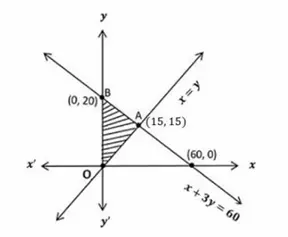
If A and B are independent events, then which of the following is/are true? (A) $\bar{A}$ and B are independent events (B) $P(A \cap B) = 0$ (C) $\bar{A}$ and $\bar{B}$ are independent events (D) $P(A \cap B) = P(A) + P(B)$ Choose the correct answer from the options given below:
Match List-I with List-II | List-I | List-II | | --- | --- | | (A) If vector $\vec{a}$ and $\vec{b}$ are such that $\vec{a} = \lambda \vec{b}$ and $\vert \vec{a}\vert = \vert \vec{b}\vert $, then | (I) $\vec{a}$ and $\vec{b}$ are orthogonal | | (B) Projection vector of $\vec{a}$ on $\vec{b}$ | (II) $[0, 12]$ | | (C) $\vec{a}$ and $\vec{b}$ are non-zero vectors such that $\vert \vec{a} + \vec{b}\vert = \vert \vec{a} - \vec{b}\vert $, then | (III) $\vec{a} = \pm \vec{b}$ | | (D) If $\vert \vec{a}\vert = 4, -3 \le \lambda \le 2$, then the range of $\vert \lambda \vec{a}\vert $ | (IV) $(\dfrac{\vec{a} \cdot \vec{b}}{\vert \vec{b}\vert ^2}) \vec{b}$ | Choose the correct answer from the options given below:
The following system of equations: $x + y - z = 7$ $4x + \lambda y - \lambda z = 3$ $3x + 2y - 4z = 5$ does not possess a solution if the value of $\lambda$ is:
Let $\vec{a} = \hat{i} + 2\hat{j} + 3\hat{k}, \vec{b} = -\hat{i} + 2\hat{j} + \hat{k}, \vec{c} = 3\hat{i} + \hat{j}$ be three vectors. If $(\vec{a} + \lambda\vec{b})$ is perpendicular to $\vec{c}$, then the value of $\lambda$ is
The probability that in a year of the 22nd century choosen at random, there will be 53 Sundays is:
If $\begin{vmatrix} p-a & 0 & c-r \\ 0 & q-b & c-r \\ a & b & r \end{vmatrix} = 0$, then the value of $\dfrac{p}{p-a} + \dfrac{q}{q-b} + \dfrac{r}{r-c}$ is
If $A = \begin{bmatrix} -2 \\ -1 \\ -4 \end{bmatrix}$, $B = [-1 \quad 2 \quad 3]$, then the value of $A'B'$ is
The probability distribution of a random variable X is given by | X | 0 | 1 | 2 | |---|---|---|---| | P(X) | k | 2k | 3k | If k > 0, then $P(0 < X \leq 2)$ is equal to
If A is a square matrix such that $A^2 = A$ then which of the following statements are TRUE ? (Where I is an identity matrix of same order as A) (A) $(I+A)^4 = I + 15A$ (B) $(I+A)^2 = I + 3A$ (C) $(I+A)^6 = I + 30A$ (D) $(I+A)^3 = I + 7A$ Choose the correct answer from the options given below:
Match List-I with List-II | List-I | List-II | |---|---| | Matrix/equations | Values | | (A) $\begin{bmatrix} 2x+1 & 3y \\ 0 & y^2-5y \end{bmatrix} = \begin{bmatrix} x+3 & y^2+2 \\ 0 & -6 \end{bmatrix}$ | (I) $x = 2, y = -1$ | | (B) $\begin{bmatrix} 1 & 2 & -1 \\ x & 0 & 3 \\ y & 3 & 4 \end{bmatrix}$ is symmetric | (II) $x = 2, y = 2$ | | (C) $[x \ \ 1]\begin{bmatrix} 1 & 0 \\ -2 & -3 \end{bmatrix}\begin{bmatrix} 5 & 2 \\ 0 & y \end{bmatrix} = O$ | (III) $x = -2, y = 2$ | | (D) $\begin{bmatrix} x & 0 \\ 1 & 1 \end{bmatrix}\begin{bmatrix} x & 0 \\ 1 & 1 \end{bmatrix} = \begin{bmatrix} 4 & 0 \\ -1 & y/2 \end{bmatrix}$ | (IV) $x = 2, y = 0$ | Choose the correct answer from the options given below:
If $\vec{a}$ and $\vec{b}$ are two non-zero orthogonal vectors, then $|\vec{a} + \vec{b}|$ is equal to
If the points (a, b), (c, d) and (a + c, b + d) are collinear, then
The corner points of the feasible region with the constraints $x + y \leq 30$, $x + y \geq 15$, $y \leq 20$, $x \leq 15$ and $x$, $y \geq 0$ are
Which of the following statement are correct? (A) $A = [a_{ij}]_{n \times n}$ is a diagonal matrix if $a_{ij} = 0$ when $i = j$ (B) A square matrix $A = [a_{ij}]$ is called a symmetric matrix if $a_{ij} = a_{ji}$ for all $i, j$ (C) A square matrix $A = [a_{ij}]$ is called a skew-symmetric matrix if $a_{ij} = -a_{ji}$ for all $i, j$ (D) For every square matrix $A$, there exist an identity matrix of the same order such that $IA = AI = I$ Choose the correct answer from the options given below:
If the corner points of the bounded feasible region of an LPP are (0,2), (3,0), (6,0), (6,8) and (0,5), then the minimum value of objective function F = 4x + 6y occurs at
Let $A = \begin{bmatrix} \cos\theta & -\sin\theta \\ \sin\theta & \cos\theta \end{bmatrix}$, then $(A^{-1})^T$ equals
Which one of the following set of constraints represents the shaded region given below? 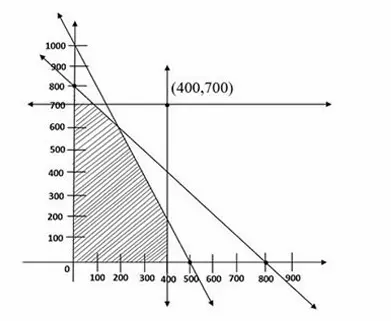
Match List-I with List-II Let $A$ and $B$ be two events such that $P(A) = 0.2$, $P(B) = 0.4$, $P(B|A) = 0.5$ | List-I | List-II | | --- | --- | | (A) $P(A \cap B)$ | (I) $0.5$ | | (B) $P(A\vert B)$ | (II) $0.8$ | | (C) $P(A \cup B)$ | (III) $0.25$ | | (D) $P(A')$ | (IV) $0.1$ | Choose the correct answer from the options given below:
If $\hat{i}$, $\hat{j}$ and $\hat{k}$ are unit vectors along the co-ordinate axes OX, OY and OZ respectively, then (A) $\hat{i} \times \hat{j} = \hat{k}$ (B) $\hat{k} \times \hat{i} = -\hat{j}$ (C) $\hat{j} \cdot \hat{j} = 1$ (D) $\hat{j} \cdot \hat{k} = 0$ Choose the correct answer from the options given below:
For a random variable x, probability distribution P(x) is given by $P(x) = \frac{k}{6}(3-x), x = 0, 1, 2$, then Match List-I with List-II | List-I | List-II | |---|---| | (A) k is equal to | (i) $\frac{1}{2}$ | | (B) P(x = 0) | (ii) 1 | | (C) P(x < 2) | (iii) $\frac{1}{6}$ | | (D) P(1 < x ≤ 2) | (iv) $\frac{5}{6}$ | Choose the correct answer from the options given below:
Given a matrix A of order 3x3. If |A|=3 then the value of |A(adj A)| is:
For the L.P.P. Maximize z = 10x + 6y subjected to 3x + y ≤ 12, 2x + 5y ≤ 34, x, y ≥ 0. Then the feasible region represented by system of inequalities is
Probability distribution of random variable X is | X | -2 | -1 | 0 | 1 | 2 | |---|---|---|---|---|---| | P(X) | 2/11 | 1/11 | 4/11 | 3/11 | 1/11 | Then the value of E(X) is
Which of the following statement('s) is/are TRUE? (A) Skew symmetric matrix of even order is always symmetric (B) Skew symmetric matrix of odd order is non-singular (C) Skew symmetric matrix of odd order is singular (D) Skew symmetric matrix is always square matrix Choose the correct answer from the options given below:
The projection vector of the vector $2\hat{i} + 3\hat{j} + \hat{k}$ on $2\hat{i} + \hat{j} - 2\hat{k}$ is
A random variable X has the following probability distribution: | X | 0 | 1 | 2 | 3 | |---|---|---|---|---| | P(X) | 0.2 | 0.1 | 0.3 | 0.4 | The variance of X will be
If $A = [a_{ij}]_{3 \times 2}$ where $a_{ij} = i + j$, then (A) A is a square matrix (B) $a_{21} + a_{32} = 8$ (C) Number of elements in A is 6 (D) Transpose of $A = \begin{bmatrix}2 & 3 \\ 3 & 4 \\ 4 & 5\end{bmatrix}$ Choose the correct answer from the options given below:
If A is a singular matrix, then A{adj A} is equal to
If A and B are two events such that $P(A) = \frac{1}{2}$, $P(B) = \frac{1}{3}$ and $P(A \cap B) = \frac{1}{4}$, then which of the following statements are true? (A) A and B are independent events (B) $P(A | B) = \frac{3}{4}$ (C) $P(A' | B') = \frac{5}{8}$ (D) $P(A' | B) = \frac{1}{4}$ Choose the correct answer from the options given below:
The probability distribution of a random variable $x$ is, $P(x) = \frac{k}{2^x}, x = 0, 1, 2, 3$. Then Match List-I with List-II | List-I | List-II | |---|---| | (A) $k$ | (I) $\frac{2}{15}$ | | (B) $P(x = 1)$ | (II) $\frac{1}{5}$ | | (C) $P(1 < x < 3)$ | (III) $\frac{8}{15}$ | | (D) $P(x \geq 2)$ | (IV) $\frac{4}{15}$ | Choose the correct answer from the options given below:
Linear inequalities corresponding to the shaded feasible region OABCO in the given figure are 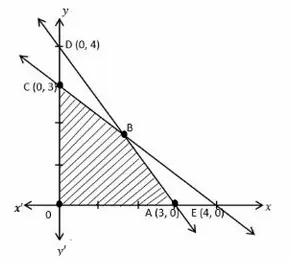
For the linear programing problem, $Minimize(Z) = 60x + 30y$ subject to: $2x - y \geq -5; 3x + y \geq 3; 2x - 3y \leq 12; x, y \geq 0$ the optimal value of $z$ is
Solution of the inequality $\frac{2x+3}{4x-5} \geq 0$ is
If $a_{ij}=i+3j$, then the matrix of order 2 with elements as $a_{ij}$ is
Relation R on the set $A = \{1, 2, ..., 15\}$ defined as $R = \{(x, y): y - 4x = 0\}$ is
In a college, 30% students fail in physics, 25% fail in Mathematics and 10% fail in both. One student is chosen at random. The probability that she fails in physics if she has failed in mathematics is
If $A$ is an invertible matrix of order 3, then Match List-I with List-II | List-I | List-II | | --- | --- | | (A) $\vert \text{adj} A\vert $ | (I) $8\vert A\vert $ | | (B) $\vert A(\text{adj} A)\vert $ | (II) $\vert A\vert ^2$ | | (C) $\vert 2A\vert $ | (III) $\frac{1}{\vert A\vert }$ | | (D) $\vert A^{-1}\vert $ | (IV) $\vert A\vert ^3$ | Choose the correct answer from the options given below:
If A is an invertible matrix, then which of the following statement(s) is/are TRUE? (A) $|A^{-1}| = |A|$ (B) $(A^{-1})^{-1} = A$ (C) $A^{-1} = \frac{adj A}{|A|}$ (D) $(A^T)^{-1} = (A^{-1})^T$ Choose the correct answer from the options given below:
Which of the following statements are true? (A) If $\vec{r} = x\hat{i} + y\hat{j} + z\hat{k}$, then $x, y, z$ are called direction ratios of $\vec{r}$. (B) For any two vectors $\vec{a}$ and $\vec{b}$, $\vec{a} + \vec{b} = \vec{b} + \vec{a}$ (C) $\vec{a} \perp \vec{b}$ if and only if $\vec{a} \times \vec{b} = \vec{0}$ (D) Projection of $\vec{b}$ on $\vec{a}$ is $\frac{\vec{a} \cdot \vec{b}}{|\vec{a}|^2}$ Choose the correct answer from the options given below:
If the binomial distribution $X\sim B(n, p)$ of mean 3 and variance $\frac{3}{2}$, $(p + q) = 1$, then which of the following is/are TRUE? (A) $q = \frac{1}{2}$, $n = 6$ (B) $P(X \leq 5) = \frac{63}{64}$, $p = \frac{1}{2}$ (C) $q = \frac{1}{3}$, $p = \frac{2}{3}$ (D) $P(X = 4) = \frac{15}{64}$, $n = 6$ Choose the correct answer from the options given below:
If $A = [a_{ij}]$ is skew symmetric matrix of order 'n', then
A random variable X has the following probability distribution: | X | 2 | 3 | 4 | 5 | |---|---|---|---|---| | P(X) | 5/k | 7/k | 9/k | 11/k | Then the value of $\frac{k}{4}$ is:
Let A be a matrix such that $A = \begin{bmatrix} 1 & 2 \\ -2 & 3 \end{bmatrix}$. Then which of the following are TRUE? (A) A is non-singular matrix (B) $A^T = A$ (C) A is not invertible matrix (D) A is not skew-symmetric matrix Choose the *correct* answer from the options given below:
Which of the following statements are correct? (A) Inverse of a matrix, if it exists, is unique (B) $(kA)' = -kA'$ (where k is any real number) (C) For an invertible matrix $A$, $(A^{-1})^{-1} = A$ (D) For an invertible matrix $A$, $(A')^{-1} = (A^{-1})'$ Choose the **correct** answer from the options given below:
Which of the following statements are correct? (A) The mean and variance of the Poisson distribution are equal. (B) The mean and variance of a Binomial distribution are equal. (C) An unbiased die is thrown again and again until two sixes are obtained, then the probability of obtaining the second six in the 3rd throw is $\frac{5}{108}$. (D) If the variance of a Poisson distribution is 2, then P(X = 2) = $2e^{-2}$ Choose the **correct** answer from the options given below:
The value of k for which the system of equations $x + y + z = 1$ $x - ky + z = 1$ $x - y + z = 1$ has more than one solutions is
60% members of a committee favour a certain proposal and 40% members oppose the proposal. A member is selected and let the random variable X = 0 if he opposes and X = 1 if he is in favour. Then the variance of the random variable X is
The objective function of an LPP is $z = ax + \beta y, (a, \beta > 0)$ in that has to be maximized/minimized subject to constraints $x + y \leq 2$, $x \geq 0$, $y \geq 0$. Then max (z) $-$ min (z) is equal to
Two persons A and B throw a die alternately till one of them gets a 'three' and wins the game. The probability of A's winning if A starts first is
A random variable X has the following probability distribution: | X | 0 | 1 | 2 | 3 | 4 | 5 | 6 | 7 | |---|---|---|---|---|---|---|---|---| | P(X) | 0 | k | 2k | 2k | 3k | k² | 2k² | 7k² + k | The value of $P(4 < x < 7)$ is equal to
If $A = \begin{bmatrix} 2 & 1 & 3 \\ 4 & -3 & 5 \end{bmatrix}$ and $B = \begin{bmatrix} -2 & 3 \\ 4 & -5 \\ 1 & 2 \end{bmatrix}$, then which of the following statements are TRUE? (A) AB is defined (B) AB and BA both are defined and AB = I, where I is an identity matrix of order 2 (C) BA is defined (D) AB and BA both are defined and AB = BA Choose the correct answer from the options given below:
If A and B are square matrices of the same order, then (A+B) (A-B) is equal to
For the linear programming problem(LPP), Maximize $Z = 4x + y$ $x + y \leq 5$ $3x + y \leq 9$ $x,y \geq 0$. Which of the following are NOT true? (A) The given LPP has unbounded feasible region. (B) The corner points of the feasible region are (0,0), (0, 5), (3, 2) and (3, 0). (C) The optimal value of the objective function is 12. (D) The given LPP has a unique optimal solution. Choose the correct answer from the options given below:
If $A = [a_{ij}]_{2×2}$ where $a_{ij} = \begin{cases} 1, & i \neq j \\ 0, & i = j \end{cases}$ and $I$ is the identity matrix of order 2, then $(A^2 - 3A + 4I)$ is (A) Symmetric Matrix (B) Skew-symmetric Matrix (C) Non-singular Matrix (D) Square Matrix Choose the correct answer from the options given below:
The matrix $\begin{bmatrix} 0 & 0 & 0 \\ 0 & 0 & 0 \\ 0 & 0 & 0 \end{bmatrix}$ is a (A) Null matrix (B) Unit matrix (C) Symmetric matrix (D) Skew-symmetric matrix Choose the correct answer from the options given below:
If the probability of two successes is 9 times the probability of 3 successes in 3 trials of a binomial distribution, then the probability of success in each trial is:
Match List-I with List-II | List-I | List-II | |---|---| | (A) Angle between $\vec{i} - \vec{j}$ and $\vec{j} + \vec{k}$ | (I) 0 | | (B) Angle between $2\vec{j} - \vec{k}$ and $\vec{j} + 2\vec{k}$ | (II) $\frac{2\pi}{3}$ | | (C) Angle between $\vec{i} + 2\vec{j}$ and $5\vec{i} + 10\vec{j}$ | (III) $\frac{\pi}{6}$ | | (D) Angle between $\sqrt{3}\vec{i} + \vec{j}$ and $\vec{i}$ | (IV) $\frac{\pi}{2}$ | Choose the correct answer from the options given below:
The feasible region associated with the inequality $2x + 3y > 4$ is
If matrices $A = [1 \quad 2 \quad 3]$ and $B = \begin{bmatrix} 1 \\ 2 \\ 3 \end{bmatrix}$, then $BA$ is equal to:
Which of the following statements are correct? (A) If E and F are independent events then $P(E \cap F) = P(E) \cdot P(F)$ (B) If E and F are mutually exclusive events, then $P(E \cup F) = P(E) + P(F) - P(E) \cdot P(F)$ (C) The conditional probability of an event E, given the occurrence of the event F is given by $\frac{P(E \cap F)}{P(F)}, P(F) \neq 0$ (D) If E and F be the events associated with the sample space S of an experiment, then $P(\overline{E}|F) = 2 - P(E|F)$ Choose the correct answer from the options given below:
If A be a square matrix of order 3 such that $|A| = 2$, then $|adj(2A)|$ is equal to
If A and B are symmetric matrices, then AB - BA is
If X is a random variable and $a$, $b$ are real numbers, then which of the following statements are true? (A) $Var(aX+b) = a^2 Var(X)$ (B) $E(aX+b)= a E(X) + b$ (C) $E(aX+b)= a E(X) - E(b)$ (D) $Var(aX+b)= a Var(X) + b$ Choose the correct answer from the options given below:
A random variable X has the following probability distribution: | X | 0 | 1 | 2 | |---|---|---|---| | P(X) | 1/4 | 1/2 | 1/4 | then, which of the following is correct?
If $A = \begin{bmatrix} 3 & 2a \\ 1 & 5 \end{bmatrix}$ and $B = \begin{bmatrix} 2 & 3 \\ b & 5 \end{bmatrix}$ both are singular matrices, then $a + b$ is equal to
A unit vector perpendicular to the vectors $\hat{i} - \hat{j}$ and $\hat{i} + \hat{j}$ is
If the area of a triangle whose vertices are $(-2, 4)$, $(2, -6)$ and $(k, 4)$, $(k > 0)$ is 35 squnits, then the value of k is
The diagonal elements of a skew symmetric matrix are all
The probability that it will rain on any particular day is 50%. The probability that it rains only on the first 4 days of the week is:
If a random variable $X$ has the following probability distribution: | X | 0 | 1 | 2 | 3 | 4 | |---|---|---|---|---|---| | P(X) | k | 2k | 3k | k² | 6k² | , then Match List-I with List-II | List-I | List-II | |---|---| | (A) k | (I) 3/7 | | (B) $P(X < 2)$ | (II) 6/49 | | (C) $P(X > 3)$ | (III) 1/7 | | (D) $P(2 \leq X \leq 3)$ | (IV) 22/49 | Choose the correct answer from the options given below:
let $\vec{a}$ be a non-zero vector of magnitude '$a$' and $\lambda$ is a non-zero scalar, then $\lambda\vec{a}$ is a unit vector if
How many minimum number of times must a man toss a fair coin so that the probability of having at least one head is more than 90%?
The function $f: [-1, 1] \rightarrow R$ is given by $f(x) = \frac{x}{x + 2}$
The system of equations $x + y - z = 1, 3x + y - 2z = 3, x - y + \lambda z = 1$ has infinite number of solutions if $\lambda$ is equal to
As per the below-mentioned graph of shaded bounded feasible region of the LPP, the maximum value of the objective function $z = 2x + y$ is 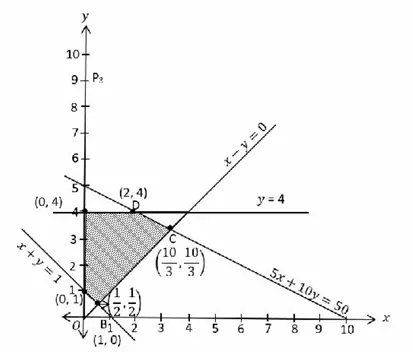
If $A = \begin{bmatrix} x & 3 \\ 2 & 4 \end{bmatrix}$, $B = \begin{bmatrix} 2 & 3 \\ y & 3 \end{bmatrix}$ and $C = \begin{bmatrix} z & 1 \\ 8 & 2 \end{bmatrix}$ are singular matrices then: (A) $x > y$ (B) $y > z$ (C) $z > x$ (D) $x \neq y \neq z$ Choose the correct answer from the options given below:
The maximum value of the objective function $Z = 8x + 2y$ of an LPP subject to constraints $2x + y \leq 3, 2x + 3y \leq 6, x \geq 0, y \geq 0$ is:
Let $A = \{1, 2, 3\}$. Then, the number of relations containing $(1, 2)$ and $(1, 3)$ which are reflexive and symmetric but not transitive, is
If the sum and difference of squares of mean and variance of a Binomial distribution is $\frac{225}{256}$ and $\frac{63}{256}$ respectively, the $P(X \geq 2)$ is:
The corner points of the bounded feasible region for an LLP are: (5, 5), (15, 15), (0, 20) and (0, 10). Let $z = 3x + 9y$ be the objective function. Then the value of $maximum(z) - minimum(z)$ is
The probability distribution of a random variable X is | X | 0 | 1 | 2 | 3 | 4 | |---|---|---|---|---|---| | P(X) | 0.2 | k | k | 2k | k | Match List-I with List-II | List-I | List-II | |---|---| | (A) value of k | (I) $\frac{16}{25}$ | | (B) $P(x \geq 2)$ | (II) $\frac{9}{25}$ | | (C) $P(x = 3)$ | (III) $\frac{4}{25}$ | | (D) $P(x < 2)$ | (IV) $\frac{8}{25}$ | Choose the correct answer from the options given below:
$A = \begin{bmatrix} 1/3 & 2 \\ 0 & 2x - 3 \end{bmatrix}$ & $B = \begin{bmatrix} 3 & 6 \\ 0 & -1 \end{bmatrix}$ If $AB = I$ (Where I is an identity matrix of order 2) , then value of x is
If $A = \begin{bmatrix} 1 & 2 & 1 \\ 2 & 3 & 1 \\ 0 & 0 & 1 \end{bmatrix}$ then $|adj(3A^T)|^2$ is equal to
The objective function of an LPP is $z = ax + by$. If the maximum value of the objective function is 180, which occurs at two points (15,15) and (0,20), then which one of the following is true?
If $\vec{a} = 2\hat{i} - \hat{j} + 3\hat{k}$ and $\vec{b} = 2\hat{i} + 2\hat{j} + \hat{k}$, then Match List-I with List-II | List-I | List-II | |---|---| | (A) Projection of $\vec{a}$ on $\vec{b}$ is | (I) $-7\hat{i} + 4\hat{j} + 6\hat{k}$ | | (B) $\vec{a} \times \vec{b}$ is | (II) $\frac{1}{\sqrt{101}}(-7\hat{i} + 4\hat{j} + 6\hat{k})$ | | (C) unit vector along $\vec{a} + \vec{b}$ is | (III) $\frac{5}{3}$ | | (D) Unit vector perpendicular to both $\vec{a}$ & $\vec{b}$ is | (IV) $\frac{1}{\sqrt{33}}(4\hat{i} + \hat{j} + 4\hat{k})$ | Choose the correct answer from the options given below:
If P, Q and R are matrices of order 2x3, 3x5 and 5x3 respectively. Then which of the following are valid? (A) P Q R (B) P R Q (C) Q R (D) R Q (E) P R Choose the correct answer from the options given below:
If A is a square matrix, then $(A^T - A)$ is-
If $\begin{bmatrix} a-b & 0 & 0 \\ 0 & b-c & 0 \\ 0 & 0 & c-2 \end{bmatrix}$ is a scalar matrix such that $a + b + c = 0$, then, which of the following are TRUE? (A) $a = 0$ (B) $b = 0$ (C) $a = 1$ (D) $c = 1$ Choose the correct answer from the options given below:
If the corner points of the bounded feasible region of an LPP with objective function Maximize $z = 2x + 3y$ are (0,0), (1,2) and (1,1), then its optimal value is
If the corner points of bounded feasible region for an LPP are (0,2) (3,0) (6,0) (6,8) and (0, 5) then the minimum value of the objective function f=4x+6y occur at
If A and B are two square symmetric matrices of same order, then AB-BA is
Two persons A and B throw a die alternately till one of them gets a six and wins the game. If A begins, then the probabilities of winning of A and B respectively are
If three balls are drawn one by one without replacement from a bag containing 5 white and 4 red balls, then the probability distribution of the number of white balls drawn is
The system of equations $x + y + z = 7$ $x + 2y + 3z = 5$ $x + 3y + \lambda z = \mu$ has a unique solution, if
If $\begin{bmatrix} x - 2 & 3 & -2 \\ y & 0 & -4 \\ 2 & z & 0 \end{bmatrix}$ is a skew symmetric matrix, then the value of $x + y + z$ is
If X is a random variable and a, b are real numbers, then which of the following statements are correct? (A) $E[aX+b] = a E(X) + b$ (B) $Var (aX + b) = a^2 Var (X) + b$ (C) $Var (aX + b) = a Var (X)$ (D) $Var (X) = E(X^2) - [E(X)]^2$ Choose the correct answer from the options given below:
Which of the following is NOT a basic requirement of the linear programming problem (LPP)?
Two numbers are selected without replacement at random, one at a time from the first six positive integers. Let x denotes the larger of the two numbers. Match List-I with List-II | List-I | List-II | |---|---| | (A) P(x = 2) | (i) $\frac{4}{15}$ | | (B) P(x = 3) | (ii) $\frac{1}{15}$ | | (C) P(x = 4) | (iii) $\frac{2}{15}$ | | (D) P(x = 5) | (iv) $\frac{1}{5}$ | Choose the correct answer from the options given below:
If the probability that an individual suffers a bad reaction from an injection of a given serum is 0.001. The probability that out of 2000 individuals, more than two individuals suffer from bad reaction is: [Given that $e^{-2} \approx 0.13534$]
If $A = \begin{bmatrix} 5 & 2 \\ 4 & 3 \end{bmatrix}$ is a given matrix, then which of the following statements are correct? (A) $|A| = 7$ (B) minor of $3 = -5$ (C) co-factor of $2 = -4$ (D) $adj(A) = \begin{bmatrix} 3 & -2 \\ -4 & 5 \end{bmatrix}$ Choose the correct answer from the options given below:
If A and B are independent events, then which of the following is **not** true?
Let $A = \begin{bmatrix} \cos \theta & -\sin \theta \\ \sin \theta & \cos \theta \end{bmatrix}$ and $I = \begin{bmatrix} 1 & 0 \\ 0 & 1 \end{bmatrix}$. If $A^T + A = I$, then
If $A = \begin{bmatrix} 1 & 2 \\ 4 & 5 \end{bmatrix}$, then Match **List-I** with **List-II** | List-I | List-II | |---|---| | (A) det (A) | (I) $-\frac{1}{3}$ | | (B) det $(A^{-1})$ | (II) $-12$ | | (C) det (2A) | (III) $-3$ | | (D) det $(3A^T)$ | (IV) $-27$ | Choose the **correct** answer from the options given below:
A Linear Programming Problem (LPP) consists of which of the following components? (A) Decision variables (B) The graphical compliment (C) The objective function (D) The linear constraints Choose the **correct** answer from the options given below:
Let $A = [a_{ij}]_{3 \times 3}$ be a matrix, defined by $a_{ij} = \begin{cases} 2i+3j & , i < j \\6 &, i=j\\ 3i-2j & , i > j \end{cases}$. The number of elements in A which are greater than 6, is
Let A = {1, 2, 3}. The number of equivalence relations containing (1, 3) is
Consider a L.P.P, Maximize $Z = 3x + 5y$ subject to constraints $2x + 6y ≤ 6$, $x - y ≥ 0$, $x ≥ 0$, $y ≥ 0$. Then which of the following are true? (A) The feasible region of L.P.P is bounded region (B) The corner points of the feasible region are (0, 0), (2, 2), (0, 1) (C) Maximum value of Z is 9 (D) Point (1, 3) lies in the feasible region Choose the correct answer from the options given below:
The solution set of the linear constraints $x - 2y \geq 0, 2x - y \leq -4, x \geq 0$ and $y \geq 0$ is
A dice is thrown twice, the probability of occurence of 5 at least once is
If A is a square matrix and I is the identity matrix of same order such that $A^2 = I$, then $3(A - I)^3 + 3(A + I)^3 - 15A$ is equal to
If the matrix $\begin{bmatrix} 0 & 7 & -12 \\ -7 & 0 & -5 \\ 2a & 5 & 3b \end{bmatrix}$ is skew-symmetric, then the value of $(4a + 3b)$ is:
Which of the following statements are NOT correct about Standard Normal Distribution? (A) The probability curve of the Standard Normal Distribution is a bell-shaped curve. (B) The Standard Normal variate (Z) score describes the position of each data point in terms of its distance from the mean, when measured in standard deviation units. (C) The Z-score is negative if the data point lies above the mean, and positive if it lies below the mean. (D) There is a 95.45 % probability of randomly selecting a score between $\mu - \sigma$ and $\mu + \sigma$, when $\sigma$ is standard deviation and $\mu$ is mean. Choose the correct answer from the options given below:
A coin is tossed twice and outcomes are recorded. If the random variable X represents the number of heads in the experiment, then the expectation of X will be:
The feasible region of the linear programming problem is represented below: 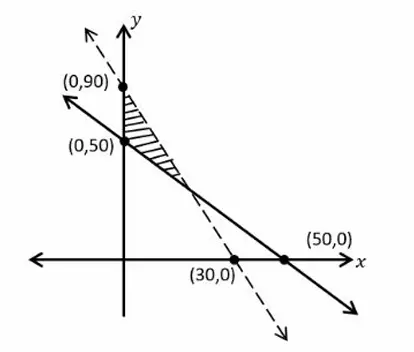 The constraints of this LPP are
Let $\begin{vmatrix} x & 2 \\ 18 & x \end{vmatrix} = \begin{vmatrix} -4 & -2 \\ -8 & -4 \end{vmatrix}$. Then (A) $x = -4$ (B) $x = -6$ (C) $x = 4$ (D) $x = 6$ Choose the correct answer from the options given below:
Match List-I with List-II | List-I | List-II | |---|---| | (A) Angle between $\hat{i} - \hat{j}$ and $\hat{i} + \hat{j}$ | (I) $\pi$ | | (B) Angle between $\hat{i} - \hat{j} + \hat{k}$ and $-\hat{i} + \hat{j} - \hat{k}$ | (II) $\frac{3\pi}{4}$ | | (C) Angle between $\hat{i} + \hat{j}$ and $-\hat{i}$ | (III) $\frac{\pi}{4}$ | | (D) Angle between $\hat{i} + \hat{k}$ and $\hat{k}$ | (IV) $\frac{\pi}{2}$ | Choose the correct answer from the options given below:
If A and B are square matrices of order 3 such that $|A| = 3$ and $|B| = -1$, then $|3AB|$ is equal to
For what value of k, the following system of equations has infinitely many solutions? $x + 2y = 5, 3x + ky = 15$
If $A = \begin{bmatrix} x+z & 2 & -3 \\ x & 0 & 4 \\ 3 & x-y & 0 \end{bmatrix}$ is a skew-symmetric matrix, then which of the following are true? (A) $y > z > x$ (B) $x > y$ (C) $x + y + z > 0$ (D) $z > x$ Choose the correct answer from the options given below:
Let $\vec{a}, \vec{b}$ be two vectors such that $|\vec{a}| = 2, |\vec{b}| = 3, \vec{a} \cdot \vec{b} = 4$, then $|\vec{a} - \vec{b}|$ is equal to
If $A = \begin{bmatrix} 0 & 0 & \sqrt{3} \\ 0 & \sqrt{3} & 0 \\ \sqrt{3} & 0 & 0 \end{bmatrix}$, then $|adj A|$ is equal to
The corner points of the feasible region associated with the LPP: Maximise $Z = px + qy$, $p,q > 0$ subject to $2x + y \leq 10$, $x + 3y \leq 15$, $x, y \geq 0$ are (0, 0), (5, 0), (3, 4) and (0, 5). If optimum value occurs at both (3, 4) and (0, 5), then
Bag A contains 2 unbiased and 3 biased coins whereas Bag B contains 3 unbiased and 2 biased coins. A bag is selected at random and 2 coins are taken out simultaneously. The probability, that both coins are unbiased is:
Let $F(z)$ be the cumulative density function of the standard normal variate $z$, then which of the following are correct? (A) $F(z) = \frac{1}{\sqrt{2\pi}} \int_{-\infty}^z e^{-\frac{z^2}{2}} dz$, $-\infty < z < \infty$ (B) $F(-z) = 1 - F(z)$ (C) $F(0) = 0$ (D) $F(\infty) = 1$ Choose the correct answer from the options given below:
Which of the following statements are correct in reference to the linear programming problem(LPP): Maximize ${Z} = 5x + 2y$ subject to the following constraints $3x + 5y \leq 15$, $5x + 2y \leq 10$, $x \geq 0, y \geq 0$. (A) The LPP has a unique optimal solution at $(2, 0)$ only. (B) The feasible region is bounded with corner points $(0, 0)$, $(2, 0)$, $(20/19, 45/19)$ and $(0, 3)$. (C) The optimal value is unique, but there are an infinite number of optimal solutions. (D) The feasible region is unbounded. Choose the correct answer from the options given below:
Let A be a non-singular matrix of order 3 and $|A| = 15$, then $|adj A|$ is equal to
Which one of the following set of constraints does the given shaded region represent? 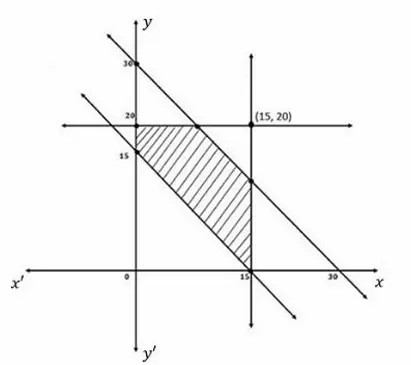
If A and B are skew-symmetric matrices, then which one of the following is NOT true?
The corner points of the feasible region of the LPP: Minimize $Z = -50x + 20y$ subject to $2x - y \geq -5$, $3x + y \geq 3$, $2x - 3y \leq 12$ and $x, y \geq 0$ are
Let $A = \begin{bmatrix} 1 & 2 & 1 \\ -1 & 3 & 2 \\ 2&4&1\end{bmatrix}$ and $M_{ij}$, $A_{ij}$ respectively denote the minor, co-factor of an element $a_{ij}$ of matrix A, then which of the following are true? (A) $M_{22} = -1$ (B) $A_{23} = 0$ (C) $A_{32} = 3$ (D) $M_{23} = 1$ (E) $M_{32} = -3$ Choose the correct answer from the options given below:
The number of all possible matrices of order $2 \times 3$ with entries -1 or 1 is
A lot of 50 watches is known to have 10 defective watches. If 8 watches are selected one by one with a replacement at random, then the probability that there will be at least one defective watch is:
If A and B are two invertible matrices, then which of the following statements are correct? (A) $|A^{-1}| = |A|^{-1}$ (B) $adjA = |A|A^{-1}$ (C) $(AB)^{-1} = A^{-1}B^{-1}$ (D) $(A + B)^{-1} = A^{-1} + B^{-1}$ Choose the **correct** answer from the options given below:
An urn I contains 3 white and 4 blue balls, while urn II contains 5 white and 6 blue balls. One ball is drawn at random from one of the urns and it is found to be white. The probability that it was drawn from urn II is
The minimum value of the objective function $z = x + 2y$ of an L.P.P. subject to constraints $2x + y \geq 3, \frac {x} {2} + 2y \geq 6, x \geq 0, y \geq 0$ is:
Match **List-I** with **List-II** Consider two vectors $\vec{a} = \hat{i} + 2\hat{j} - \hat{k}$ and $\vec{b} = -3\hat{i} - 6\hat{j} + 3\hat{k}$, then | List-I | List-II | |---|---| | (A) Angle between $\vec{a}$ and $\vec{b}$ is | (I) $\cos^{-1}\left(\frac{1}{\sqrt{6}}\right)$ | | (B) Angle between $\vec{a}$ and $x$-axis is | (II) $\cos^{-1}\left(\frac{2}{\sqrt{6}}\right)$ | | (C) Angle between $\vec{b}$ and $x$-axis is | (III) $\pi$ | | (D) Angle between $\vec{a}$ and $y$-axis is | (IV) $\cos^{-1}\left(-\frac{1}{\sqrt{6}}\right)$ | Choose the **correct** answer from the options given below:
Let $A = [a_{ij}]$ be a square matrix of order 3 with $|A| = 2$ and let $C = [c_{ij}]$ where $c_{ij} =$ cofactor of $a_{ij}$ in A. Then $|C|$ is equal to:
If $\det \begin{pmatrix} 2x & 5 \\ 8 & x \end{pmatrix} = \det \begin{pmatrix} 6 & -2 \\ 1 & 1 \end{pmatrix}$, then the value of $x$ is
One person speaks truth in 60% of the cases and another person in 80% of the cases. They are likely to agree in stating the same fact in
The standard deviation of the number of tails in three tosses of a coin is:
If $z = 3x + 4y$ be the objective function of a of a linear programming problem (LPP) and (3, 1), (2, 4), (0, 4), (5, 0) be corner points of the bounded feasible region. Then the maximum value of objective function is
If the corner points of the bounded feasible region for a Linear Programming Problem (LPP) are A(0,2), B(3, 0), C(2, 3) and D(3, 1), then the maximum value of the objective function $Z = 4x + 2y$ occurs at
Let A = $[a_{ij}]_{n \times n}$ be a matrix. Then Match List-I with List-II | List-I | List-II | | --- | --- | | (A) $A^T = A$ | (I) A is a singular matrix | | (B) $A^T = -A$ | (II) A is a non-singular matrix | | (C) $\vert A\vert = 0$ | (III) A is a skew symmetric matrix | | (D) $\vert A\vert \neq 0$ | (IV) A is a symmetric matrix | Choose the correct answer from the options given below:
Which of the following inequalities are NOT correct? (A) If $a > 1, b > 1,$ then $\log_b a + \log_a b \leq 2$ (B) For any real number $x, (9^x + 9^{1-x}) \geq 9$ (C) If $a,b,c$ are non-zero real numbers of the same sign, then $\left(\frac{a}{b} + \frac{b}{c} + \frac{c}{a}\right) \leq 3$ (D) If $a,b,c$ are three distinct real numbers, then $(a + b)(b + c)(c + a) \geq 8abc$ Choose the **correct** answer from the options given below:
If A and B are invertible matrices then which of the following statement is NOT correct?
If A and B are independent events, then which of the following statements are TRUE? (A) $P(A \cap B) = P(A).P(B)$ (B) $P(A \cap B) = P(A) - P(B)$ (C) $P(A \cup B) = P(A) + P(B) - P(A).P(B)$ (D) $P(A \cap B) = P(A). P(B|A)$ Choose the correct answer from the options given below:
Match List-I with List-II | List-I | List-II | |---|---| | Mathematical Statement | Value | | (A) $\hat{i} \cdot (\hat{j} \times \hat{k})$ | (I) $-\hat{k}$ | | (B) $\hat{j} \cdot (\hat{i} \times \hat{k})$ | (II) 1 | | (C) $\hat{i} \times (\hat{j} \times \hat{k})$ | (III) -1 | | (D) $\hat{j} \times \hat{i}$ | (IV) $\vec{0}$ | Choose the correct answer from the options given below:
If $|\vec{a}| = 1$, $|\vec{b}| = 2$, $|2\vec{a}+\vec{b}| = 2\sqrt{3}$ then $|\vec{a}-\vec{b}|$ is:
The corner points of the bounded feasible region determined by the system of linear inequalities are $(0, 0)$, $(2, 4)$, $(0, 5)$ and $(4, 0)$. If the maximum value of $z = ax + by$, where $a, b > 0$ occurs at both $(2, 4)$ and $(4, 0)$, then
Showing 500 of 744 questions.