Algebra PYQ
CUET UG Mathematics — Algebra previous year questions with solutions.
Browse by Year
Algebra at a glance
Questions per year
1106 across 5 yearsDifficulty mix
1106 total- easy276 · 25%
- medium788 · 71%
- hard42 · 4%
Subtopic-wise weightage
Breakdown of the 1101 Algebra questions tagged to a subtopic, by year — darker cells mean more questions.
| Subtopic | Weightage | Total | 2025 | 2024 | 2023 | 2022 |
|---|---|---|---|---|---|---|
| Matrices & Determinants | 38.9% | 428 | 299 | 13 | 52 | 64 |
| Probability | 25.4% | 280 | 179 | 11 | 21 | 69 |
| Linear Programming | 15.1% | 166 | 118 | 6 | 19 | 23 |
| Vector Algebra | 11.1% | 122 | 81 | 5 | 12 | 24 |
| Relations & Functions | 7.4% | 81 | 45 | 2 | 16 | 18 |
| Inequalities | 2.2% | 24 | 21 | 1 | 2 | |
| All subtopics | 1101 | 743 | 38 | 122 | 198 |
All Algebra Questions (1106)
If f(x) = 2x + 3, then f⁻¹(x) is:
A relation R in the set A = {1, 2,3, 4} is given by R = {(1,1), (2,2), (1,2), (2,3), (3,4), (4,4), (1,3), (2,4), (1,4)} is
If $P(A) = \frac{3}{5}$, $P(B) = \frac{1}{2}$ and $P(A \cap B) = \frac{1}{4}$, then $P(\overline{A} | \overline{B})$ is
The maximum value of a LPP $z = 3x + 4y$ subject to the constraints: $x + y \leq 6$, $x \geq 0$, $y \geq 0$ is:
Match List-I with List-II | List-I | List-II | |---|---| | (A) The number of possible matrices of order 3x3 with each entry 1 or 0 | (I) $2^4$ | | (B) The number of possible matrices of order 2x3 with each entry 1 or 0 | (II) $2^9$ | | (C) The number of possible matrices of order 2x3 with each entry 0,1,2 | (III) $2^6$ | | (D) The number of possible matrices of order 2x2 with each entry 1 or 0 | (IV) $3^6$ | Choose the correct answer from the options given below:
If $A = \begin{bmatrix} 4 & 5 \\ 2 & 1 \end{bmatrix}$ and $I$ is an identity matrix of order 2, then $A - 3I$ equals
In the given figure, feasible region represented by the constraints $4x + y \geq 80$, $x + 5y \geq 115$, $3x + 2y \leq 150$, $x,y \geq 0$ is 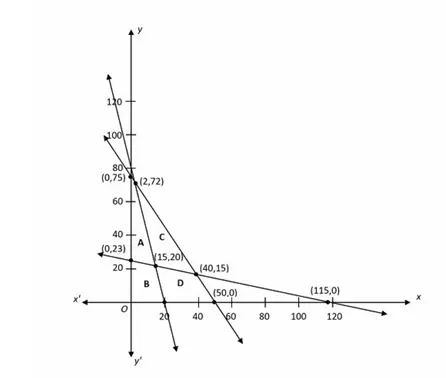
The projection of the vector $2\hat{i} - \hat{j} + 3\hat{k}$ on the vector $3\hat{i} + 2\hat{j} + 6\hat{k}$ is
Which of the following inequalities holds true? (A) $\sqrt{5} + \sqrt{3} > \sqrt{6} + \sqrt{2}$. (B) If $a > b$ and $c < 0$, then $\frac{a}{c} < \frac{b}{c}$. (C) $\frac{1}{x^2} > \frac{1}{x} > 1$, if $0 < x < 1$. (D) If $a$ and $b$ are positive integers and $\frac{a - b}{6.25} = \frac{4}{2.5}$, then $b > a$. Choose the correct answer from the options given below:
If a random variable y follows Poisson's distribution such that $P(X = 2) = 9 P(X = 4) + 90 P(X = 6)$, then sum of the mean and variance of X is
If $\vec{a}, \vec{b}, \vec{c}$ are vectors such that $\vec{a} + \vec{b} + \vec{c} = \vec{0}$ and $|\vec{a}| = 1, |\vec{b}| = 2, |\vec{c}| = 5$, then the expression $\vec{a}\cdot\vec{b} + \vec{b}\cdot\vec{c} + \vec{c}\cdot\vec{a}$ equals
Let $A$ and $B$ be square matrices of order 3, then det $[(A - A^T) + (B - B^T)]$ is equal to
If A is an invertible matrix of order 3 and the determinant of A is 9, then the determinant of $A^{-1}$ is:
A die is thrown 4 times and getting 3 is considered a success. The probability of 2 successes is:
Let $\vec{a} = \hat{i} + 4\hat{j} + 2\hat{k}$, $\vec{b} = 3\hat{i} - 2\hat{j} + 7\hat{k}$ and $\vec{c} = 2\hat{i} + \hat{j} + 4\hat{k}$. A vector $\vec{d}$ which is perpendicular to both $\vec{a}$ and $\vec{b}$, and $\vec{c} \cdot \vec{d} = 14$, is:
If A and B are symmetric matrices of the same order, then which one of the following is true?
The relation R in the set $\{1, 2, 3\}$ given by $R = \{(1, 1), (2, 2), (3, 3), (1, 2), (1, 3), (2, 3)\}$ is:
Match List-I with List-II If the random variable x has the following distribution: | x | 0 | 1 | 2 | otherwise | |---|---|---|---|-----------| | P(x) | k | k | 2k | 0 | | List-I | List-II | |---|---| | (A) k | (I) $\frac{3}{4}$ | | (B) P(x ≥ 2) | (II) $\frac{1}{4}$ | | (C) P(x ≤ 2) | (III) $\frac{1}{2}$ | | (D) P(0 < x ≤ 2) | (IV) 1 | Choose the correct answer from the options given below:
The corner points of the bounded feasible region for an LPP are (0, 20), (3,12), (6,8), and (0,15). The objective function is $Z = \alpha x + \beta y$, where $\alpha, \beta > 0$. If the maximum of Z occurs at the corner points (3,12) and (6,8), then the relationship between $\alpha$ and $\beta$ is:
Let $A$ be a non-singular square matrix of order $n$, then Match List-I with List-II | List-I | List-II | | --- | --- | | (A) $A(\text{adj} A)$ | (I) $\frac{1}{\vert A\vert }$ | | (B) $\vert \text{adj} A\vert $ | (II) $\vert A\vert ^n$ | | (C) $\vert A^{-1}\vert $ | (III) $\vert A\vert I$ | | (D) $\vert A(\text{adj} A)\vert $ | (IV) $\vert A\vert ^{n-1}$ | Choose the correct answer from the options given below:
If $\begin{bmatrix} x+y & 4 \\ 1+z & y \end{bmatrix} = \begin{bmatrix} 2 & 4 \\ 5 & 6 \end{bmatrix}$, then
Let A be a non-singular square matrix of order 3 and $|adj A| = 5$ then $|A|$ is equal to
The solution set of $6 \leq -3(2x - 4) < 12$, $x \in R$ is:
The number of all possible matrices of order $2 \times2$ with each entry $0, 1$ or $2$ are.