Algebra PYQ — Page 2
CUET UG Mathematics — Algebra previous year questions with solutions.
All Algebra Questions (1106)
If $|\vec{a}| = a$, then the value of $|\vec{a} \times \hat{i}|^2 + |\vec{a} \times \hat{j}|^2 + |\vec{a} \times \hat{k}|^2$ is
Let $f: \mathbb{R} \rightarrow \mathbb{R}$ be defined as $f(x) = [x]$, where [x] denotes the greatest integer less than or equal to x. Then which of the following statements are correct? (A) f is one-one but not onto (B) f is not onto (C) f is not one-one (D) f is one-one and onto Choose the correct answer from the options given below:
A person can sell a maximum of 20 units of shirts and pants on which a profit of ₹40 is made on each shirt and a profit of ₹30 on each pant. A minimum of 2 shirts are being sold, while pants are sold at least 4 times as many as shirts. Then the maximum profit is:
The function $f: [-1, 1] \rightarrow R$ (set of real numbers) given by $f(x) = \frac{x}{x+3}$ is
If the matrix $M = \begin{bmatrix} 0 & -1 & 3\alpha \\ 1 & \beta & -5 \\ -6 & 5 & 0 \end{bmatrix}$ is skew-symmetric, then
The point which provides the optimal solution of the linear programming problem maximize $z = 21x + 35y$ $3x + 2y \leq 30$ $4x + 5y \leq 60$ $x \geq 0, y \geq 0$ has the coordinates
The binomial distribution for which the mean is 5 and variance 4, is
Match List-I with List-II | List-I | List-II | | :--- | :--- | | **Type of matrix** | **Conditions** | | (A) Square matrix A | (I) $A = [a_{ij}]_{m \times m}$ where $\begin{cases} a_{ij} = 0 & , i \neq j \\ a_{ij} = k & , i = j \end{cases}$, where $k \neq 0$ is constant. | | (B) Scalar Matrix A | (II) $A = [a_{ij}]_{m \times m}$ | | (C) Diagonal matrix A | (III) $A = [a_{ij}]_{m \times m}$ where $\begin{cases} a_{ij} = 0 & , i \neq j \\ a_{ij} = 1 & , i = j \end{cases}$ | | (D) Identity matrix A | (IV) $A = [a_{ij}]_{m \times m}$ where $a_{ij} = 0$, $i \neq j$ | Choose the correct answer from the options given below:
The maximum value of the objective function $z = 2x + 3y$ of an L.P.P. subjected to the constraints $x - y \le 1$, $x + y \le 3$, $x, y \ge 0$ is
A can solve 90% problems and B can solve 70% problems of the book. A problem is selected at random from the book. The probability that the problem is solved, is equal to
For some constant 'k', if the system of linear equations $2x - y + 3z = 1$ $x - 2y + z = 3$ $kx + y - z = 0$ has a unique solution, then
The relation R on the set of real numbers defined by $R = \{(a, b): a \leq b^2\}$ is (A) Reflexive (B) Not symmetric (C) Neither reflexive nor transitive (D) Transitive Choose the correct answer from the options given below:
For the system of equations AX = B, which of the following is correct?
If $A = \begin{bmatrix} 2 & -2 & 1 \\ 0 & 4 & 2 \end{bmatrix}$ and $B = \begin{bmatrix} 1 & -2 & 7 \\ 2 & 0 & 6 \end{bmatrix}$ are two matrices such that $3A - 2B + 4C = 0$, then matrix $C$ is equal to:
If A and B are two events such that P(A) ≠ 0 and P(B | A) = 1 then
Let X denotes the number of heads in a simultaneous toss of three coins, then $P(0 < X < 3)$ is
The system of equation $2x + \lambda y = 8$, $\lambda x + 8y = 3$ has a unique solution if the value of $\lambda$ is (are):
A man is known to speak truth 3 out of 4 times. He throws a die and reports that it is four. The probability that it is actually four is
Let the random variable X represent the positive difference between the number of heads and the number of tails obtained when a coin is tossed 6 times. Then probability $P(X \leq 3)$ is equal to
If $x, y$ and $z$ are non-zero distinct numbers, then $\begin{vmatrix} x+y & y+z & z+x \\ z & x & y \\ 1 & 1 & 1 \end{vmatrix}$ is equal to
If $A = \begin{bmatrix} 1 & 2 \\ 4 & -3 \end{bmatrix}$ and $f(x) = 2x^2 - 4x + 5$, the $f(A)$ is equal to
The domain of the function $\cos^{-1}(2x - 3)$ is
If $\mathbb{Z}$ and $\mathbb{R}$ denote set of integers and set of real numbers respectively, then match List I with List II. | List-I | List-II | |---|---| | (A) $5x - 3 \leq 3x + 1$, $x \in \mathbb{Z}$ | (I) $x \in (-\infty, -3]$ | | (B) $3x + 17 \leq 2(1 - x)$, $x \in \mathbb{R}$ | (II) $x \in (-\infty, -1)$ | | (C) $13x + 17 \leq 2(1 - x)$, $x \in \mathbb{R}$ | (III) $\{......, -4, -3, .......,0,1\}$ | | (D) $\frac{2x + 3}{5} - 2 > \frac{3(x - 2)}{5}$, $x \in \mathbb{Z}$ | (IV) $\{......, -4, -3, -2\}$ | Choose the correct answer from the options given below:
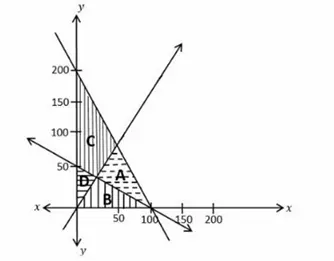
The feasible region represented by the constraints: $x + 2y \geq 100$, $2x - y \leq 0$, $2x + y \leq 200$, $x \geq 0$, $y \geq 0$ of an LPP is: