CUET UG 2023 — Algebra
Mathematics Algebra questions from CUET UG 2023.
Other Years
123 Algebra Questions from 2023
The number of ways to arrange the letters of the word "COMMITTEE" is:
If A is a square matrix of order 3, B = kA and |B| = $x$|A| then,
Which of the following graphs represent a function ?
The number of all onto functions from the set {1, 2, .......n} to itself is
The value of the determinant $\begin{vmatrix} a\cos\theta & b\sin\theta & 0 \\ -b\sin\theta & a\cos\theta & 0 \\ 0 & 0 & c \end{vmatrix}$ is :
If $A = \begin{bmatrix} 3 & 1 \\ -1 & 2 \end{bmatrix}$, then $A^2 - 5A + 7I =$
The unit vector in the direction of $\vec{a} + \vec{b}$ if $\vec{a} = 2\hat{i} - \hat{j} + 2\hat{k}$ & $\vec{b} = -\hat{i} + \hat{j} + -\hat{k}$ is :
The matrix $\begin{bmatrix} 2 & 0 & 0 \\ 0 & 1 & 0 \\ 0 & 0 & 1 \end{bmatrix}$ is a
If corner points of a feasible region are (0, 0), (2, 0), $\left(\frac{20}{19}, \frac{45}{19}\right)$ and (0, 3), then (A) Maximum value of $z = 5x + 3y$ is 10 (B) Minimum value of $z = 5x + 3y$ is 0 (C) Maximum value of $z = 5x + 3y$ is $\frac{235}{19}$ and minimum value is 0 (D) Maximum value of $z = 5x + 3y$ is 10 and minimum value is 0 Choose the correct answer from the options given below :
Let $\begin{vmatrix} 3x & -7 \\ 1 & 4 \end{vmatrix} = \begin{vmatrix} 3 & 2 \\ 4 & x \end{vmatrix}$, then value of $x$ is :
### Match List–I with List–II 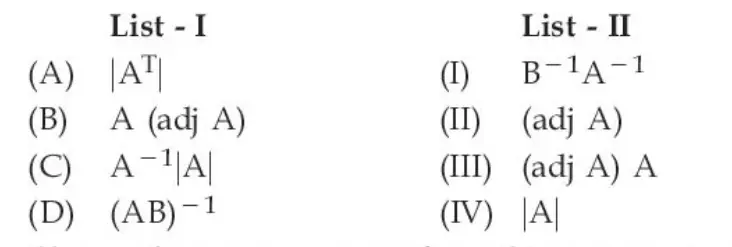 Choose the correct answer from the options given below
If $\begin{vmatrix} 2 & 3-x \\ x & 1 \end{vmatrix} = 0$, then the values of $x$ are:
Let $\vec{a}$ and $\vec{b}$ be two unit vectors. If the vectors $\vec{c} = 5\vec{a} - 4\vec{b}$ and $\vec{d} = \vec{a} + 2\vec{b}$ are perpendicular to each other, then the angle between $\vec{a}$ and $\vec{b}$ is :
If $A = \begin{pmatrix} \cos 2\theta & \sin 2\theta \\ -\sin 2\theta & \cos 2\theta \end{pmatrix}$, then $A^2 =$
If the matrix $A = \begin{bmatrix} x & -2 & -5y \\ 2 & 0 & -9 \\ 10 & 3z & 0 \end{bmatrix}$ is skew-symmetric, then the value of $(2x - 3y + 4z)$ is :
If $x, y$ & $z$ are non zero real numbers, the inverse of matrix $A = \begin{bmatrix} x & 0 & 0 \\ 0 & y & 0 \\ 0 & 0 & z \end{bmatrix}$ is :
The value of the determinant $\Delta = \begin{vmatrix} 1! & 2! & 3! \\ 2! & 3! & 4! \\ 3! & 4! & 5! \end{vmatrix}$ is :
If the matrix $A = \begin{bmatrix} 0 & x+y & 1 \\ 3 & z & 2 \\ x-y & -2 & 0 \end{bmatrix}$ is skew-symmetric, then :
If $\begin{vmatrix} 2x & 2 \\ 4 & x \end{vmatrix} = 10$, then $x$ is:
The probability that a student is not a swimmer is $\frac{1}{5}$. Then the probability that out of five students, four are swimmers is :
The value of $2y - 3x$, if $2\begin{bmatrix} x & 5 \\ 7 & y-3 \end{bmatrix} + \begin{bmatrix} 3 & -4 \\ 1 & 2 \end{bmatrix} = \begin{bmatrix} 7 & 6 \\ 15 & 14 \end{bmatrix}$ is :
If matrix $A = \begin{bmatrix} 3 & x \\ y & 0 \end{bmatrix}$ and $A' = A$, then :
The value of $\begin{vmatrix} \sqrt{3}/2 & 1/2 \\ \sqrt{3}/2 & 1/2 \end{vmatrix}$
Let the vectors $\vec{a} = \hat{i} - 3\hat{j} + 2\hat{k}, \vec{b} = 2\hat{i} + \hat{j} - \hat{k}$ and $\vec{c} = 3\hat{i} + 5\hat{j} - 2\lambda\hat{k}$ be coplanar. Then $\lambda$ is equal to
Let $f : R \to R$ defined by $f(x) = 2x^3 - 7$ for $x \in R$. Then : (A) $f$ is one-one function (B) $f$ is many to one function (C) $f$ is bijective function (D) $f$ is into function Choose the correct answer from the options given below :
A manufacturer can sell $x$ items at a price of Rs $3x+5$ each. The cost price of $x$ items is Rs $x^2 + 5x$. If x is the number of items she should sell to get no profit and no loss, then:
The programming problem Max $Z = 2x + 3y$ subject to the conditions $0 \leq x \leq 3, 0 \leq y \leq 4$ is :
The feasible region for a LPP is shown in the given figure. The maximum value of $z = 2x + 5y$ is :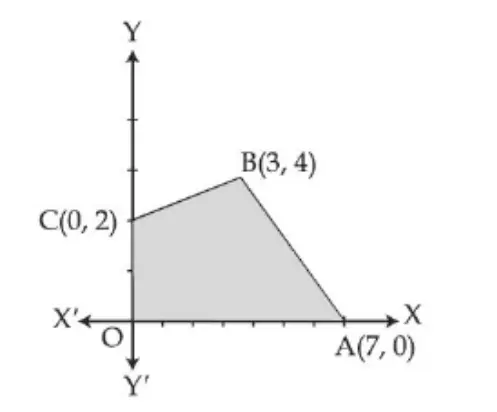
The number of square matrices of order 2 using numbers 1 and $-1$ exactly once and the number 0 twice is :
Let $A = [a_{ij}]$ be a $2 \times 2$ matrix such that $a_{ij} = \frac{|-3i+j|}{2}$ then $a_{21}$ is :
All points lying inside the triangle formed by the points (5, 0), (-1, 2) and (1, 3) satisfy : (A) $3x + 2y - 18 > 0$ (B) $3x + 2y > 0$ (C) $2x + y + 13 < 0$ (D) $2x - 3y - 12 < 0$ (E) $2x - 3y + 12 > 0$ Choose the **correct** answer from the options given below :
Let A be a square matrix of order 3 then |3A| is equal to
In a Linear Programming problem, the objective function is always :
The black and red die are rolled. The conditional probability of obtaining a sum greater than 9 given that the black die resulted in a 5 is :
If a fair coin is tossed 10 times, then the probability of obtaining at least one head is :
Relation R on Real Numbers is defined as $R = \{(a, b) : a \leq b\}$. The relation is :
The inverse of the function $f : R \to R$ given by $f(x) = 2x + 7$ is :
The position vector of a point R which divides the line joining two points P and Q whose position vectors are $\hat{i} + 2\hat{j} - \hat{k}$ and $-\hat{i} + \hat{j} + \hat{k}$ respectively in the ratio 2 : 1 externally is :
The random variable X has a probability distribution P(X) of the following form, where k is some number. $P(X=x) = \begin{cases} k, & \text{if } x=0 \\ 2k, & \text{if } x=1 \\ 3k, & \text{if } x=2 \\ 0, & \text{otherwise} \end{cases}$ Then $P(x \leq 2)$ is :
The matrix $A = \begin{bmatrix} 0 & 1 & -3 \\ -1 & 0 & 0 \\ 3 & 0 & 0 \end{bmatrix}$ is a
The linear constraints, for which the shaded area in the figure is the feasible region of an LPP, are :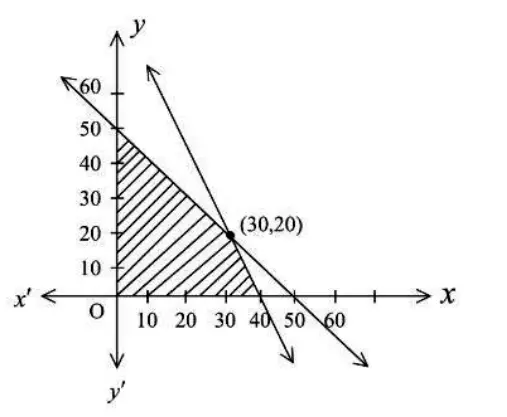
Let A = {1,2,3}. Consider the relation R = {(1,1),(2,2),(3,3),(1,2),(2,3),(1,3)}. Then R is
Match List I with List II | LIST I | LIST II | |---|---| | A. The area of parallelogram determined by vectors $2\hat{i}$ and $3\hat{j}$ | I. 2 | | B. The value of $(\hat{i} \times \hat{j}) \cdot \hat{k} + (\hat{j} \times \hat{k}) \cdot \hat{i}$ | II. 4 | | C. The value of a for which the vectors $2\hat{i} - 3\hat{j} + 4\hat{k}$ and $a\hat{i} - 6\hat{j} + 8\hat{k}$ are collinear. | III. 0 | | D. The value of $\lambda$ for which the vectors $2\hat{i} + \hat{j} + \hat{k}$ and $2\hat{i} - 4\hat{j} + \lambda\hat{k}$ are perpendicular | IV. 6 | Choose the correct answer from the options given below:
If three points $A(a_1, b_1), B(a_2, b_2)$ and $C(a_3, b_3)$ are collinear and $D = \begin{vmatrix} a_1 & b_1 & 1 \\ a_2 & b_2 & 1 \\ a_3 & b_3 & 1 \end{vmatrix}$, then:
Which of the following statements is NOT CORRECT.
The corner points of the feasible region determined by the system of linear constraints are (0, 0), (0, 40), (20, 40), (60, 20), (60, 0). The objective function is $z = 4x + 3y$. Compare the quantity in Column - A and Column - B. | Column - A | Column - B | |---|---| | Maximum value of z | 350 |
In a box containing 100 bulbs, 10 are defective. Then the probability, that out of a sample of 5 bulbs none is defective, is:
Two dice are thrown simultaneously. If X denotes the number of sixes, then the variance of X is:
The range of the function $f(x) = \frac{1}{3 - \sin 4x}$ is:
If $A = \begin{bmatrix} -2 & 6 \\ -5 & -1 \end{bmatrix}$ then $A^{-1}$ is :
If A is a square matrix of order 3 such that $|A|=2$, then the value of $|adj(adj A)|$ is :
Owner of a whole sale computers shop plans to sell 2 types of computers. A desktop and portable model. If $x$ is the number of desktops and $y$ is the number of portable model and the shop's capacity cannot exceed 250 units. Which of the following is correct ?
If $A = \begin{bmatrix} 1 & 2 \\ 4 & 2 \end{bmatrix}$, then the value of K for which $|2A| = K|A|$ is :
In a LPP, let R be the feasible region. A. If R is unbounded then a max./min. value of objective function may not exist. B. If R is bounded then a max. and min. value of objective function will always exist. C. If a solution exists, it must occur at a corner point. D. If R is bounded then max. will exist but min. may or may not exist for an objective function. Choose the correct answer from the options given below:
Match List - I with List - II. | List - I | List - II | |----------|-----------| | (A) The solution set of the inequality $-5x > 3$, $x \in R$, is | (I) $\left[\frac{20}{7}, \infty\right)$ | | (B) The solution set of the inequality is, $\frac{-7x}{4} \leq -5$, $x \in R$ is, | (II) $\left[\frac{4}{7}, \infty\right)$ | | (C) The solution set of the inequality $7x - 4 \geq 0$, $x \in R$ is, | (III) $\left(-\infty, \frac{7}{5}\right)$ | | (D) The solution set of the inequality $9x - 4 < 4x + 3$, $x \in R$ is, | (IV) $\left(-\infty, -\frac{3}{5}\right)$ | Choose the correct answer from the options given below :
If $\begin{bmatrix} 3 & 2x+5y & -2 \\ x+4y & 7 & -5 \end{bmatrix} = \begin{bmatrix} 3 & 10 & -2 \\ 2 & 7 & -5 \end{bmatrix}$ Then the values of $x$ and $y$ are :
The inverse of the matrix $A = \begin{bmatrix} 2 & 3 \\ 1 & 2 \end{bmatrix}$ is:
Let $\vec{a} = 4\hat{i} - \hat{j} + 3\hat{k}$ and $\vec{b} = -2\hat{i} + \hat{j} - 2\hat{k}$. Then (A) $\vec{a}$ is a unit vector (B) $\vec{a} \times \vec{b} = -\hat{i} + 2\hat{j} + 2\hat{k}$ (C) $\vec{a}$ and $\vec{b}$ are parallel vectors (D) $\vec{a}$ and $\vec{b}$ are neither parallel nor perpendicular vectors Choose the correct answer from the options given below :
Match List - I with List - II. | List - I | List - II | |----------|-----------| | (A) The common region determined by all the constraints of LPP is called | (I) objective function | | (B) Minimize $z = c_1x_1 + c_2x_2 + ..... + c_nx_n$ is | (II) convex set | | (C) A solution that also satisfies the non-negative restrictions of a LPP is called | (III) feasible region | | (D) The set of all feasible solutions of a LPP is a | (IV) feasible solution | Choose the correct answer from the options given below :
The set of value of $x$ for which the angle between the $\vec{a} = 2x^2\hat{i} + 4x\hat{j} + \hat{k}$ and $\vec{b} = 7\hat{i} - 2\hat{j} + x\hat{k}$ is obtuse is :
If $\begin{vmatrix} 3x & 4 \\ 7 & x \end{vmatrix} = \begin{vmatrix} 6 & 3 \\ 2 & 1 \end{vmatrix}$ then :
If A is a square matrix of order 3 and $|A| = 5$, then $|adj(adjA)|$ is :
Given $A = \begin{bmatrix} 2 & 3 \\ 1 & 4 \end{bmatrix}$ and $B = \begin{bmatrix} x & y \\ 1 & 4 \end{bmatrix}$, If $A = B$, then $x$ and $y$ are :
The mean number of heads in two tosses of a coin is :
Let $A = \begin{bmatrix} 1 & -2 & 3 \\ 1 & 2 & 1 \\ \lambda & 2 & -3 \end{bmatrix}$. If $A^{-1}$ does not exist, then $\lambda =$
Match List - I with List - II. | List - I | List - II | |---|---| | (A) If A and B are mutually exclusive events, then $P(A \cup B) =$ | (I) $\frac{P(A \cap B)}{P(B)}, P(B) \neq 0$ | | (B) If A and B are independent events, then $P(A \cap B) =$ | (II) $\frac{P(A \cap B)}{P(A)}, P(A) \neq 0$ | | (C) If A and B are two events of a sample space of an experiment, then $P(A/B) =$ | (III) $P(A) \cdot P(B)$ | | (D) If A and B are two events of a sample space of an experiment, then $P(B/A) =$ | (IV) $P(A) + P(B)$ | Choose the correct answer from the options given below :
If $|\vec{a}| = 3$ and $|\vec{b}| = 4$, then a value of $\lambda$ for which $\vec{a} + \lambda \vec{b}$ and $\vec{a} - \lambda \vec{b}$ are perpendicular is :
If $A = \begin{bmatrix} 1 & -2 & 3 \\ -4 & 2 & 4 \end{bmatrix}$ and $B = \begin{bmatrix} 1 & -2 \\ 3 & -4 \\ 2 & 4 \end{bmatrix}$ then product AB is :
The variance of number of heads in three tosses of a coin is :
The corner points of the feasible region determined by the following system of linear inequalities : $2x + y \leq 10$, $x + 3y \leq 15$, $x, y \geq 0$ are (0, 0), (5, 0), (3, 4) and (0, 5). Let $z = px + qy$, where $p, q > 0$ condition on p and q so that maximum of z occurs at both (3, 4) and (0, 5) is :
For the following probability distribution : | X | 1 | 2 | 3 | 4 | |---|---|---|---|---| | P(X) | 1/10 | 1/5 | 3/10 | 2/5 | $E(X^2)$ is equal to :
Which of the following statements is incorrect regarding matrices ? For any matrices A and B of suitable orders,
The mean of the number of heads in a simultaneous toss of three coins is :
Match **List - I** with **List - II**. | | List - I | | List - II | |---|---|---|---| | (A) | $f(x) = \frac{1}{x}, f : \mathbf{R} - \{0\} \to \mathbf{R} - \{0\}$ | (I) | neither injective nor surjective | | (B) | $f(x) = x^2, f : \mathbf{N} \to \mathbf{N}$ | (II) | surjective but not injective | | (C) | $f(x) = x^2, f : \mathbf{R} \to \mathbf{R}$ | (III) | injective but not surjective | | (D) | $f : \{1, 2, 3\} \to \{1, 2\}$ defined as $f : \{(1, 1), (2, 2), (3, 1)\}$ | (IV) | injective and surjective | Choose the **correct** answer from the options given below :
Match **List - I** with **List - II**. | | List - I | | List - II | |---|---|---|---| | (A) | Area of triangle $\Delta$ with adjacent sides $\vec{a}$ and $\vec{b}$ | (I) | $\vec{a} \times \vec{b}$ | | (B) | Area of parallelogram with adjacent sides $\vec{a}$ and $\vec{b}$ | (II) | $\frac{1}{2}\lvert \vec{a} \times \vec{b} \rvert$ | | (C) | $(\vec{a} - \vec{b}) \times (\vec{a} + \vec{b})$ | (III) | $\lvert \vec{a} \times \vec{b} \rvert$ | | (D) | $\lvert \vec{a} \rvert \lvert \vec{b} \rvert \sin\theta \hat{n}$, where symbols have their usual meaning | (IV) | $2(\vec{a} \times \vec{b})$ | Choose the **correct** answer from the options given below :
Which of the following statements are **correct** ? (A) $|A'| = |A|$, where A is the transpose of matrix A (B) If $A = [a_{ij}]_{3 \times 3}$, then $|4A| = 64|A|$ (C) $|A| = |\text{adj } A|^{n-1}$, where n is the order of the matrix (D) If A is an invertible matrix of order 2, then $\det(A^{-1})$ is equal to $\frac{1}{\det(A)}$ Choose the **correct** answer from the options given below :
If $\vec{a} = 5\hat{i} - \hat{j} - 3\hat{k}$ & $\vec{b} = \hat{i} - 3\hat{j} + 5\hat{k}$ the angle between $\vec{a} + \vec{b}$ and $\vec{a} - \vec{b}$ is :
The relation $R = \{(a, b) : a \leq b^2\}$ on the set of real numbers is:
Let $f(x) = x^3$ be a function with domain {0, 1, 2, 3} then domain of $f^{-1}$ is :
A manufacturing company makes two models M$_1$ and M$_2$ of a product. Each piece of M$_1$ requires 9 labour hours for fabricating and one labour hour for finishing. Each piece of M$_2$ require 12 labour hours for fabricating and 3 labour hours for finishing. For fabricating and finishing, the maximum labour hours available are 180 and 30 respectively. The company makes a profit of Rs.800 on each piece of M$_1$ and Rs.1200 on each piece of M$_2$ The maximum profit will be at the point
If $5x + y \leq 100$, $x + y \leq 60$, $x \geq 0$, $y \geq 0$. Then one of the corner points of the feasible region is :
If a, b and c are all different from zero and $\begin{vmatrix} 1+a & 1 & 1 \\ 1 & 1+b & 1 \\ 1 & 1 & 1+c \end{vmatrix} = 0$, then the value of $\frac{1}{a} + \frac{1}{b} + \frac{1}{c}$ is :
If a fair coin is tossed 10 times the probability of atleast 6 heads is:
Which one of the following options is incorrect? For a square matrix A in the matrix equation AX = B.
If $P = \begin{bmatrix} 1 & x & 3 \\ 1 & 3 & 3 \\ 2 & 4 & 4 \end{bmatrix}$ is the adjoint of 3x3 matrix A and $|A|$ is 4, then $x$ is equal to :
The value of $\begin{vmatrix} 1 & a & b+c \\ 1 & b & c+a \\ 1 & c & a+b \end{vmatrix}$ is
For the LPP Maximise $z = x + y$ subject to $x - y \leq -1$, $-x + y \leq 2$, $x, y \geq 0$, $z$ has :
If in a binomial distribution $n = 4$, $P(X=0) = \frac{16}{81}$, then $P(X=4)$ equals :
Let A = PQ. The elementary operation on A, that produces the same effect as it does on applying on P and keeping Q unchanged is : (A) $R_i \leftrightarrow R_j$ (B) $R_i \to R_i + KR_j$ (C) $C_i \to KC_i$ (D) $C_i \to C_i + KC_j$ Choose the **correct** answer from the options given below :
A and B throw a die alternatively till one of them gets a number more than 4 and wins the game. Then the probability of winning the game by B, if A starts first :
If the probability distribution of a random variable X is as given below : | X | -1 | 0 | 1 | 2 | 3 | |---|---|---|---|---|---| | P(X) | K | $\frac{1}{5}$ | 2K | $\frac{3}{10}$ | K | Then the value of K is :
The solution of a LPP with basic feasible solutions (0, 0), (10, 0), (0, 20), (10, 15) and objective function Max $Z = 2x + 3y$ is :
The order of a null matrix is :
A doctor is to visit a patient. It is known that the probabilities that he will come by train, bus, scooter or by other means of transport are respectively $\frac{3}{10}, \frac{1}{5}, \frac{1}{10}$ and $\frac{2}{5}$. The probabilities that he will be late are $\frac{1}{4}, \frac{1}{3}$ and $\frac{1}{12}$, if he comes by train, bus and scooter respectively, but if he comes by other means of transport, then he will not be late. When he arrives, he arrives late. The probability that he comes by bus is:
Probabilities to solve a specific problem by A, B and C are $\frac{1}{2}, \frac{1}{3}$ and $\frac{1}{4}$ respectively. Probability that at least one will solve the problem is:
Given relation $R = \{(x, y) : y = x + 5, x < 4, x, y \in N\}$. Where N is a set of natural numbers then :
Match List - I with List - II. If $A = \begin{vmatrix} 3 & -2 & 3 \\ 2 & 1 & -1 \\ 4 & -3 & 2 \end{vmatrix}$ | List - I | List - II | |----------|-----------| | (A) $M_{23}$ | (I) $-17$ | | (B) $A_{32} + a_{13}$ | (II) $-1$ | | (C) A | (III) 0 | | (D) $a_{13}A_{12} + a_{23}A_{22} + a_{33}A_{32}$ | (IV) 12 | Choose the correct answer from the options given below :
Let $A = \begin{bmatrix} 3 & -1 \\ 2 & 4 \end{bmatrix}$, then adjoint (A) is:
The area of the parallelogram determined by the vectors $\hat{i} + 2\hat{j} + 3\hat{k}$ and $3\hat{i} - 2\hat{j} + \hat{k}$ is
A coin is tossed 7 times. The probability of getting at least 4 heads is:
If $f(x) = \sqrt{x}$, $g(x) = 2x - 3$, then domain of $fog(x)$ is :
The feasible region of an LPP Max $Z = 3x + 2y$ subject to $x \geq 0, y \geq 0, x - 2y \leq 3$ is:
A manufacturing company makes two models M$_1$ and M$_2$ of a product. Each piece of M$_1$ requires 9 labour hours for fabricating and one labour hour for finishing. Each piece of M$_2$ require 12 labour hours for fabricating and 3 labour hours for finishing. For fabricating and finishing, the maximum labour hours available are 180 and 30 respectively. The company makes a profit of Rs.800 on each piece of M$_1$ and Rs.1200 on each piece of M$_2$ The above Linear Programming Problem [LPP] is given by
Choose the wrong statement from the following :
The feasible region for an LPP is shown below. Let $Z = 3x - 4y$ be the objective function. Maximum of Z occurs at : 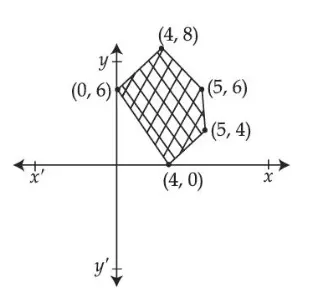
The set of values of K for which the system of equations $\begin{bmatrix} 2 & 3 & 1 \\ 4 & 5 & 0 \\ 1 & K & 3 \end{bmatrix} \begin{bmatrix} x \\ y \\ z \end{bmatrix} = \begin{bmatrix} 5 \\ 6 \\ 7 \end{bmatrix}$ gives a unique solution is :
If A and B are invertible matrices of order 3, $|A| = 2$ and $|(AB)^{-1}| = -\frac{1}{6}$, then the value of $|B|$ is :
Let A be the square matrix of order 3, then |kA|, where k is a scalar, is equal to:
The region represented by the system of inequalities $x, y \geq 0$ ; $2x + 3y \geq 4$ ; $x \geq 1$ is :
Urn I contains 6 red balls and 4 black balls and Urn II contains 4 red balls and 6 black balls. One ball is drawn at random from Urn I and placed in Urn II. If one ball is drawn at random from Urn II, then the probability that it is a red ball is :
If matrix A is of order $2 \times 3$ and B of order $3 \times 2$, then
If the matrix $A = \begin{bmatrix} \cos\theta & \sin\theta \\ -\sin\theta & \cos\theta \end{bmatrix}$, then $A^2$ is equal to:
If order of matrix A is $m \times p$ and order of matrix B is $p \times n$, then what is the order of matrix AB ?
If $f: R \to R$ is defined by $f(x) = \sin x + x$, then $f(f(x))$ is:
If a set P contains 5 elements and the set Q contains 8 elements, then the number of one-one functions from A to B is :
If the points (2, 1), $(-1, 4)$ and (a, 3) are collinear then the value/(s) of a is/(are) :
In $\triangle ABC$ :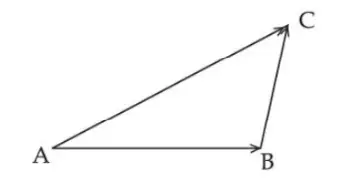 (A) $\vec{AB} + \vec{BC} + \vec{CA} = \vec{O}$ (B) $\vec{AB} + \vec{BC} - \vec{AC} = \vec{O}$ (C) $\vec{AB} + \vec{BC} - \vec{CA} = \vec{O}$ (D) $\vec{AB} - \vec{CB} + \vec{CA} = \vec{O}$ (E) $\vec{AB} - \vec{CB} - \vec{CA} = \vec{O}$ Choose the correct answer from the options given below :
The sum of the products of elements of any row with the cofactors of corresponding elements is equal to :
Let R be a relation on the set of natural numbers N defined by nRm if n divides m. Then R is : (A) Reflexive Relation (B) Symmetric Relation (C) Transitive Relation (D) Identity Relation Choose the **correct** answer from the options given below :
If A is a square matrix of order 3, then |adj A| is equal to:
In a meeting, 70% of the members favour and 30% oppose a certain proposal. A member is selected at random and we take X = 0 if he opposed, and X = 1 if he is in favour. Then, E (X) is :
Two cards are drawn simultaneously from a well shuffled pack of 52 cards. Then variance of the number of kings is
If $A = \begin{bmatrix} \cos\theta & \sin\theta & 0 \\ -\sin\theta & \cos\theta & 0 \\ 0 & 0 & 1 \end{bmatrix}$ and B is a square matrix of order 3, then |AB| is equal to: