CUET UG 2022 — Algebra
Mathematics Algebra questions from CUET UG 2022.
Other Years
199 Algebra Questions from 2022
The 10th term of AP: 3, 7, 11, 15, ... is
Match List I with List II: Given that A and B are invertible matrices of size $3 \times 3$ | List I | List II | |---|---| | A. $\lvert AB \rvert$ | I. $\frac{1}{\lvert A \rvert}$ | | B. $\lvert \operatorname{Adj} A \rvert$ | II. $\lvert A \rvert \lvert B \rvert$ | | C. $\lvert A^{-1} \rvert$ | III. $B^{-1} \cdot A^{-1}$ | | D. $(AB)^{-1}$ | IV. $\lvert A \rvert^2$ | Choose the correct answer from the options given below:
The value of the expression $\frac{x^2 + y^2}{x - y}$ is:
Which of the following figures shows a bijective function from set $X_1$ to set $X_2$ : 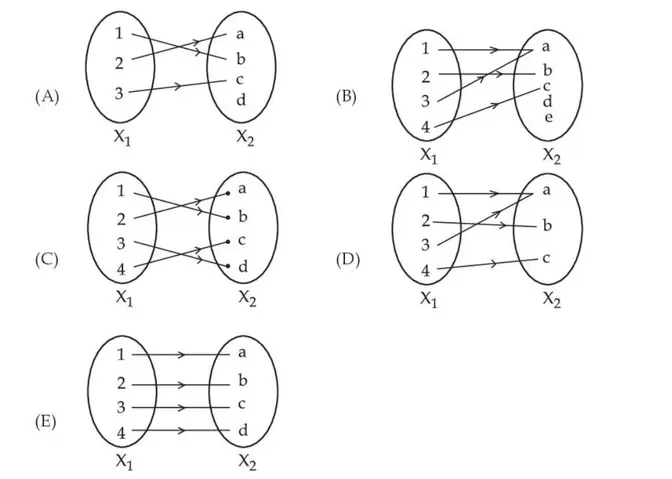 Choose the correct answer from the options given below :
If $\theta$ is the acute angle between two unit vectors $\vec{a}$ and $\vec{b}$, then $\cos\frac{\theta}{2} =$
When the doctor arrives late, what is the probability that he comes by other means of transport?
Which of the following statements are true? (A) $f:\mathbb{R} \to \mathbb{R}$ given by $f(x) = 3x$ is one-one onto. (B) $f:\mathbb{R} \to \mathbb{R}$ given by $f(x) = x^4$ is one-one and onto. (C) $f:\mathbb{Z} \to \mathbb{Z}$ given by $f(x) = x^2$ is neither one-one nor onto. (D) $f:\mathbb{R} \to \mathbb{R}$ given by $f(x) = |x|$ is neither one-one nor onto. (Where $\mathbb{R}$ is the set of all real numbers and $\mathbb{Z}$ is the set of all integers) Choose the correct answer from the options given below:
If $A = \begin{bmatrix} 1 & -1 & 1 \\ 1 & -2 & -2 \\ 2 & 1 & 3 \end{bmatrix}$ and square matrix $B$ satisfy $AB = 8I$, then the value of $|B|$ is:
Let L be the set of all lines in a plane and R be the relation in L defined as $R = \{(l_1, l_2) : l_1 \text{ is perpendicular to } l_2, \text{ where } l_1, l_2 \in L\}$. Choose the correct answer :
If $\begin{bmatrix} 2x-1 & -3 & 6 \\ 3 & 3y-2 & 4 \\ -6 & -4 & 4z-3 \end{bmatrix}$ is skew symmetric matrix, then $xyz$ is equal to
The set of all values of $\alpha$ for which the system of linear equations $x + y + z = 1$ $x + 2y + 4z = \alpha$ $x + 4y + 10z = \alpha^2$ is consistent, is
Bag I contains 3 red and 4 black balls while another Bag II contains 5 red and 6 black balls. One ball is drawn at random from one of the bags and it is found to be red. The probability that it was drawn from Bag II is :
The value $x$ is:
Let the matrix $A = \begin{bmatrix} 1 & 2 & 3 \\ 4 & 5 & 6 \end{bmatrix}$ and $AB = \begin{bmatrix} 5 & 6 & 7 \\ 8 & 9 & 10 \end{bmatrix}$ then order of B is :
Area of the rectangular plot is:
If $A = \begin{bmatrix} 6 & -8 \\ -2 & 5 \end{bmatrix}$ and $A^2 - 10A = C$ then C is equal to
If $\begin{vmatrix} -1 & a & a^2 \\ -1 & b & b^2 \\ -1 & c & c^2 \end{vmatrix}^2 = \lambda$ and $a - b = 1$, $b - c = 2$ and $c - a = 3$, then the value of $\lambda$ is
If $A = \begin{bmatrix} 1 & 2 & 3 \\ 2 & 1 & 4 \\ 3 & 2 & 1 \end{bmatrix}$, then which of the following is the value of $(\text{adj } A)^{-1}$
If $\vec{a} = \hat{i} - \hat{j} + \hat{k}$, $\vec{b} = 2\hat{i} + \hat{j} - 3\hat{k}$, $\vec{c} = 2\hat{i} - \hat{j} + 7\hat{k}$ and $\vec{a} \times (\vec{b} \times \vec{c}) = \lambda \vec{b} + \mu \vec{c}$ (When $\lambda$, $\mu$ are scalars), then the value of $\lambda + \mu$ is:
If $\vec{a}, \vec{b}$ and $\vec{c}$ are three unit vectors such that $\vec{a} + \vec{b} + \vec{c} = 0$, then the value of $\vec{a} \cdot \vec{b} + \vec{b} \cdot \vec{c} + \vec{c} \cdot \vec{a}$ is
The probability that the study time of students is at least 1 hour
The objective function for a L.P.P. is $Z = 5x + 7y$ and the corner points of the bounded feasible region are (0, 0), (7, 0), (3, 4) and (0, 2), then the maximum value of Z occurs at
If $A = \begin{bmatrix} 6 & 4 \\ 5 & 3 \end{bmatrix}$ and $B = adj(A)$, then $|B|$ is equal to:
A vector perpendicular to a plane containing a triangle ABC having vertices as $A(1,1,0)$, $B(2,1,1)$ and $C(0,3,2)$, is:
If $A = \begin{bmatrix} 2x & 0 \\ x & x \end{bmatrix}$ and $A^{-1} = \begin{bmatrix} 1 & 0 \\ -1 & 2 \end{bmatrix}$, then the value of $x$ is
The probability distribution of a discrete random variable X is given as : | x | 0 | 1 | 2 | 3 | 4 | |---|---|---|---|---|---| | P(X=x) | 0.1 | k | 2k | 2k | k | The value of K is:
If $\begin{vmatrix} (a-x)^2 & (a-y)^2 & (a-z)^2 \\ (b-x)^2 & (b-y)^2 & (b-z)^2 \\ (c-x)^2 & (c-y)^2 & (c-z)^2 \end{vmatrix} = \lambda(a-b)(b-c)(c-a) \cdot (x-y)(y-z)(z-x)$ then the value of $\lambda$ is:
The optimal value of linear programming problem maximum $Z = 3x + 4y$, subject to, $x + 3y \leq 12$ $x + y \geq 8$ $x, y \geq 0$ is
The breadth of plot is:
If A is a matrix of order $m \times n$ and B is another matrix such that $A'B$ and $BA'$ are both defined, then the order of matrix B is
The probability distribution of a random variable $X$ is | x | 0 | 1 | 2 | 3 | | --- | --- | --- | --- | --- | | P(X = x) | $\frac{1}{4}$ | $\frac{1}{8}$ | $\frac{1}{8}$ | $\frac{1}{2}$ | The variance of $X$ is
If $\vec{p} = \hat{i} + \hat{j} - 2\hat{k}$ and $\vec{q} = 2\hat{i} + \hat{j} - \hat{k}$, then the area of parallelogram having diagonals $(\vec{p} + \vec{q})$ and $(\vec{p} - \vec{q})$ is
The values of $x$ and $y$ in the equation $2\begin{bmatrix} x & 1 \\ 4 & -3 \end{bmatrix} + 3\begin{bmatrix} -2 & 1 \\ 2 & y-2 \end{bmatrix} = \begin{bmatrix} 2 & 5 \\ 14 & 3 \end{bmatrix}$ are respectively:
In Binomial distribution with parameters $n = 100$ and p, Variance of distribution is maximum when p is equal to :
The number of all possible matrices of order 3 x 3 with each entry belonging to the set {0, 1} is:
If $n(A) = 3$, $n(B) = 2$, then number of all possible surjective function from set A to set B are :
It is given that only 0.1% of a large population have COVID infection. In this population, the reliability of COVID RTPCR-test is specified as follows : For persons having COVID, 90% of the test detects the disease but 10% goes undetected. For persons not having COVID, 99% of the test is judged COVID negative but 1% are diagnosed as COVID positive. Based on the above informations, answer the question : The probability that the selected person will be diagonosed as COVID positive is :
Bag I contains 4 red and 5 black balls, while another Bag II contains 5 red and 6 black balls. One ball is drawn at random from one of the bags and it is found to be black. Then the probability that it was drawn from Bag II, is
A shopkeeper sells three types of flower seeds $A_1, A_2, A_3$. They are sold as a mixture where the proportions are 4 : 4 : 2 respectively. The germination rates of the three types of seeds are 45%, 60% and 35% respectively. Calculate the probability in the following cases. The probability of a randomly chosen seed to germinate is :
A shopkeeper sells three types of flower seeds $A_1, A_2, A_3$. They are sold as a mixture where the proportions are 4 : 4 : 2 respectively. The germination rates of the three types of seeds are 45%, 60% and 35% respectively. Calculate the probability in the following cases. The probability that seed will not germinate, given that the seed is of type $A_3$.
The number of all different possible matrices of order $2 \times 2$ with each entry $-1$, $0$ or $1$ is :
The constraints to the LPP are: A. $3x + 2y \leq 720$ B. $2x + 3y \leq 720$ C. $x + y \leq 300$ D. $x \geq 0$ and $y \geq 0$ E. $x + y \geq 300$ Choose the correct answer from the options given below:
The value of $k$ is
The probability distribution of number of doublets in three throws of a pair of dice is
Five numbers taken out from numbers 1-30 and arrange them in ascending order. The probability that the third number will be 20 is
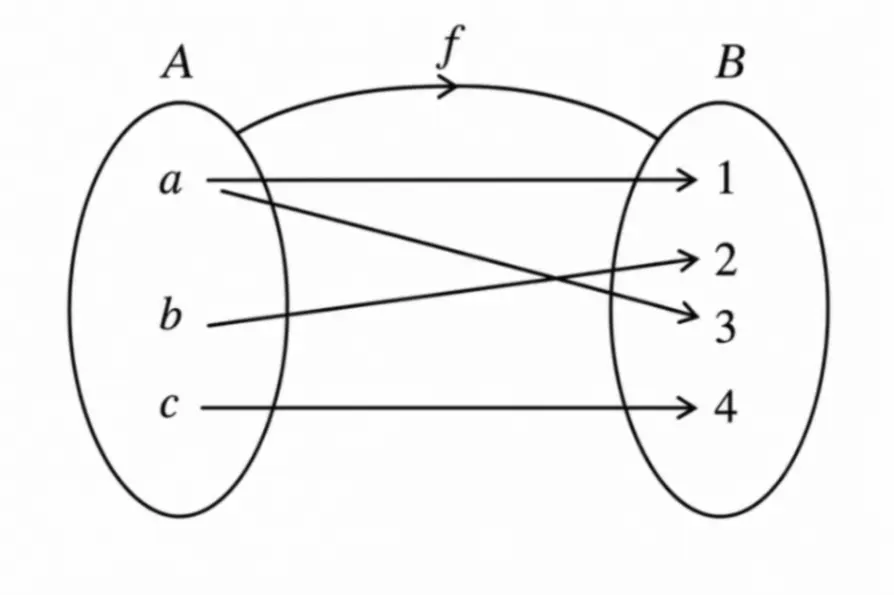Which of the following is true on the basis of above diagram?
A shopkeeper sells three types of flower seeds $A_1, A_2, A_3$. They are sold as a mixture where the proportions are 4 : 4 : 2 respectively. The germination rates of the three types of seeds are 45%, 60% and 35% respectively. Calculate the probability in the following cases. The probability that seed is not of type $A_1$, given that seed germinates.
The maximum profit per week is :
Two cards are drawn successively with replacement from a well shuffled deck of 52 cards. The probability distribution of the number of kings will be:
It is given that only 0.1% of a large population have COVID infection. In this population, the reliability of COVID RTPCR-test is specified as follows : For persons having COVID, 90% of the test detects the disease but 10% goes undetected. For persons not having COVID, 99% of the test is judged COVID negative but 1% are diagnosed as COVID positive. Based on the above informations, answer the question : The probability that randomly selected person from a population, not having COVID is :
In linear programming, the optimal value of the objective function is attained at the points given by
A shopkeeper sells three types of flower seeds $A_1, A_2, A_3$. They are sold as a mixture where the proportions are 4 : 4 : 2 respectively. The germination rates of the three types of seeds are 45%, 60% and 35% respectively. Calculate the probability in the following cases. The probability that seed is of type $A_1$ given that seed doesn't germinate.
If R is a relation on $A = \{a, b, c\}$ such that $R = \{(a,a), (b,b)\}$, which element/elements should be included to make R an equivalence relation. A. (c, c) B. (c, c), (a, c), (c, a) C. (a, b), (b, c), (a, c) D. (b, c), (c, c), (c, a), (b, a) Choose the correct answer from the options given below:
It is given that only 0.1% of a large population have COVID infection. In this population, the reliability of COVID RTPCR-test is specified as follows : For persons having COVID, 90% of the test detects the disease but 10% goes undetected. For persons not having COVID, 99% of the test is judged COVID negative but 1% are diagnosed as COVID positive. Based on the above informations, answer the question : The probability that the person is actually having COVID given that he is tested as COVID positive is :
If $R$ is a relation on $Z$ (set of all integers) defined by $xRy$, iff $|x - y| \leq 1$, then (a) $R$ is reflexive (b) $R$ is symmetric (c) $R$ is transitive (d) $R$ is not symmetric (e) $R$ is not transitive Choose the most appropriate answer from the options given below
The modulus function $f : R \to R$, given by $f(x) = |x|$, is :
If $3A = \begin{bmatrix} 1 & 2 & 2 \\ 2 & 1 & -2 \\ x & 2 & y \end{bmatrix}$ and $AA^T = I$, then $x + y$ is equal to
If the area of a triangle with vertices A(1,3), B(0,0) and C(k,0) is 3 sq. units, then k is:
Let $A$ and $B$ be two non-singular, square matrices of same order, and A. $(AB)^{-1} = B^{-1} \cdot A^{-1}$ B. $(A+B)^{-1} = B^{-1} + A^{-1}$ C. $adj. A = |A| \cdot A^{-1}$ D. $det(A^{-1}) = [det A]^{-1}$ Choose the correct answer from the options given below
If a fair coin is tossed 10 times, then the probability of getting all heads or all tails, is :
A feasible solution is :
The probability that the task is completed on time by none of them is
Match List - I with List - II. | | List - I (Two given vector) | | List - II (Projection of $\vec{a}$ on $\vec{b}$) | |---|---|---|---| | (A) | $\vec{a} = \hat{i} - \hat{j}$, $\vec{b} = \hat{i} + \hat{j}$ | (I) | $\frac{2}{\sqrt{5}}$ | | (B) | $\vec{a} = \hat{i} + \hat{j}$, $\vec{b} = 2\hat{i} - \hat{k}$ | (II) | 0 | | (C) | $\vec{a} = \hat{j} + \hat{k}$, $\vec{b} = \hat{i} + \hat{k}$ | (III) | $\sqrt{2}$ | | (D) | $\vec{a} = 2\hat{i} + 3\hat{j}$, $\vec{b} = \hat{i} - \hat{k}$ | (IV) | $\frac{1}{\sqrt{2}}$ | Choose the correct answer from the options given below :
The probability that task is completed on time by at least one of them is:
If a relation R is defined on the set $X = \{1, 2, 3, 4\}$ as $R = \{(1,1), (2,2), (3,4), (4,3)\}$, then R is
It is given that only 0.1% of a large population have COVID infection. In this population, the reliability of COVID RTPCR-test is specified as follows : For persons having COVID, 90% of the test detects the disease but 10% goes undetected. For persons not having COVID, 99% of the test is judged COVID negative but 1% are diagnosed as COVID positive. Based on the above informations, answer the question : The probability of the person to be tested as COVID positive, given that he is actually not having COVID is :
The angle between the vectors $\hat{i} - \hat{j}$ and $\hat{j} - \hat{k}$ is:
Objective function of LPP is:
A card is picked at random from a pack of 52 playing cards. If the picked card is a queen, then probability of card to be of spade type also, is
A function f: R $\to$ R is given by $f(x) = x^3 + 3$. If $f(x) = -24$, then the value of x is:
If A and B are square matrices of same order, then $A'B - B'A$ is a:
Let $R : \mathbb{R} \to \mathbb{R}$, where $\mathbb{R}$ is the set of real numbers and R be a relation. An element $(x, y) \in R$ if $x + y - \sqrt{2}$ belongs to the set of irrational numbers. Then the relation R is :
The number of possible matrices of order $2 \times 2$ with each entry $0$ or $1$ or $2$ is :
Consider an experiment of tossing 3 coins simultaneously. Define the following events: $E$ = [Three heads or three tails appear] $F$ = [At least two heads appear] and $G$ = [At most two heads appear] Choose the correct option:
In the family mother, father and son stand up at random for a family picture. Define following two events : $E$ = [Son stands at one of the two ends in the picture] $F$ = [Father stands in the middle of the picture] The value of $P(F/E)$ is :
The probability that a student knows the answer, is:
If answer is correct, the probability that he guesses, is :
The conditional probability that his answer is correct when it is given that he knew it :
The probability of answering a question correctly, is :
$\begin{vmatrix} a+b & 1 & 0 \\ a^2-b^2 & a-b & 1 \\ a^3+b^3 & a^2+b^2+ab & a^2-b^2 \end{vmatrix} =$
If $|\vec{a}| = 8$, $|\vec{b}| = 3$ and $|\vec{a} \times \vec{b}| = 12$, then the value of $\vec{a} \cdot \vec{b}$ is
A random variable X has the following probability distribution: | x | 1 | 2 | 3 | 4 | |---|---|---|---|---| | p(x) | 2k | 4k | 3k | k | The value of E(X) is:
A relation R = {(1,1),(2,2),(3,3),(1,2),(2,1),(1,3),(2,3)} on A = {1,2,3} will be an equivalence relation, if we delete: Choose the correct answer from the options given below:
If P and Q are symmetric matrices of same order, then $(PQ - QP)$ is
If A and B are square matrices of order 3 such that $|A| = 2$, $|B| = 3$, and $|2A \cdot \text{adj}(3(\text{adj}B))| = 2^\alpha \cdot 3^\beta$, then value of $\alpha + \beta$ is:
The type of feasible region and its corner points are. A. bounded B. unbounded C. (0,5), (2,4), (10,0) D. (0,8), (2,4), (4,0) E. (0,8), (2,4), (10,0) Choose the correct answer from the options given below:
The value of $P(E)$ is
The probability of 'the student knows the answer given that he answered it correctly' is
If $2 \begin{bmatrix} a & d \\ b & c \end{bmatrix} + 3 \begin{bmatrix} 1 & -1 \\ 0 & 2 \end{bmatrix} = 3 \begin{bmatrix} 3 & 5 \\ 4 & 6 \end{bmatrix}$, then the value of $|a + b - c - d|$ is
If the system of linear equations $x + 2y - 3z = 1$ $(2p+1)y + z = 2$ $3x + 3z = 5$ has a unique solution, then p can not be equal to
The probability that exactly two of them complete the task on time is
Value(s) of $x$ for which, $\begin{vmatrix} x & 1 \\ 5 & x \end{vmatrix} = \begin{vmatrix} 8 & 2 \\ 2 & 1 \end{vmatrix}$ is:
When the doctor arrives late, what is the probability that he comes by metro?
Match List I with List II | List I | List II | |---|---| | A. Range of $\lvert x\rvert$ | I. $(-5, \infty)$ | | B. Range of $9x^2 + 6x - 5$ for all $x \geq 0$ | II. $[0, \infty)$ | | C. Domain of $\dfrac{1}{\sqrt{x+5}}$ | III. $\{(1,1), (2,2), (3,3)\}$ | | D. Smallest equivalence relation on Set $\{1,2,3\}$ | IV. $[-5, \infty)$ | Choose the correct answer from the options given below:
If A is a square matrix of order 3 and $|adj A| = 49$, then $|7A^{-1}|^2$
Three urns contain 6 red, 4 black; 4 red, 6 black and 5 red, 5 black marbles respectively. One of the urns is selected at random and a marble is drawn from it. If the marble drawn is red, then the probability that it is drawn from the first urn is
Let $\vec{OA} = 2\hat{i} - \hat{j} + \hat{k}$ and $\vec{OB} = \hat{i} + \hat{j} - \hat{k}$. Then A. The magnitude of vector $\vec{OA}$ is 6 B. The magnitude of vector $\vec{OB}$ is $\sqrt{3}$ C. The vector $\vec{AB}$ is $(-\hat{i} + 2\hat{j} - 2\hat{k})$ D. $\vec{OA} \cdot \vec{OB} = 0$ E. $\vec{OA} \parallel \vec{OB}$ Choose the correct answer from the options given below:
If A and B are two independent events such that $P(A) = 0.4$, and $P(B) = 0.5$, then P (neither A nor B) is
The probability that the study time of students is at least 3 hours
If $x = \begin{vmatrix}1 & 2 & 3 \\ 2 & 3 & 1 \\ 3 & 1 & 2\end{vmatrix}$ then value of $9-2x$ is :
$[\vec{a} + \vec{b},\ \vec{b} + \vec{c}, \vec{a} + \vec{b} + \vec{c}]$ is equal to
Match List - I with List - II. | List - I | List - II | |---|---| | (A) Two events E and F will be independent if $P(E'F')$ is equal to | (I) $1 - P(E/F)$ | | (B) If $P(F) \neq 0$, then $P(E'/F)$ is equal to | (II) $P(E) = P(F)$ | | (C) If E and F are independent events, then | (III) $P(E \cap F') = P(E) \cdot P(F')$ | | (D) If $P(E \cap F) \neq 0$ and $P(E/F) = P(F/E)$, then | (IV) $[1-P(E)][1-P(F)]$ | Choose the correct answer from the options given below :
Match List - I with List - II. | List - I | List - II | |---|---| | (A) $\begin{bmatrix}0 & -5 & 9 \\ 5 & 0 & -3 \\ -9 & 3 & 0\end{bmatrix}$ | (I) Scalar matrix | | (B) $\begin{bmatrix}5 & 0 & 0 \\ 0 & 5 & 0 \\ 0 & 0 & 5\end{bmatrix}$ | (II) Diagonal matrix | | (C) $\begin{bmatrix}1 & 0 & 0 \\ 0 & -5 & 0 \\ 0 & 0 & 7\end{bmatrix}$ | (III) Symmetric matrix | | (D) $\begin{bmatrix}3 & -2 & 1 \\ -2 & -5 & 6 \\ 1 & 6 & 0\end{bmatrix}$ | (IV) Skew-symmetric matrix | Choose the correct answer from the options given below :
Match List - I with List - II. | List - I | List - II | |---|---| | (A) $A$ is a square matrix of order $3$ and $\lvert 2A \rvert = k\lvert A \rvert$, then $k$ is | (I) $0$ | | (B) Value of $\begin{vmatrix}1 & a & b+c \\ 1 & b & c+a \\ 1 & c & a+b\end{vmatrix}$ is | (II) $3$ | | (C) Matrix $\begin{bmatrix}5-x & x+1 \\ 2 & 4\end{bmatrix}$ is singular, then $x =$ | (III) $8$ | | (D) If $A = (a_{ij}) = \begin{bmatrix}5 & 3 & 8 \\ 2 & 0 & 1 \\ 1 & 2 & 3\end{bmatrix}$, then the minor of the element $a_{23}$ is | (IV) $7$ | Choose the correct answer from the options given below :
Which of the following relations on the set $A = \{1, 2, 3\}$ are equivalence ? (A) $R = \{(1,1), (2,2), (1,2), (2,1)\}$ (B) $R = \{(1,1), (2,2), (3,3)\}$ (C) $R = \{(1,1), (1,2), (2,1)\}$ (D) $R = \{(1,1), (2,2), (3,3), (1,2), (2,1), (2,3), (3,2), (1,3), (3,1)\}$ (E) $R = \{(1,1), (2,2), (3,3), (1,2)\}$ Choose the correct answer from the options given below :
In a hospital, there are 300 patients, out of which 120 are female. It is known that out of 120 females, 10% of the patients are below 40 years of age. What is the probability that a patient chosen randomly is below 40 yrs of age given that the chosen patient is a female.
It is given that only 0.1% of a large population have COVID infection. In this population, the reliability of COVID RTPCR-test is specified as follows : For persons having COVID, 90% of the test detects the disease but 10% goes undetected. For persons not having COVID, 99% of the test is judged COVID negative but 1% are diagnosed as COVID positive. Based on the above informations, answer the question : The probability of the person tested as COVID positive, given that he is actually having COVID is :
If A is a square matrix of order 3 and $|A|$ is 2, then value of $|adj(A)|$ is :
The number of all possible non-singular matrices of order $2 \times 2$ with each entry 0 or 1 is :
Let X be a discrete random variable and probability distribution X is | X | $-1$ | 0 | 1 | |---|---|---|---| | P(X) | $\frac{1}{2}$ | $\frac{1}{5}$ | $\frac{3}{10}$ | Then E(X) is equal to :
A shopkeeper sells three types of flower seeds $A_1, A_2, A_3$. They are sold as a mixture where the proportions are 4 : 4 : 2 respectively. The germination rates of the three types of seeds are 45%, 60% and 35% respectively. Calculate the probability in the following cases. The probability that seed is of type $A_2$ given that seed germinate.
The probability that he copied it given that his answer is correct :
The length ($x$) and breadth ($y$) of plot satisfy equations:
The area of the parallelogram whose adjacent sides are determined by the vectors $\vec{a} = \hat{i} - \hat{j} + 3\hat{k}$ and $\vec{b} = 2\hat{i} - 7\hat{j} + \hat{k}$ is :
The corner points of feasible region are: A. (0, 240) B. (0, 0) C. (300, 0) D. (120, 180) E. (180, 120) Choose the correct answer from the options given below:
If $\vec{a} = a_1\hat{i} + a_2\hat{j} + a_3\hat{k}$ and $\vec{b} = b_1\hat{i} + b_2\hat{j} + b_3\hat{k}$ are two non zero vectors inclined at an angle $\theta$, then identify the correct option out of the given options. (a) $\cos\theta = \frac{\vec{a} \cdot \vec{b}}{|\vec{a}| \cdot |\vec{b}|}$ (b) $\vec{a}$ and $\vec{b}$ are perpendicular, if $a_1 b_1 + a_2 b_2 + a_3 b_3 = 0$ (c) $\vec{a}$ and $\vec{b}$ are perpendicular, if $\frac{a_1}{b_1} = \frac{a_2}{b_2} \neq \frac{c_1}{c_2}$ (d) for $\theta = \pi$, $\vec{a} \times \vec{b} = 0$ (e) $\cos\theta = \frac{|\vec{a} \times \vec{b}|}{|\vec{a}| \cdot |\vec{b}|}$ Choose the most appropriate answer from the options given below
The probability that exactly one of them complete the task on time is
If the objective function for an LPP is max.$(z) = 300x + 700y$ and the corner points for the bounded feasible region are $(6,0)$ $(5,0)$ $(0,6)$ $(4,4)$ and $(0,4)$, then the maximum values of z occurs at :
If $-3 \leq k \leq 1$ and $|\vec{a}| = 2$ then $|k\vec{a}|$ is
The maximum value of $z = 4x + 3y$, if the feasible region for an LPP is as shown below is: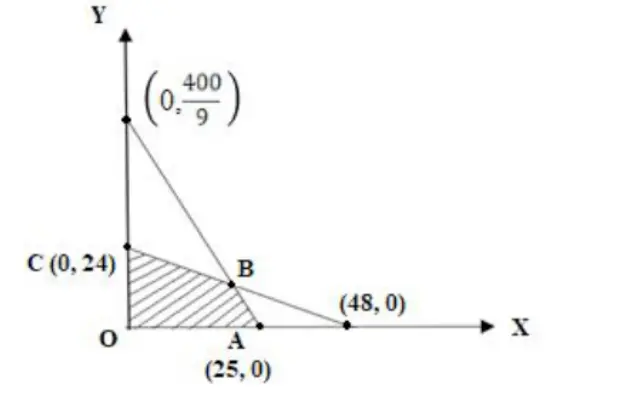
A manufacturer of electronic circuit has a stock of 200 resistors, 120 transistors and 150 capacitors and is required to produce two types of circuits A and B. Type A requires 20 resistors, 10 transistors and 10 capacitors. Type B requires 10 resistors, 20 transistors and 30 capacitors. If the profit on type A circuit is Rs. 50 and that on type B circuit is Rs. 60, identify the constraints for this LPP, if it was assumed that x circuit B of type A and y circuits of type B was produced by the manufacturer. A. $x + 2y \geq 15$ B. $2x + y \leq 20$ C. $x + 2y \leq 12$ D. $x, y \leq 0$ Choose the correct answer from the options given below
If $\vec{a}$ is a unit vector and $(\vec{x} - \vec{a}) \cdot (\vec{x} + \vec{a}) = 8$ then $|\vec{x}|$ is
Arrange the vectors in descending order of their magnitudes. (A) $\hat{i} + \hat{j} + \hat{k}$ (B) $2\hat{i} - 3\hat{j}$ (C) $\frac{1}{2}\hat{i} - \frac{1}{3}\hat{j}$ (D) $2\hat{i} - \hat{k}$ Choose the correct answer from the options given below :
It is given that student marked the answer correctly, the probability that he guesses is
The vertices of a closed convex polygon representing the feasible region of the LPP with, objective function $z = 5x + 3y$ are $(0, 0)$, $(3, 1)$, $(1, 3)$ and $(0, 2)$. The maximum value of $z$ is
The solution of LPP max.(z) = $5x + 3y$ subject to $2x + y \leq 6$ $x + y \leq 4$ $x \geq 0, y \geq 0$, is
The unit vector in the direction of the sum of vectors $\vec{a} = 2\hat{i} + 2\hat{j} - 5\hat{k}$ and $\vec{b} = 2\hat{i} + \hat{j} + 3\hat{k}$ is :
If $|\vec{a}| = |\vec{b}| = |\vec{a} + \vec{b}| = 1$, then $|\vec{a} - \vec{b}|$ is equal to:
The linear equation involving $x$ and $y$ are written in matrix form as:
The probability that B alone complete the task on time is:
Let $A = (a_{ij})$ and $B = (b_{ij})$ are square matrices of same order. (A) The number of possible matrices of order $2 \times 2$ with entries $-1, 0, 1$ is 81. (B) $A + A'$ is skew symmetric matrix (C) $A \cdot A^{-1} = 0$, $|A| \neq 0$ (D) A is skew symmetric matrix if $a_{ij} = -a_{ji}$ for all $i, j$ (E) $(AB)' = A'B'$ Choose the correct answer from the options given below :
The corner points of the feasible region determined by inequalities of LPP are $(4, 10)$, $(6, 8)$ and $(6, 5)$. Let $z = 3x + 4y$ be the objective function. Then the sum of maximum value of z and minimum value of z is :
The equation of the line passing through (-2, 3, 4) and parallel to the vector $2\hat{i} - \hat{j} + \hat{k}$ is:
If $|\vec{a}| = 3|\vec{b}|$, $|\vec{b}| = 2$ and angle between $\vec{a}$ and $\vec{b}$ is $60^\circ$, then $|\vec{a} - \vec{b}|$ is equal to:
Let A be a non singular square matrix of $2 \times 2$. Then, $|adj\ A|$ is equal to
If $A$ and $B$ are independent events such that $0 < P(A) < 1$ and $0 < P(B) < 1$, then identify the correct statements. (A) $A$ and $B'$ are independent (B) $A'$ and $B$ are independent (C) $A$ and $B$ are mutually exclusive (D) $A'$ and $B'$ are independent Choose the correct answer from the options given below :
The optimal solution of the Linear Programming problem Maximize $Z = 3x_1 + 5x_2$, s.t. $3x_1 + 2x_2 \leq 18$ $x_1 \leq 4$ $x_2 \leq 6$ $x_1 \geq 0, x_2 \geq 0$ is
Let $f : [2, \infty) \to \mathbf{R}$ be a function defined by $f(x) = x^2 - 4x + 5$. The range of $f$ is :
Let $\vec{a} = 2\hat{i} + 3\hat{j} - 4\hat{k}$ and $\vec{b} = 3\hat{i} - 5\hat{j} + 6\hat{k}$. Let $\vec{c}$ be a vector such that $\vec{c} \times \vec{a} = \vec{b} \times \vec{c}$ and $\vec{c}\cdot(2\vec{a}-3\vec{b}) = 238\sqrt{2}$ then $|\vec{c}|^2$ is equal to :
When the doctor arrives late, what is the probability that he comes by bike?
The feasible region and optimal solution of a LPP with objective function, max.$(z) = 600x + 400y$, subject to : $x + 2y \leq 12$, $2x + y \leq 12$, $x + 1.25y \geq 5$, $x \geq 0$ and $y \geq 0$, is: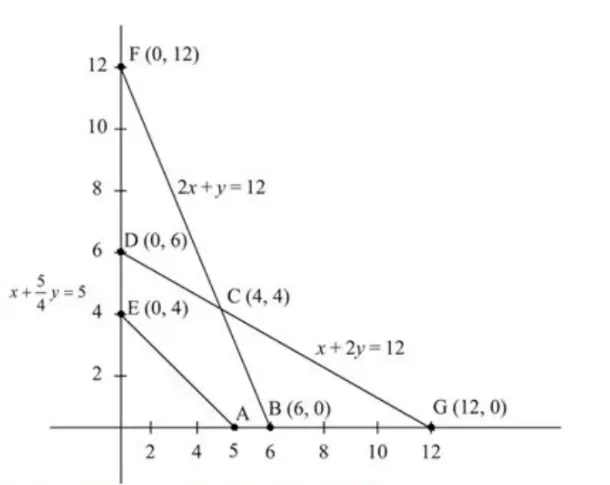 The feasible region and optimal solution is _____
Match List - I with List - II. | List - I | List - II | |---|---| | (A) The value of $\hat{i}\cdot(\hat{j}\times\hat{k}) + \hat{j}\cdot(\hat{i}\times\hat{k}) + \hat{k}\cdot(\hat{i}\times\hat{j})$ | (I) 16 | | (B) If $\lvert\vec{a}\rvert=10$, $\lvert\vec{b}\rvert=2$ and $\vec{a}\cdot\vec{b}=12$, then the value of $\lvert\vec{a}\times\vec{b}\rvert$ is | (II) $\frac{\pi}{4}$ | | (C) If $\theta$ is the angle between two vectors $\vec{a}$ and $\vec{b}$, then the value of $\theta$, for which $\vec{a}\cdot\vec{b} = \lvert\vec{a}\times\vec{b}\rvert$ is | (III) 14 | | (D) If $\vec{a}$ and $\vec{b}$ are perpendicular and $\vec{a} = 2\hat{i}+4\hat{j}+\lambda\hat{k}$ and $\vec{b} = 3\hat{i}-5\hat{j}+\hat{k}$, then the value of $\lambda$ is | (IV) 1 | Choose the correct answer from the options given below :
The value of $P(E/E_1)$ is
The probability that the study time of students is not more than one hour.
The feasible solution to the LPP is-
Choose the correct statement A. If any two rows or any two columns are identical or proportional, then value of determinant is Zero. B. Minor of an element $a_{ij}$ of the determinant of matrix A is the determinant obtained by deleting $i^{th}$ row and $j^{th}$ column C. If $A = \begin{bmatrix} 1 & 5 \\ 6 & 7 \end{bmatrix}$, then A is Skew-symmetric matrix D. If $A = \begin{bmatrix} 1 & 2 \\ 4 & 5 \end{bmatrix}$, then $(A + A')$ is Symmetric matrix E. If $|A| = 0$, then A is non-singular matrix
Match List - I with List - II. | | List - I | | List - II | |---|---|---|---| | (A) | $A = \begin{bmatrix} 6 & 9 \\ 2 & 3 \end{bmatrix}$, $B = \begin{bmatrix} 2 & 6 & 0 \\ 7 & 9 & 8 \end{bmatrix}$, AB will be | (I) | $\begin{bmatrix} 75 & 117 & 72 \\ 35 & 39 & 24 \end{bmatrix}$ | | (B) | $P = \begin{bmatrix} 8 & 45 & 30 \\ 17 & 19 & 5 \end{bmatrix}$, $Q = \begin{bmatrix} 67 & 72 & 42 \\ 8 & 30 & 19 \end{bmatrix}$, P+Q will be | (II) | $\begin{bmatrix} 75 & 117 & 72 \\ 25 & 39 & 24 \end{bmatrix}$ | | (C) | $\begin{bmatrix} 85 & 42 & 69 \\ 73 & 42 & 50 \end{bmatrix} - \begin{bmatrix} 10 & -75 & -3 \\ 38 & 3 & 26 \end{bmatrix}$ | (III) | $\begin{bmatrix} 75 & 117 & 72 \\ 25 & 49 & 24 \end{bmatrix}$ | | (D) | $2 \begin{bmatrix} 34 & 36 & 30 \\ 12 & 18 & 20 \end{bmatrix} + \begin{bmatrix} 7 & 55 & 12 \\ 1 & 13 & -16 \end{bmatrix}$ | (IV) | $\begin{bmatrix} 75 & 127 & 72 \\ 25 & 49 & 24 \end{bmatrix}$ | Choose the correct answer from the options given below :
If the matrix $\begin{bmatrix} 0 & -1 & 3x \\ 1 & y & -5 \\ -6 & 5 & 0 \end{bmatrix}$ is skew-symmetric, then
If $A = \begin{bmatrix} 0 & 2 & -3 \\ y & 0 & -1 \\ z & x & 0 \end{bmatrix}$ is skew symmetric matrix, then $x^3 + y^3 + z^3 - 3xyz$ is equal to :
When the doctor arrives late, what is the probability that he comes by cab?
The constraints are - A. $2x + y \leq 8$ B. $2x + y \geq 8$ C. $x + 2y \leq 10$ D. $x + 2y \geq 10$ E. $x, y \geq 0$ Choose the correct answer from the options given below:
If two numbers are selected at random from the first 25 natural numbers, then the probability that their sum will be odd is:
Read the following statements carefully: A. Determinant is a square matrix B. If A be any given square matrix of order n, then $A(\text{adj}A) = (\text{adj}A)A = |A|I$. C. If A and B are nonsingular matrices of the same order, then AB and BA are also nonsingular matrices of the same order. D. If A is a nonsingular matrix, then its inverse does not exist Which of the above statements are true? Choose the correct answer from the options given below:
If A and B are two independent events with $P(A) = \frac{1}{5}$ and $P(B) = \frac{1}{3}$, then $P(A'/B)$ is:
The value of $y$ is
The length of the plot is:
If $A=\begin{bmatrix}2 & 0 & 0 \\ -1 & 2 & 3 \\ 3 & 3 & 5\end{bmatrix}$, then $A(\text{adj } A)$ is equal to :
The objective function (z) to maximize the profit is:
Three friends A, B and C are playing with a pair of dice. They throw two dice alternately. Coming of a doublet on two dice leads to a success and the game stops. If A starts the game, then the probability of his winning, is :
If an unbiased coin is tossed 10 times, probability of obtaining more head than tail is :
If $0 < x < \pi$ and the matrix $\begin{bmatrix} 4\sin x & -1 \\ -3 & \sin x \end{bmatrix}$ is singular, then the values of $x$ are :
If $\vec{a}$ and $\vec{b}$ are two perpendicular vectors such that $|\vec{a}| = 3$, $|\vec{b}| = 4$ and $\theta$ is the angle between $\vec{a}$ and $(\vec{a} - \vec{b})$, then $\cos\theta$ is equal to:
In a triangle, $\triangle ABC$, the sides AB and AC are represented by vectors $\hat{i} + \hat{j} + \hat{k}$ and $2\hat{i} - \hat{k}$ respectively. The length of median drawn from vertex A to BC is:
If $x-y=2$ and $y-z=3$ then value of $\begin{vmatrix}1 & x & x^2 \\ 1 & y & y^2 \\ 1 & z & z^2\end{vmatrix} =$
Which is the most suitable definition for random variable among the options given below:
If P is matrix of order $m \times n$ and Q is a matrix such that PQ' and Q'P are both computable, then the order of matrix Q is
Consider the linear programming problem : Minimize $z = 50x + 70y$ Subject to $2x+y \geq 8$, $x+2y \geq 10$, $x \geq 0$, $y \geq 0$ The minimum value of objective function is :
Two numbers are selected at random (without replacement) from the first three positive integers. Let $X$ denotes the larger of the two integers, then the probability distribution of $X$ is
Bag A contains 2 red and 3 white balls, Bag B contains 3 red and 2 white balls. If a ball is drawn at random and is found to be red, then the probability that it was drawn from bag B, is :
The matrix $\begin{bmatrix} 4 & 0 & 0 \\ 0 & 4 & 0 \\ 0 & 0 & 4 \end{bmatrix}$ is: A. a square matrix B. a scalar matrix C. a diagonal matrix D. an identity matrix Which of the above statements are true? Choose the correct answer from the options given below:
The random variable $X$ has a probability distribution $P(X=x) = \begin{cases} 5k, & x=0 \\ 2k, & x=1 \\ 3k, & x=2 \\ 0, & \text{otherwise.} \end{cases}$ Then, the value of $E(X)$ is :
The Relation $R = \{(x, y) : x \leq y^2\}$ defined on the set $\mathbf{R}$ of Real numbers is : (A) reflexive but not symmetric (B) neither reflexive nor symmetric (C) neither reflexive nor transitive (D) reflexive but not transitive (E) not reflexive but symmetric Choose the correct answer from the options given below :
If $2\begin{bmatrix}3 & 4 \\ 5 & x\end{bmatrix} + \begin{bmatrix}1 & y \\ 0 & 1\end{bmatrix} = \begin{bmatrix}7 & 0 \\ 10 & 5\end{bmatrix}$, then the value of $x-y$ is :
If A and B are square matrices of same order n, then identify correct statements from the statements given below: A. $|adj\ A| = |A|^{n-1}$ B. $|A \cdot B| = |B| \cdot |A|$ C. $adj\ A' = (adj\ A)'$ D. $adj\ AB = (adj\ A) \cdot (adj\ B)$ E. $|A^n| = |A|^n$ Choose the correct answer from the options given below:
The probability that a question is guessed by a student and found to be correct is.
If $A$ is square matrix of order 3 and $A \cdot (Adj.(A)) = 10I$, then the value of $\frac{1}{25}|Adj.(A)|$ is
Assume $P$, $Q$, $R$ and $S$ are matrices of order $2 \times m$, $k \times n$, $m \times 2$ and $2 \times 3$ respectively. The restrictions on $k$, $m$ and $n$, so that $PQ + RS$ is defined are
If the mean and variance of a binomially distributed random variable X are 4 and 2 respectively, then $P(X = 2)$ is equal to
The system of equations $3x + 4y = 5$, $6x + 7y = -8$ is written in matrix form as
Let A and B be square matrices of order 3 and k is a constant. If $|A| \neq 0$ and $|B| \neq 0$, where $|A|$ represents the determinant of A, then which of the following statements are true ? (where A' denotes the transpose of matrix A) (A) $(AB)^{-1} = B^{-1} A^{-1}$ (B) $(A+B)' = A' \times B'$ (C) $(AB)' = A'B'$ (D) $|kA| = k^3 |A|$ (E) $|A'| = |A|$ Choose the correct answer from the options given below :
If $A$ is a skew-symmetric matrix and $n$ is an odd positive integer, then $A^n$ is :
The equations in terms of $x$ and $y$ are:
The value of $\hat{i} \cdot (\hat{k} \times \hat{j}) + \hat{j} \cdot (\hat{i} \times \hat{k}) + \hat{k} \cdot (\hat{j} \times \hat{i})$ is
There are three identical boxes I, II and III, each containing two balls. In box I, both balls are red, In box II, both balls are blue and box III contains one blue ball and one red ball. A boy randomly chooses a box and takes out a ball at random from it. If the ball is red, then the probability that the other ball in the box is also red colour is:
What is the probability that the doctor arrives late ?
Identify the correct statements. (A) If $A$ is a non-singular matrix, then $A^{-1} = \frac{|A|}{(\text{adj } A)}$ (B) If $A$ is an invertible matrix then $\frac{1}{|A^{-1}|} = |A|$ (C) If $A$ and $B$ are two invertible matrices of the same order then $AB$ is also invertible matrix and $(BA)^{-1} = A^{-1}B^{-1}$ (D) If $A$ is an invertible matrix, then $A^T$ is also invertible and $(A^T)^{-1} = \frac{1}{(A^{-1})^T}$ Choose the correct answer from the options given below :
A letter is expected to come either from city 'SURAT' or from city 'RAMPUR' through post office. If on the way, envelope containing the letter is damaged and only two consecutive alphabets RA are visible on it, then the probability that letter comes from the city 'SURAT' is :
In Binomial distribution with parameters $n = 12$ and $p = \frac{1}{3}$, value of $E(X^2) + E(X)$ is :
If the points $(2, -3)$, $(\lambda, -1)$ and $(0, 4)$ are collinear, then the value of $\lambda$ is :
The area of rectangular field is:
The minimum cost of the mixture is-
A die is tossed four times. The probability of getting an odd number at least once, is
If $f:\mathbb{R} \to [-5, \infty)$ is defined as $f(x) = x^2 - 5$, then the function f is A. one-one B. many-one C. onto D. into Which of the above statements are true? Choose the correct answer from the options given below:
The probability that the study time of students is exactly 2 hours
The corner points of the feasible region for an L.P.P. are $(0, 10)$, $(5, 5)$, $(15, 15)$ and $(0, 20)$. If the objective function is $z = px + qy$; $p, q > 0$, then the condition on $p$ and $q$ so that the maximum of $z$ occurs at $(15, 15)$ and $(0, 20)$ is
A. A relation $R$ on a set $A$ is called an equivalence relation, if it is reflexive, symmetric and transitive. B. The function $f : R \to R$ defined by $f(x) = e^x$ is not one-one. C. The one-one function is also known as injective function. D. The onto function is also known as subjective function. E. A function $f : X \to Y$ is said to be many-one, if two or more than two elements in set $X$ have the different image in set $Y$. Choose the correct answer from the option given below:
If $A^2 - A + I = O$, where O is the zero matrix and I is the identity matrix, then $A^{-1}$ is
A man is known to speak truth 4 out of 5 times. He throws a die and reports that five appears. Then the probability that actual five appears on the dice is
Let X be the random variable with probability distribution given by the following table. | X | 0 | 1 | 2 | 3 | |---|---|---|---|---| | P(X = x) | $\frac{1}{8}$ | k | $\frac{3}{8}$ | $\frac{1}{8}$ | The value of $P(X \leq 1)$ is: