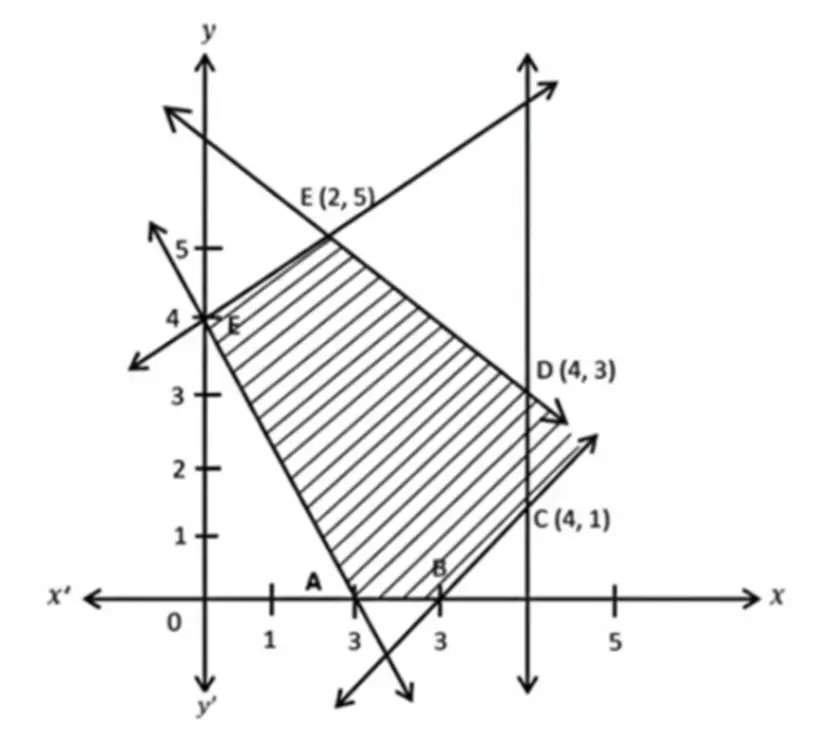
For linear programming problems, the maximum or minimum value of the objective function occurs at one or more corner points of the feasible region.
From the graph, identify the coordinates of each vertex:
- Point A: (x1,y1)
- Point B: (x2,y2)
- Point C: (x3,y3)
- Point D: (x4,y4)
- Point E: (x5,y5)
- Point F: (x6,y6)
Calculate z=3x+4y−2 at each corner point:
At Point A:
z=3(x1)+4(y1)−2
At Point B:
z=3(x2)+4(y2)−2
At Point C:
z=3(x3)+4(y3)−2
At Point D:
z=3(x4)+4(y4)−2
At Point E:
z=3(x5)+4(y5)−2
At Point F:
z=3(x6)+4(y6)−2
Comparing all calculated values, Point E gives the highest value of z.
Therefore, the maximum value of the objective function occurs at Point E only.