JEE Main 2021 — Thermodynamics
Physics Thermodynamics questions from JEE Main 2021.
Other Years
64 Thermodynamics Questions from 2021
A monoatomic ideal gas, initially at temperature ${T}_{1}$ is enclosed in a cylinder fitted with a frictionless piston. The gas is allowed to expand adiabatically to a temperature ${T}_{2}$ by releasing the piston suddenly. If ${l}_{1}$ and ${l}_{2}$ are the lengths of the gas column, before and after the expansion respectively, then the value of $\frac{{T}_{1}}{{T}_{2}}$ will be:
The volume $V$ of an enclosure contains a mixture of three gases, $16g$ of oxygen, $28g$ of nitrogen and $44g$ of carbon dioxide at absolute temperature $T$. Consider $R$ as universal gas constant. The pressure of the mixture of gases is :
A mixture of hydrogen and oxygen has volume $500{\mathrm{cm}}^{3},$ temperature $300K,$ pressure $400k\mathrm{Pa}$ and mass $0.76g.$ The ratio of masses of oxygen to hydrogen will be:
A bimetallic strip consists of metals $A$ and $B$. It is mounted rigidly as shown. The metal $A$ has higher coefficient of expansion compared to that of metal $B$. When the bimetallic strip is placed in a cold both, it will : 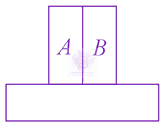
Each side of a box made of metal sheet in cubic shape is $a$ at room temperature $T$, the coefficient of linear expansion of the metal sheet is $\alpha$. The metal sheet is heated uniformly, by a small temperature $\Delta T$, so that its new temperature is $T+\Delta T$. Calculate the increase in the volume of the metal box.
One mole of an ideal gas is taken through an adiabatic process where the temperature rises from $27^{\circ}C$ to $37^{\circ}C$. If the ideal gas is composed of polyatomic molecule that has 4 vibrational modes, which of the following is true? $[R=8.314J{\mathrm{mol}}^{-1}{k}^{-1}]$
Two spherical soap bubbles of radii ${r}_{1}$ and ${r}_{2}$ in vacuum combine under isothermal conditions. The resulting bubble has a radius equal to:
A rod $CD$ of thermal resistance $10.0{\mathrm{KW}}^{-1}$ is joined at the middle of an identical rod $AB$ as shown in figure. The ends $A,B$ and $D$ are maintained at $200^{\circ}C,100^{\circ}C$ and $125^{\circ}C$ respectively. The heat current in $CD$ is $PW$. The value of $P$ is 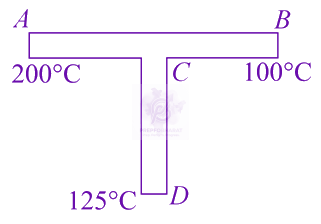
$1$ mole of rigid diatomic gas performs a work of $\frac{Q}{5}$ when heat $Q$ is supplied to it. The molar heat capacity of the gas during this transformation is $\frac{xR}{8}.$ The value of $x$ is [$R$ universal gas constant]
The number of molecules in one litre of an ideal gas at $300K$ and $2$ atmospheric pressure with mean kinetic energy $2\times {10}^{-9}J$ per molecule is:
In the reported figure, heat energy absorbed by a system in going through a cyclic process is ______$\pi J.$ 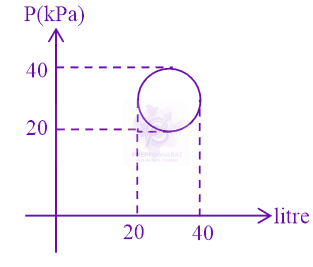
Consider a sample of oxygen behaving like an ideal gas. At $300K$, the ratio of root-mean-square (RMS) velocity to the average velocity of the gas molecule would be : (Molecular weight of oxygen is $32g{\mathrm{mol}}^{-1};R=8.3J{K}^{-1}{\mathrm{mol}}^{-1}$)
Given below are two statements: one is labelled as Assertion $A$ and the other is labelled as Reason $R$. Assertion $A$ : When a rod lying freely is heated, no thermal stress is developed in it. Reason $R$ : On heating, the length of the rod increases. In the light of the above statements, choose the correct answer from the options given below:
For an ideal gas the instantaneous change in pressure $P$ with volume $V$ is given by the equation $\frac{dP}{dV}=-aP.$ If $P={P}_{0}$ at $V=0$ is the given boundary condition, then the maximum temperature one mole of gas can attain is: (Here $R$ is the gas constant)
The temperature $\theta$ at the junction of two insulating sheets, having thermal resistances ${R}_{1}$ and ${R}_{2}$ as well as top and bottom temperatures ${\theta }_{1}$ and ${\theta }_{2}$ (as shown in figure) is given by : 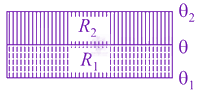
A $2\mathrm{kg}$ steel rod of length $0.6m$ is clamped on a table vertically at its lower end and is free to rotate in the vertical plane. The upper end is pushed so that the rod falls under gravity. Ignoring the friction due to clamping at its lower end, the speed of the free end of the rod when it passes through its lowest position is $_______m{s}^{-1}.$ (Take $g=10{ms}^{-2})$
In the reported figure, there is a cyclic process $ABCDA$ on a sample of $1$ mol of a diatomic gas. The temperature of the gas during the process $A\rightarrow B$ and $C\rightarrow D$ are ${T}_{1}$ and ${T}_{2}({T}_{1}>{T}_{2})$ respectively. 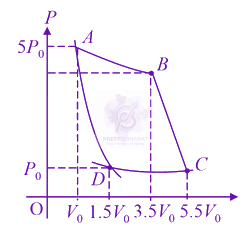 Choose the correct option out of the following for work done if processes $BC$ and $DA$ are adiabatic.
An ideal gas in a cylinder is separated by a piston in such a way that the entropy of one part is ${S}_{1}$ and that of the other part is ${S}_{2}$. Given that ${S}_{1}>{S}_{2}$. If the piston is removed then the total entropy of the system will be:
A Carnot engine operates between temperatures 600 K and 300 K...
In thermodynamics, heat and work are :
The width of one of the two slits in a Young's double slit experiment is three times the other slit. If the amplitude of the light coming from a slit is proportional to the slit-width, the ratio of minimum to maximum intensity in the interference pattern is $x:4$ where $x$ is $_______.$
If the R.M.S. speed of oxygen molecules at $0^{\circ}C$ is $160m{s}^{-1}$. Find the R.M.S. speed of hydrogen molecules at $0^{\circ}C$.
A system consists of two types of gas molecules $A$ and $B$ having the same number density $2\times {10}^{25}{m}^{-3}$. The diameter of $A$ and $B$ are $10A$ and $5A$ respectively. They suffer collisions at room temperature. The ratio of average distance covered by the molecule $A$ to that of $B$ between two successive collisions is ___________$\times {10}^{-2}$
The R.M.S. speeds of the molecules of Hydrogen, Oxygen, and Carbon dioxide at the same temperature are ${v}_{H},{v}_{O}$ and ${v}_{C}$ respectively, then:
Two identical metal wires of thermal conductivities ${K}_{1}$ and ${K}_{2}$ respectively are connected in series. The effective thermal conductivity of the combination is:
A polyatomic ideal gas has $24$ vibrational modes. What is the value of $\gamma ?$
Thermodynamic process is shown below on a $P-V$ diagram for one mole of an ideal gas. If ${V}_{2}=2{V}_{1}$, then the ratio of temperature $\frac{{T}_{2}}{{T}_{1}}$ is : 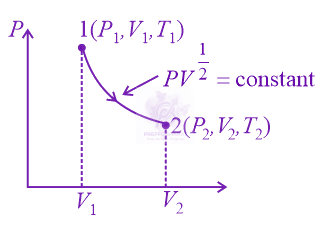
Which of the following graphs represent the behaviour of an ideal gas? Symbols have their usual meaning.
A container is divided into two chambers by a partition. The volume of first chamber is $4.5\mathrm{litre}$ and second chamber is $5.5\mathrm{litre}$. The first chamber contain $3.0$ moles of gas at pressure $2.0\mathrm{atm}$ and second chamber contain $4.0$ moles of gas at pressure $3.0\mathrm{atm}$. After the partition is removed and the mixture attains equilibrium, then, the common equilibrium pressure existing in the mixture is $x\times {10}^{-1}\mathrm{atm}$. Value of $x$ (nearest integer) is
If one mole of an ideal gas at $({P}_{1},{V}_{1})$ is allowed to expand reversibly and isothermally ($A$ to $B$) its pressure is reduced to one-half of the original pressure (see figure). This is followed by a constant volume cooling till its pressure is reduced to one-fourth of the initial value $(B\rightarrow C).$ Then it is restored to its initial state by a reversible adiabatic compression ($C$ to $A$). The net workdone by the gas is equal to: 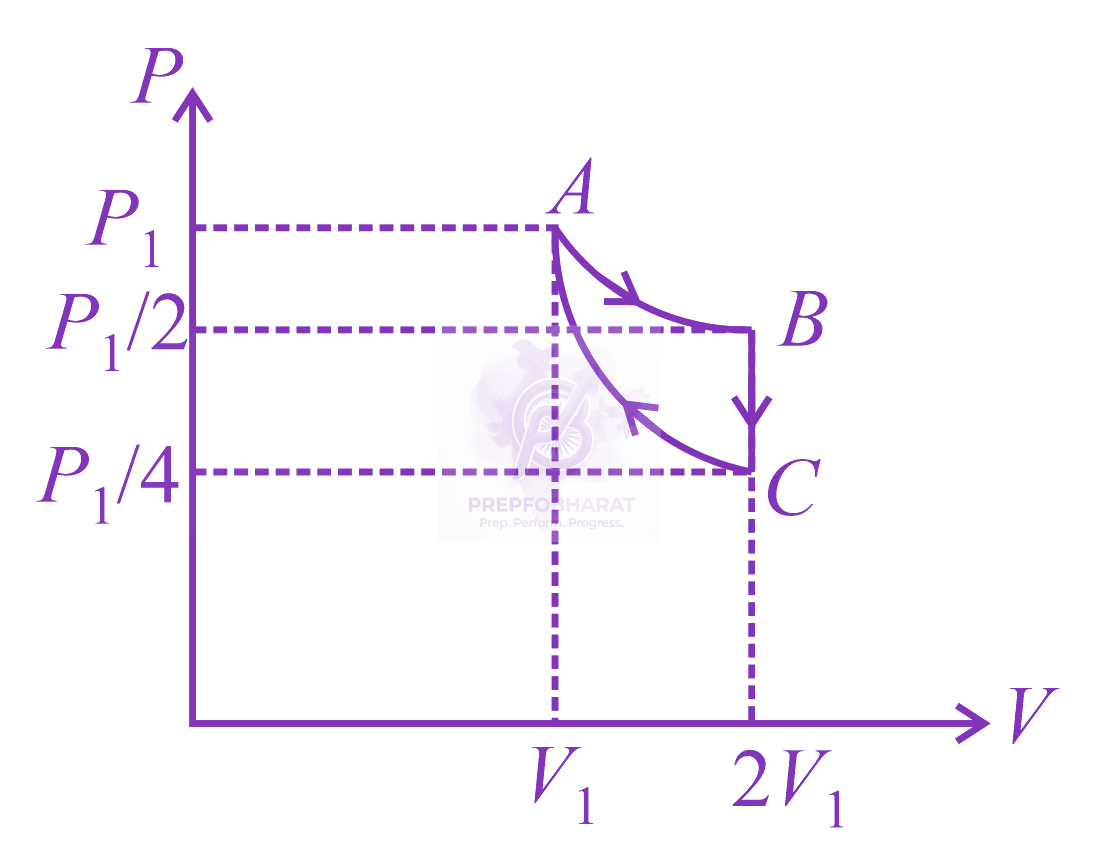
What will be the average value of energy for a monoatomic gas in thermal equilibrium at temperature $T?$
What will be the average value of energy along one degree of freedom for an ideal gas in thermal equilibrium at a temperature $T?$ (${k}_{B}$ is Boltzmann constant)
Calculate the value of the mean free path $(\lambda )$ for oxygen molecules at temperature $27^{\circ}C$ and pressure $1.01\times {10}^{5}\mathrm{Pa}$. Assume the molecular diameter $0.3\mathrm{nm}$ and the gas is ideal. $(k=1.38\times {10}^{-23}J{K}^{-1})$
The root-mean-square speed of molecules of a given mass of a gas at $27^{\circ}C$ and $1$ atmosphere pressure is $200m{s}^{-1}.$ The root-mean-square speed of molecules of the gas at $127^{\circ}C$ and $2$ atmosphere pressure is $\frac{x}{\sqrt{3}}m{s}^{-1}.$ The value of $x$ will be __________.
A diatomic gas, having ${C}_{P}=\frac{7}{2}R$ and ${C}_{V}=\frac{5}{2}R,$ is heated at constant pressure. The ratio $dU:dQ:dW$
A uniform heating wire of resistance $36\Omega$ is connected across a potential difference of $240V.$ The wire is then cut into half and a potential difference of $240V$ is applied across each half separately. The ratio of power dissipation in first case to the total power dissipation in the second case would be $1:x,$ where $x$ is
The internal energy $(U)$, pressure $(P)$ and volume $(V)$ of an ideal gas are related as $U=3PV+4.$ The gas is
Consider a mixture of gas molecule of types $A,B$ and $C$ having masses ${m}_{A}<{m}_{B}<{m}_{C}.$ The ratio of their root mean square speeds at normal temperature and pressure is:
Two thin metallic spherical shells of radii ${r}_{1}$ and ${r}_{2}({r}_{1}<{r}_{2})$ are placed with their centres coinciding. A material of thermal conductivity $K$ is filled in the space between the shells. The inner shell is maintained at temperature ${\theta }_{1}$ and the outer shell at temperature ${\theta }_{2}({\theta }_{1}<{\theta }_{2}).$ The rate at which heat flows radially through the material is :
The temperature of equal masses of three different liquids $x,y$ and $z$ are $10^{\circ}C,20^{\circ}C$ and $30^{\circ}C$ respectively. The temperature of mixture when $x$ is mixed with $y$ is $16^{\circ}C$ and that when $y$ is mixed with $z$ is $26^{\circ}C$. The temperature of mixture when $x$ and $z$ are mixed will be :
Due to cold weather, a $1m$ water pipe of cross-sectional area $1{\mathrm{cm}}^{2}$ is filled with ice at $-10^{\circ}C.$ Resistive heating is used to melt the ice. Current of $0.5A$ is passed through $4k\Omega$ resistance. Assuming that all the heat produced is used for melting, what is the minimum time required? (Given latent heat of fusion for water/ice$=3.33\times {10}^{5}J{\mathrm{kg}}^{-1},$ specific heat of ice $=2\times {10}^{3}J{\mathrm{kg}}^{-1}^{\circ}{C}^{-1}$ and density of ice $={10}^{3}\mathrm{kg}{m}^{-3})$
If one mole of the polyatomic gas is having two vibrational modes and $\beta$ is the ratio of molar specific heats for polyatomic gas $(\beta =\frac{{C}_{P}}{{C}_{v}})$ then the value of $\beta$ is :
The entropy of any system is given by, $S={\alpha }^{2}\beta \mathrm{ln}[\frac{\mu \mathrm{kR}}{J{\beta }^{2}}+3]$ where $\alpha$ and $\beta$ are the constants. $\mu ,J,k$ and $R$ are number of moles, mechanical equivalent of heat, Boltzmann's constant and gas constant, respectively. $[\text{Take }S=\frac{dQ}{T}]$ Choose the incorrect option from the following:
The correct relation between the degrees of freedom $f$ and the ratio of specific heat $\gamma$ is:
Match List $I$ with List $\mathrm{II}.$ <table class="pyq-table"><tbody><tr><td></td><td>List $I$</td><td></td><td>List $\mathrm{II}$</td></tr><tr><td>(a)</td><td>Isothermal</td><td>(i)</td><td>Pressure constant</td></tr><tr><td>(b)</td><td>Isochoric</td><td>(ii)</td><td>Temperature constant</td></tr><tr><td>(c)</td><td>Adiabatic</td><td>(iii)</td><td>Volume constant</td></tr><tr><td>(d)</td><td>Isobaric</td><td>(iv)</td><td>Heat content is constant</td></tr></tbody></table>Choose the correct answer from the options given below:
An ideal gas is expanding such that $P{T}^{3}=$ constant. The coefficient of volume expansion of the gas is:
Two ideal polyatomic gases at temperatures ${T}_{1}$ and ${T}_{2}$ are mixed so that there is no loss of energy. If ${F}_{1}$ and ${F}_{2},{m}_{1}$ and ${m}_{2},{n}_{1}$ and ${n}_{2}$ be the degrees of freedom, masses, number of molecules of the first and second gas respectively, the temperature of mixture of these two gases is:
One mole of an ideal gas at $27^{\circ}C$ is taken from $A$ to $B$ as shown in the given $PV$ indicator diagram. The work done by the system will be _______ $\times {10}^{-1}J.$ [Given, $R=8.3J{\mathrm{mole}}^{-1}K,\mathrm{ln}2=0.6931$] (Round off to the nearest integer) (Round off to the nearest integer) 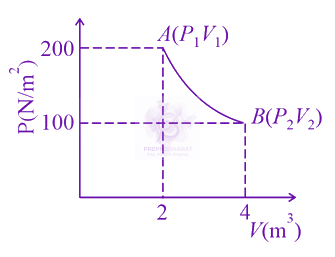
The volume $V$ of a given mass of monoatomic gas changes with temperature $T$ according to the relation $V=K{T}^{\frac{2}{3}}$. The workdone when temperature changes by $90K$ will be $xR$. The value of $x$ is [$R$ universal gas constant ]
$n$ mole of a perfect gas undergoes a cyclic process $ABCA$ (see figure) consisting of the following processes. $A\rightarrow B:$ Isothermal expansion at temperature $T$ so that the volume is doubled from ${V}_{1}$ to ${V}_{2}=2{V}_{1}$ and pressure changes from ${P}_{1}$ to ${P}_{2}$ $B\rightarrow C:$ Isobaric compression at pressure ${P}_{2}$ to initial volume ${V}_{1}.$ $C\rightarrow A:$ Isochoric change leading to change of pressure from ${P}_{2}$ to ${P}_{1}$ Total work done in the complete cycle $ABCA$ is: 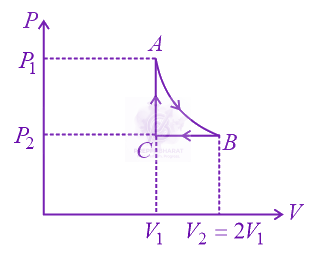
Given below are two statements: Statement I: In a diatomic molecule, the rotational energy at a given temperature obeys Maxwell's distribution. Statement II : In a diatomic molecule, the rotational energy at a given temperature equals the translational kinetic energy for each molecule. In the light of the above statements, choose the correct answer from the options given below:
A balloon carries a total load of $185\mathrm{kg}$ at normal pressure and temperature of $27^{\circ}C.$ What load will the balloon carry on rising to a height at which the barometric pressure is $45\mathrm{cm}$ of $\mathrm{Hg}$ and the temperature is $-7^{\circ}C.$ Assuming the volume constant?
The amount of heat needed to raise the temperature of $4\mathrm{moles}$ of a rigid diatomic gas from $0^{\circ}C$ to $50^{\circ}C$ when no work is done is$(R$ is the universal gas constant)
An electric appliance supplies $6000J{\mathrm{min}}^{-1}$, heat to the system. If the system delivers a power of $90W$. How long it would take to increase the internal energy by $2.5\times {10}^{3}J$?
For a gas ${C}_{\text{P}}-{C}_{\text{V}}=R$ in a state $P$ and ${C}_{\text{P}}-{C}_{\text{V}}=1.10R$ in a state $Q,{T}_{\text{P}}$ and ${T}_{\text{Q}}$ are the temperatures in two different states $P$ and $Q$, respectively. Then
Two different metal bodies $A$ and $B$ of equal mass are heated at a uniform rate under similar conditions. The variation of temperature of the bodies is graphically represented as shown in the figure. The ratio of specific heat capacities is: 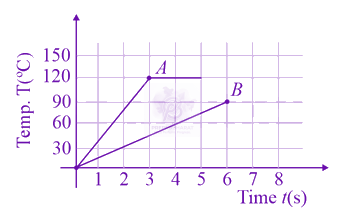
The $P-V$ diagram of a diatomic ideal gas system going under cyclic process as shown in figure. The work done during an adiabatic process $CD$ is (use $\gamma =1.4)$ : 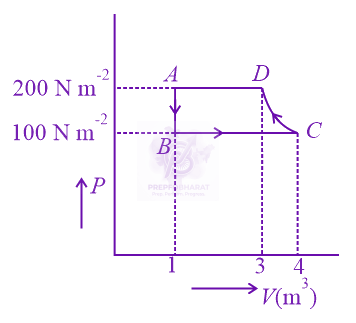
On the basis of kinetic theory of gases, the gas exerts pressure because its molecules:
A monoatomic gas of mass $4.0u$ is kept in an insulated container. The container is moving with velocity $30m{s}^{-1}$. If the container is suddenly stopped then a change in temperature of the gas ($R=$gas constant) is $\frac{x}{3R}$. Value of $x$ is,
For an adiabatic expansion of an ideal gas, the fractional change in its pressure is equal to (where $\gamma$ is the ratio of specific heats):
A sample of gas with $\gamma =1.5$ is taken through an adiabatic process in which the volume is compressed from $1200{\mathrm{cm}}^{3}$ to $300{\mathrm{cm}}^{3}.$ If the initial pressure is $200\mathrm{kPa}.$ The absolute value of the workdone by the gas in the process $=________J.$
In a certain thermodynamical process, the pressure of a gas depends on its volume as $k{V}^{3}$. The work done when the temperature changes from $100^{\circ}C$ to $300^{\circ}C$ will be $xnR$ where $n$ denotes number of moles of a gas find $x$ ;
Which one is the correct option for the two different thermodynamic processes ? 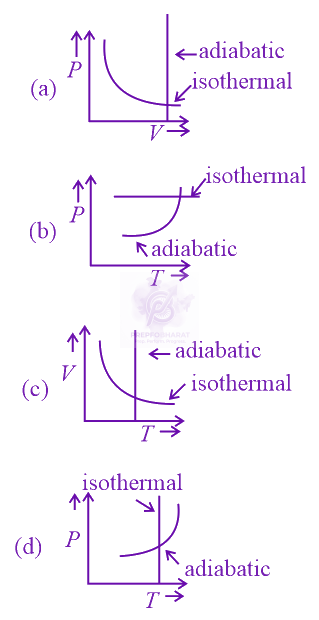
A cylindrical container of volume $4.0\times {10}^{-3}{m}^{3}$ contains one mole of hydrogen and two moles of carbon dioxide. Assume the temperature of the mixture is $400K$. The pressure of the mixture of gases is : [Take gas constant as $8.3J{\mathrm{mol}}^{-1}{K}^{-1}]$