JEE Main 2016 — Thermodynamics
Physics Thermodynamics questions from JEE Main 2016.
Other Years
7 Thermodynamics Questions from 2016
$200g$ water is heated from ${40}^{ o}C$ to ${60}^{ o}C$ . Ignoring the slight expansion of water, the change in its internal energy is close to (Given specific heat of water $=4184$ $J{\mathrm{kg}}^{-1}{K}^{-1}$):
$n$ moles of an ideal gas undergoes a process $A\rightarrow B$ as shown in the figure. The maximum temperature of the gas during the process will be: 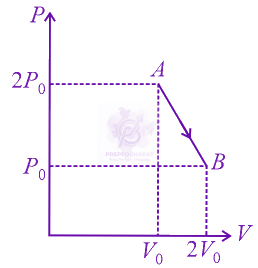
Which of the following shows the correct relationship between the pressure $'P'$ and density $\rho$ of an ideal gas at constant temperature ?
A simple pendulum made of a bob of mass m and a metallic wire of a negligible mass has a time period of $2s$ at $T=0^{\circ}C$. If the temperature of the wire is increased, and the corresponding change in its time period is plotted against its temperature, the resulting graph is a line of slope $S$. If the coefficient of linear expansion of metal is $\alpha$, then the value of $S$ is
The ratio of work done by an ideal monoatomic gas to the heat supplied to it in an isobaric process is
A pendulum clock loses 12 s a day if the temperature is ${40}^{o}$ C and gains 4s a day if the temperature is ${20}^{o}$ C. The temperature at which the clock will show correct time, and the co-efficient of linear expansion $(\alpha )$ of the metal of the pendulum shaft are respectively:
An ideal gas undergoes a quasi-static, reversible process in which its molar heat capacity C remains constant. If during this process the relation of pressure P and volume V is given by $P{V}^{n}=$ constant, then n is given by (Here ${C}_{P}$ and ${C}_{V}$ are molar specific heat at constant pressure and constant volume, respectively) :