JEE Main 2023 — Thermodynamics
Physics Thermodynamics questions from JEE Main 2023.
Other Years
52 Thermodynamics Questions from 2023
The graph between two temperature scales $P$ and $Q$ is shown in the figure. Between upper fixed point and lower fixed point there are $150$ equal divisions of scale $P$ and $100$ divisions on scale $Q$. The relationship for conversion between the two scales is given by : 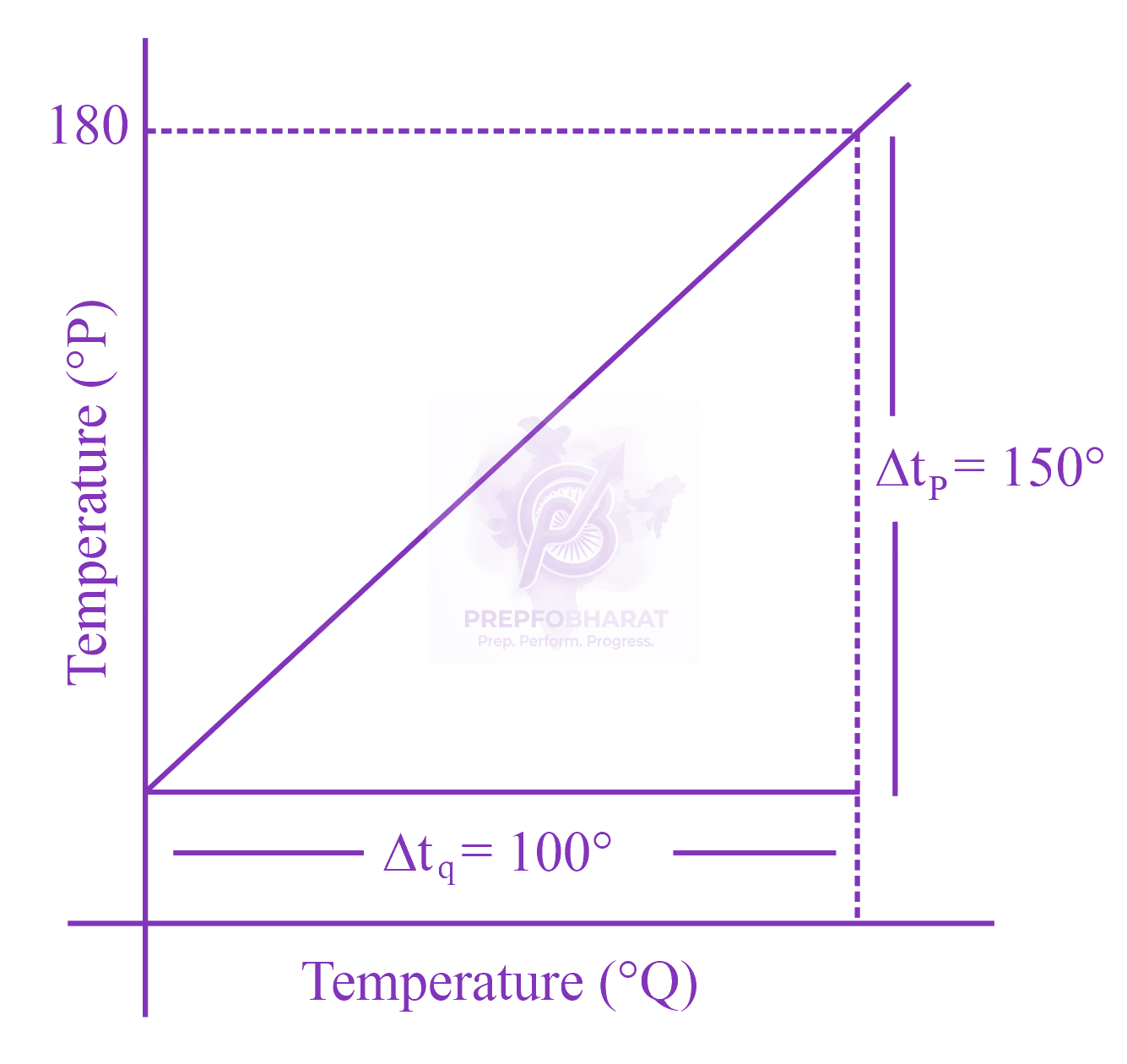.
For an ideal gas undergoing isothermal process
For an ideal gas, Cp - Cv is equal to:
A gas is compressed adiabatically, which one of the following statement is NOT true?
$1g$ of a liquid is converted to vapour at $3\times {10}^{5}\mathrm{Pa}$ pressure. If $10%$ of the heat supplied is used for increasing the volume by $1600{\mathrm{cm}}^{3}$ during this phase change, then the increase in internal energy in the process will be :
For three low density gases $A,B,C$ pressure versus temperature graphs are plotted while keeping them at constant volume, as shown in the figure 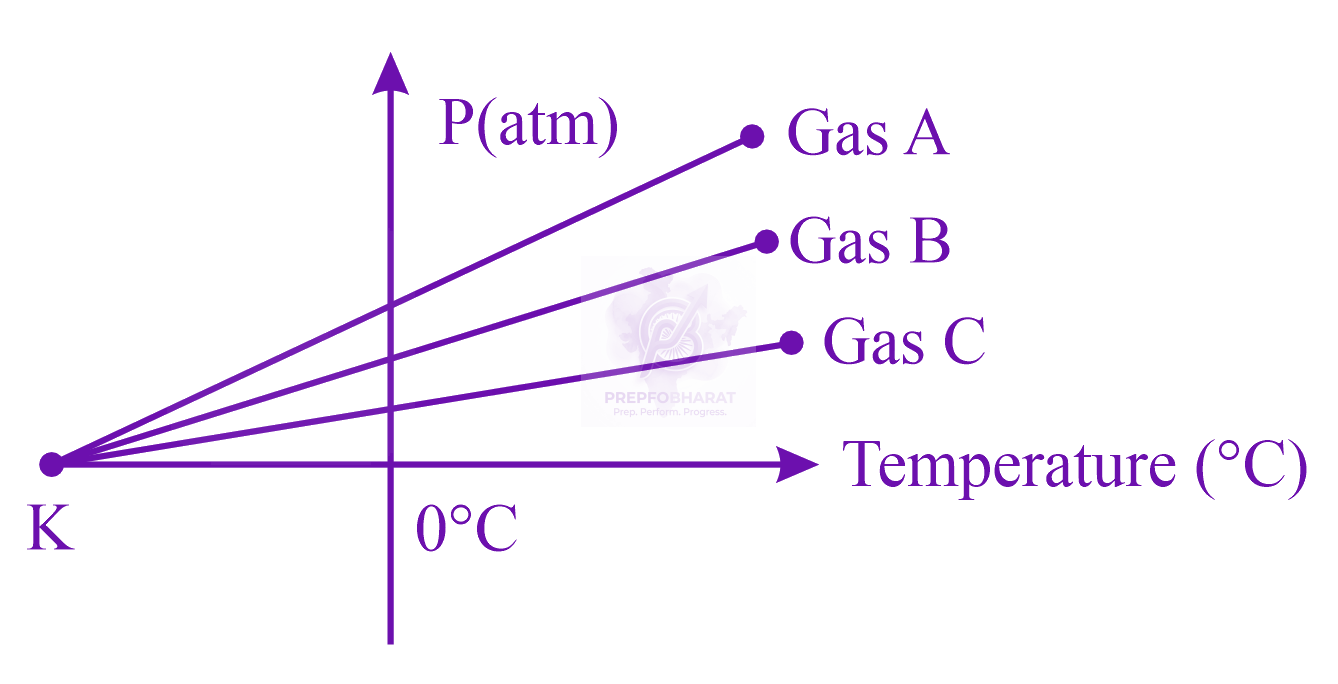 The temperature corresponding to the point $'K'$ is:
Given below are two statements: Statement I: The temperature of a gas is $-73^{\circ}C$. When the gas is heated to $527^{\circ}C$, the root mean square speed of the molecules is doubled. Statement II : The product of pressure and volume of an ideal gas will be equal to translational kinetic energy of the molecules. In the light of the above statements, choose the correct answer from the options given below:
The pressure $(P)$ and temperature $(T)$ relationship of an ideal gas obeys the equation $P{T}^{2}=$ constant. The volume expansion coefficient of the gas will be :
A faulty thermometer reads $5^{\circ}C$ in melting ice and $95^{\circ}C$ in steam. The correct temperature on absolute scale will be ______ $K$ when the faulty thermometer reads $41^{\circ}C$.
$1\mathrm{kg}$ of water at $100^{\circ}C$ is converted into steam at $100^{\circ}C$ by boiling at atmospheric pressure. The volume of water changes from $1.00\times {10}^{-3}{m}^{3}$ as a liquid to $1.671{m}^{3}$ as steam. The change in internal energy of the system during the process will be (Given latent heat of vaporisation $=2257\mathrm{kJ}/\mathrm{kg}$, Atmospheric pressure $=1\times {10}^{5}\mathrm{Pa})$
A water heater of power $2000W$ is used to heat water. The specific heat capacity of water is $4200J{\mathrm{kg}}^{-1}{K}^{-1}$. The efficiency of heater is $70%$. Time required to heat $2\mathrm{kg}$ of water from $10^{\circ}C$ to $60^{\circ}C$ is _____ $s$. (Assume that the specific heat capacity of water remains constant over the temperature range of the water).
Heat energy of $184\mathrm{kJ}$ is given to ice of mass $600g$ at $-12^{\circ}C$, Specific heat of ice is $2222.3J{\mathrm{kg}}^{–1}^{\circ}{C}^{–1}$ and latent heat of ice is $336\mathrm{kJ}{\mathrm{kg}}^{–1}$. (A) Final temperature of system will be $0^{\circ}C$ (B) Final temperature of the system will be greater than $0^{\circ}C$ (C) The final system will have a mixture of ice and water in the ratio of $5:1$ (D) The final system will have a mixture of ice and water in the ratio of $1:5$ (E) The final system will have water only Choose the correct answer from the options given below :
A flask contains hydrogen and oxygen in the ratio of $2:1$ by mass at temperature $27^{\circ}C$. The ratio of average kinetic energy per molecule of hydrogen and oxygen respectively is :
Heat is given to an ideal gas in an isothermal process. A. Internal energy of the gas will decrease. B. Internal energy of the gas will increase. C. Internal energy of the gas will not change. D. The gas will do positive work. E. The gas will do negative work. Choose the correct answer from the options given below :
The molar specific heat of a gas in a process PV² = constant is:
The temperature at which the kinetic energy of oxygen molecules becomes double than its value at $27^{\circ}C$ is
If the r.m.s speed of chlorine molecule is $490m{s}^{-1}$ at ${27}^{o}C$, the r.m.s speed of argon molecules at the same temperature will be (Atomic mass of argon $=39.9u$, molecular mass of chlorine $=70.9u$)
In an Isothermal change, the change in pressure and volume of a gas can be represented for three different temperature; ${T}_{3}>{T}_{2}>{T}_{1}$ as:
A source supplies heat to a system at the rate of $1000W.$ If the system performs work at a rate of $200W.$ The rate at which internal energy of the system increases is
A steel rod of length $1m$ and cross-sectional area ${10}^{-4}{m}^{2}$ is heated from $0^{\circ}C$ to $200^{\circ}C$ without being allowed to extend or bend. The compressive tension produced in the rod is _____$\times {10}^{4}N$. (Given Young's modulus of steel $=2\times {10}^{11}N{m}^{-2}$, coefficient of linear expansion $={10}^{-5}{K}^{-1}$ )
The pressure of a gas changes linearly with volume from $A$ to $B$ as shown in figure. If no heat is supplied to or extracted from the gas then change in the internal energy of the gas will be 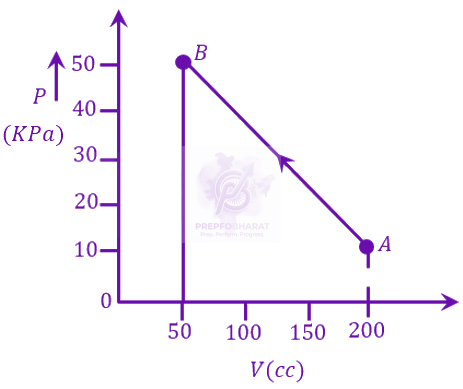
A thermodynamic system is taken through cyclic process. The total work done in the process is : 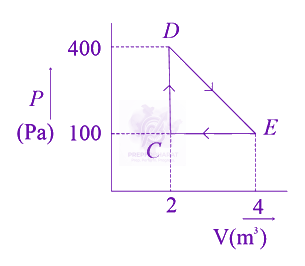
A sample of gas at temperature $T$ is adiabatically expanded to double its volume. The work done by the gas in the process is given, (given $\gamma =\frac{3}{2}$) :
Two plates A and B have thermal conductivities $84W{m}^{-1}{K}^{-1}$ and $126W{m}^{-1}{K}^{-1}$ respectively. They have same surface area and same thickness. They are placed in contact along their surfaces. If the temperatures of the outer surfaces of A and B are kept at ${100}^{\circ }C$ and ${0}^{\circ }C$ respectively, then the temperature of the surface of contact in steady state is_____ $C\circ$.
Consider two containers $A$ and $B$ containing monoatomic gases at the same Pressure $(P)$, Volume $(V)$ and Temperature $(T)$. The gas in $A$ is compressed isothermally to $\frac{1}{8}$ of its original volume while the gas in $B$ is compressed adiabatically to $\frac{1}{8}$ of its original volume. The ratio of final pressure of gas in $B$ to that of gas in $A$ is
A gas mixture consists of $2$ moles of oxygen and $4$ moles of neon at temperature $T$. Neglecting all vibrational modes, the total internal energy of the system will be:
A body cools in $7$ minutes from ${60}^{o}C$ to ${40}^{o}C$. The temperature of the surrounding is ${10}^{o}C$. The temperature of the body after the next $7$ minutes will be
According to law of equipartition of energy the molar specific heat of a diatomic gas at constant volume where the molecule has one additional vibrational mode is :-
A bicycle tyre is filled with air having pressure of $270\mathrm{kPa}$ at $27^{\circ}C$. The approximate pressure of the air in the tyre when the temperature increases to $36^{\circ}C$ is
The correct relation between $\gamma =\frac{{C}_{P}}{{C}_{V}}$ and temperature $T$ is :
The initial pressure and volume of an ideal gas are${P}_{0}$ and ${V}_{0}$. The final pressure of the gas when the gas is suddenly compressed to volume$\frac{{V}_{0}}{4}$ will be: (Given $\gamma$= ratio of specific heats at constant pressure and at constant volume.)
On a temperature scale '$X$', the boiling point of water is $65^{\circ}X$ and the freezing point is $-15^{\circ}X$. Assuming that the $X$ scale is linear. The equivalent temperature corresponding to $-95^{\circ}X$ on the Fahrenheit scale would be
Given below are two statements: Statement I: If heat is added to a system, its temperature must increase. Statement II: If positive work is done by a system in a thermodynamic process, its volume must increase. In the light of the above statements, choose the correct answer from the options given below
Match List I with List II : <table class="pyq-table"><tbody><tr><td></td><td>List I</td><td></td><td>List II</td></tr><tr><td>A</td><td>Isothermal Process</td><td>I</td><td>Work done by the gas decreases internal energy</td></tr><tr><td>B</td><td>Adiabatic Process</td><td>II</td><td>No change in internal energy</td></tr><tr><td>C</td><td>Isochoric Process</td><td>III</td><td>The heat absorbed goes partly to increase internal energy and partly to do work</td></tr><tr><td>D</td><td>Isobaric Process</td><td>IV</td><td>No work is done on or by the gas</td></tr></tbody></table>Choose the correct answer from the options given below :
A hypothetical gas expands adiabatically such that its volume changes from $08$ litres to $27$ litres. If the ratio of final pressure of the gas to initial pressure of the gas is$\frac{16}{81}$ . Then the ratio of $\frac{{C}_{p}}{{C}_{v}}$ will be.
The root mean square velocity of molecules of gas is
Match List I with List II: <table class="pyq-table"><tbody><tr><td></td><td>List I</td><td></td><td>List II</td></tr><tr><td>(A)</td><td>$3$ Translational degrees of freedom</td><td>(I)</td><td>Monoatomic gases</td></tr><tr><td>(B)</td><td>$3$ Translational, $2$ rotational degrees of freedoms</td><td>(II)</td><td>Polyatomic gases</td></tr><tr><td>(C)</td><td>$3$ Translational, $2$ rotational and $1$ vibrational degrees of freedom</td><td>(III)</td><td>Rigid diatomic gases</td></tr><tr><td>(D)</td><td>$3$ Translational, $3$ rotational and more than one vibrational degrees of freedom</td><td>(IV)</td><td>Nonrigid diatomic gases</td></tr></tbody></table>Choose the correct answer from the options given below:
A thin rod having a length of $1m$ and area of cross-section $3\times {10}^{-6}{m}^{2}$ is suspended vertically from one end. The rod is cooled from $210^{\circ}C$ to $160^{\circ}C$. After cooling, a mass $M$ is attached at the lower end of the rod such that the length of rod again becomes $1m$. Young's modulus and coefficient of linear expansion of the rod are $2\times {10}^{11}N{m}^{-2}$ and $2\times {10}^{-5}{K}^{-1}$, respectively. The value of $M$ is ______ $\mathrm{kg}$. (Take $g=10m{s}^{-2}$)
Heat energy of $735J$ is given to a diatomic gas allowing the gas to expand at constant pressure. Each gas molecule rotates around an internal axis but do not oscillate. The increase in the internal energy of the gas will be:
Given below are two statements. One is labelled as Assertion A and the other is labelled as Reason R. Assertion A : If $dQ$ and $dW$ represent the heat supplied to the system and the work done on the system respectively. Then according to the first law of thermodynamics $dQ=dU-dW$. Reason R : First law of thermodynamics is based on law of conservation of energy. In the light of the above statements, choose the correct answer from the option given below :
The $\mathrm{rms}$ speed of oxygen molecule in a vessel at particular temperature is ${(1+\frac{5}{x})}^{\frac{1}{2}}v,$ when $v$ is the average speed of the molecule. The value of $x$ will be: (take $\pi =\frac{22}{7}$)
The mean free path of molecules of a certain gas at STP is $1500d$, where $d$is the diameter of the gas molecules. While maintaining the standard pressure, the mean free path of the molecules at $373K$ is approximately:
The average kinetic energy of a molecule of the gas is
The number of air molecules per ${\mathrm{cm}}^{3}$ is increased from $3\times {10}^{19}$ to $12\times {10}^{19}.$ The ratio of collision frequency of air molecules before and after the increase in number respectively is :
Three vessels of equal volume contain gases at the same temperature and pressure. The first vessel contains neon (monoatomic), the second contains chlorine (diatomic) and third contains uranium hexafluoride (polyatomic). Arrange these on the basis of their root mean square speed $({v}_{rms})$ and choose the correct answer from the options given below:
A flask contains Hydrogen and Argon in the ratio $2:1$ by mass. The temperature of the mixture is $30^{\circ}C$. The ratio of average kinetic energy per molecule of the two gases $(\frac{{K}_{\mathrm{argon}}}{{K}_{\mathrm{hydrogen}}})$ is: (Given : Atomic Weight of $Ar=39.9$)
The root mean square speed of molecules of nitrogen gas at $27^{\circ}C$ is approximately: (Given mass of a nitrogen molecule $=4.6\times {10}^{-26}\mathrm{kg}$ and take Boltzmann constant ${k}_{B}=1.4\times {10}^{-23}J{K}^{-1}$ )
At $300K$, the rms speed of oxygen molecules is $\sqrt{\frac{\alpha +5}{\alpha }}$ times to that of its average speed in the gas. Then, the value of $\alpha$ will be (use $\pi =\frac{22}{7}$)
The temperature of an ideal gas is increased from $200K$ to $800K$. If r.m.s. speed of gas at $200K$ is ${v}_{0}$. Then, r.m.s. speed of the gas at $800K$ will be:
A hole is drilled in a metal sheet. At $27^{\circ}C$, the diameter of hole is $5\mathrm{cm}$. When the sheet is heated to $177^{\circ}C$, the change in the diameter of hole is $d\times {10}^{-3}\mathrm{cm}$ . The value of $d$ will be _____, if coefficient of linear expansion of the metal is $1.6\times {10}^{-5}/C\circ$
The thermodynamic process, in which internal energy of the system remains constant is
Let ${\gamma }_{1}$ be the ratio of molar specific heat at constant pressure and molar specific heat at constant volume of a monoatomic gas and ${\gamma }_{2}$ be the similar ratio of diatomic gas. Considering the diatomic gas molecule as a rigid rotator, the ratio $\frac{{\gamma }_{1}}{{\gamma }_{2}}$ is: