JEE Main 2026 — Thermodynamics
Physics Thermodynamics questions from JEE Main 2026.
Other Years
41 Thermodynamics Questions from 2026
In the following $p-V$ diagram the equation of state along the curved path is given by $(V-2)^{2}=4 a p$ where $a$ is a constant. The total work done in the closed path is 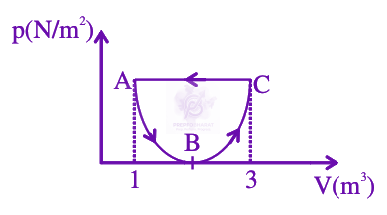
An ideal gas at pressure $P$ and temperature $T$ is expanding such that $PT^3 = $ constant. The coefficient of volume expansion of the gas is _______.
The volume of an ideal gas increases 8 times and temperature becomes $(1 / 4)^{\text {th }}$ of initial temperature during a reversible change. If there is no exchange of heat in this process $(\Delta \mathrm{Q}=0)$ then identify the gas from the following options (Assuming the gases given in the options are ideal gases):
10 mole of oxygen is heated at constant volume from $30^{\circ} \mathrm{C}$ to $40^{\circ} \mathrm{C}$. The change in the internal energy of the gas is $\_\_\_\_$ cal. (The molecular specific heat of oxygen at constant pressure, $C_{P}=7 \mathrm{cal} / \mathrm{mol}.{ }^{\circ} \mathrm{C}$ and $\mathrm{R}=2 \mathrm{cal} / \mathrm{mol}.{ }^{\circ} \mathrm{C}$.)
A certain gas is isothermally compressed to $\left(\dfrac{1}{3}\right)^{rd}$ of its initial volume ($V_o = 3$ litre) by applying required pressure. If the bulk modulus of the gas is $3 \times 10^5$ N/m$^2$, the magnitude of work done on the gas is _______ J.
A gas based geyser heats water flowing at the rate of 5.0 litres per minute from $27^{\circ} \mathrm{C}$ to $87^{\circ} \mathrm{C}$. The rate of consumption of the gas is $\_\_\_\_$ $\mathrm{g} / \mathrm{s}$. (Take heat of combustion of gas $=5.0 \times 10^{4} \mathrm{~J} / \mathrm{g}$) specific heat capacity of water $=4200 \mathrm{~J} / \mathrm{kg} \cdot{ }^{\circ} \mathrm{C}$
The r.m.s. speed of oxygen molecules at $47^{\circ} \mathrm{C}$ is equal to that of the hydrogen molecules kept at $\_\_\_\_$ ${ }^{\circ} \mathrm{C}$. (Mass of oxygen molecule/mass of hydrogen molecule $=32 / 2$)
A cylinder with adiabatic walls is closed at both ends and is divided into two compartments by a frictionless adiabatic piston. Ideal gas is filled in both (left and right) the compartments at same $P, V, T$. Heating is started from left side until pressure changes to $\dfrac{27P}{8}$. If initial volume of each compartment was $9$ litres then the final volume in right-hand side compartment is __________ litres. (for this ideal gas $C_P/C_V = 1.5$)
10 kg of ice at $-10^{\circ} \mathrm{C}$ is added to 100 kg of water to lower its temperature from 25 ${ }^{\circ} \mathrm{C}$. Consider no heat exchange to surroundings. The decrement to the temperature of water is $\_\_\_\_$ ${ }^{\circ} \mathrm{C}$. (specific heat of ice $=2100 \mathrm{~J} / \mathrm{Kg}.{ }^{\circ} \mathrm{C}$, specific heat of water $=4200 \mathrm{~J} / \mathrm{Kg}.{ }^{\circ} \mathrm{C}$, latent heat of fusion of ice $=3.36 \times 10^{5} \mathrm{~J} / \mathrm{Kg}$)
One gas of $n_1$ mole of molecules at temperature $T_1$, volume $V_1$, and pressure $P_1$, and another gas of $n_2$ mole of molecules at temperature $T_2$, volume $V_2$, and pressure $P_2$, are mixed resulting in pressure $P$ and volume $V$ of the mixture. The temperature of the mixture is _____.
A thermodynamic system is taken through the cyclic process $A B C$ as shown in the figure. The total work done by the system during the cycle $A B C$ is $\_\_\_\_$ J. 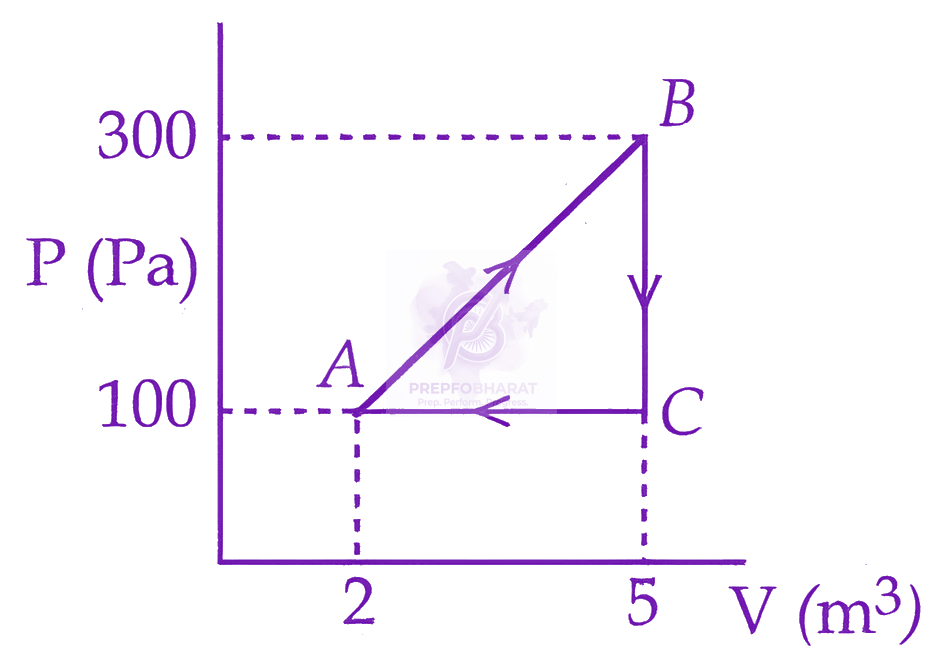
Which of the following best represents the temperature versus heat supplied graph for water, in the range of $-20^{\circ} \mathrm{C}$ to $120^{\circ} \mathrm{C}$ ?
The heat extracted out of $x$ gram of water initially at $50°C$ to cool it down to $0°C$ is sufficient to evaporate $(1000 - x)$ gram of water also initially at $50°C$. The value of $x$ (closest integer) is _______. (Take latent heat of water $2256\text{ kJ/kg.K}$, specific heat capacity of water $4200\text{ J/kg.K}$)
$5$ moles of unknown gas is heated at constant volume from $10 \, °C$ to $20 \, °C$. The molar specific heat of this gas at constant pressure $c_p = 8$ cal/mol.°C and $R = 8.36$ J/mol.°C. The change in the internal energy of the gas is _______ calorie.
A brass wire of length 2 m and radius 1 mm at $27^{\circ} \mathrm{C}$ is held taut between two rigid supports. Initially it was cooled to a temperature of $-43^{\circ} \mathrm{C}$ creating a tension $T$ in the wire. The temperature to which the wire has to be cooled in order to increase the tension in it to $1.4 T$, is $\_\_\_\_$ ${ }^{\circ} \mathrm{C}$.
Density of water at $4{ }^{\circ} \mathrm{C}$ and $20^{\circ} \mathrm{C}$ are $1000 \mathrm{~kg} / \mathrm{m}^{3}$ and $998 \mathrm{~kg} / \mathrm{m}^{3}$ respectively. The increase in internal energy of 4 kg of water when it is heated from $4{ }^{\circ} \mathrm{C}$ to $20^{\circ} \mathrm{C}$ is $\_\_\_\_$ J. (specific heat capacity of water $=4.2 \mathrm{~J} / \mathrm{kg}$. and 1 atmospheric pressure $=10^{5} \mathrm{~Pa}$)
A diatomic gas $(\gamma=1.4)$ does 100 J of work when it is expanded isobarically. Then the heat given to the gas $\_\_\_\_$ J.
A cylindrical tube $A B$ of length $l$, closed at both ends contains an ideal gas of 1 mol having molecular weight $M$. The tube is rotated in a horizontal plane with constant angular velocity $\omega$ about an axis perpendicular to $A B$ and passing through the edge at end $A$, as shown in the figure. If $P_{A}$ and $P_{B}$ are the pressures at $A$ and $B$ respectively, then (Consider the temperature is same at all points in the tube) 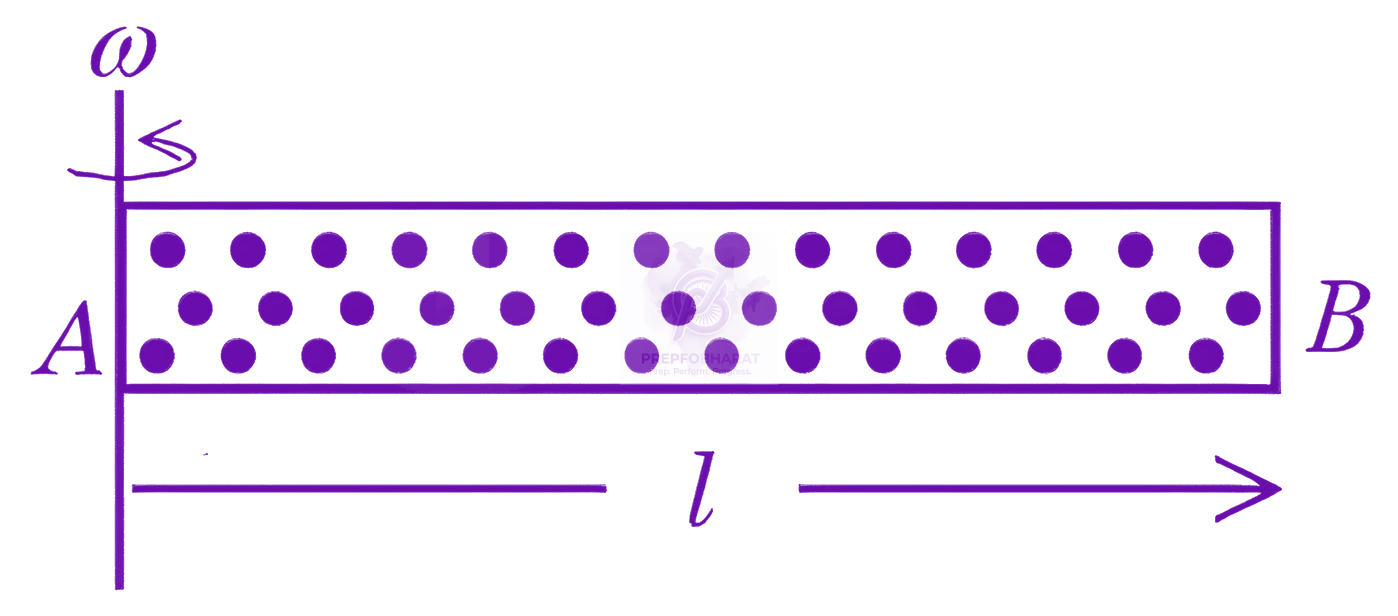
Given below are two statements: one is labelled as Assertion A and the other is labelled as Reason R Assertion A: If the average kinetic energy of $H_2$ and $O_2$ molecules, kept in two different sized containers are same, then their temperatures will be same. Reason R: The r.m.s. speed of $H_2$ and $O_2$ molecules are same at same temperature. Choose the correct answer from the options given below
Consider the following statements: A. Zeroth law of thermodynamics gives concept of temperature B. First law of thermodynamics gives concept of internal energy C. In isothermal expansion of ideal gas, $\Delta Q \neq \Delta W$ D. Product of intensive and extensive variables is extensive E. The ratio of any extensive variable to mass will be an extensive variable Choose the correct combination of statements from the options given below:
An ideal gas undergoes an isothermal expansion. Which of the following is true?
A gas of certain mass filled in a closed cylinder at a pressure of 3.23 kPa has temperature $50^{\circ} \mathrm{C}$. The gas is now heated to double its temperature. The modified pressure is $\_\_\_\_$ Pa. Note: Volume is constant.
Rods $x$ and $y$ of equal dimensions but of different materials are joined as shown in figure. Temperatures of end points $A$ and $F$ are maintained at $100^{\circ} \mathrm{C}$ and $40^{\circ} \mathrm{C}$ respectively. Given the thermal conductivity of $\operatorname{rod} x$ is three times of that of $\operatorname{rod} y$, the temperature at junction points $B$ and $E$ are (close to): 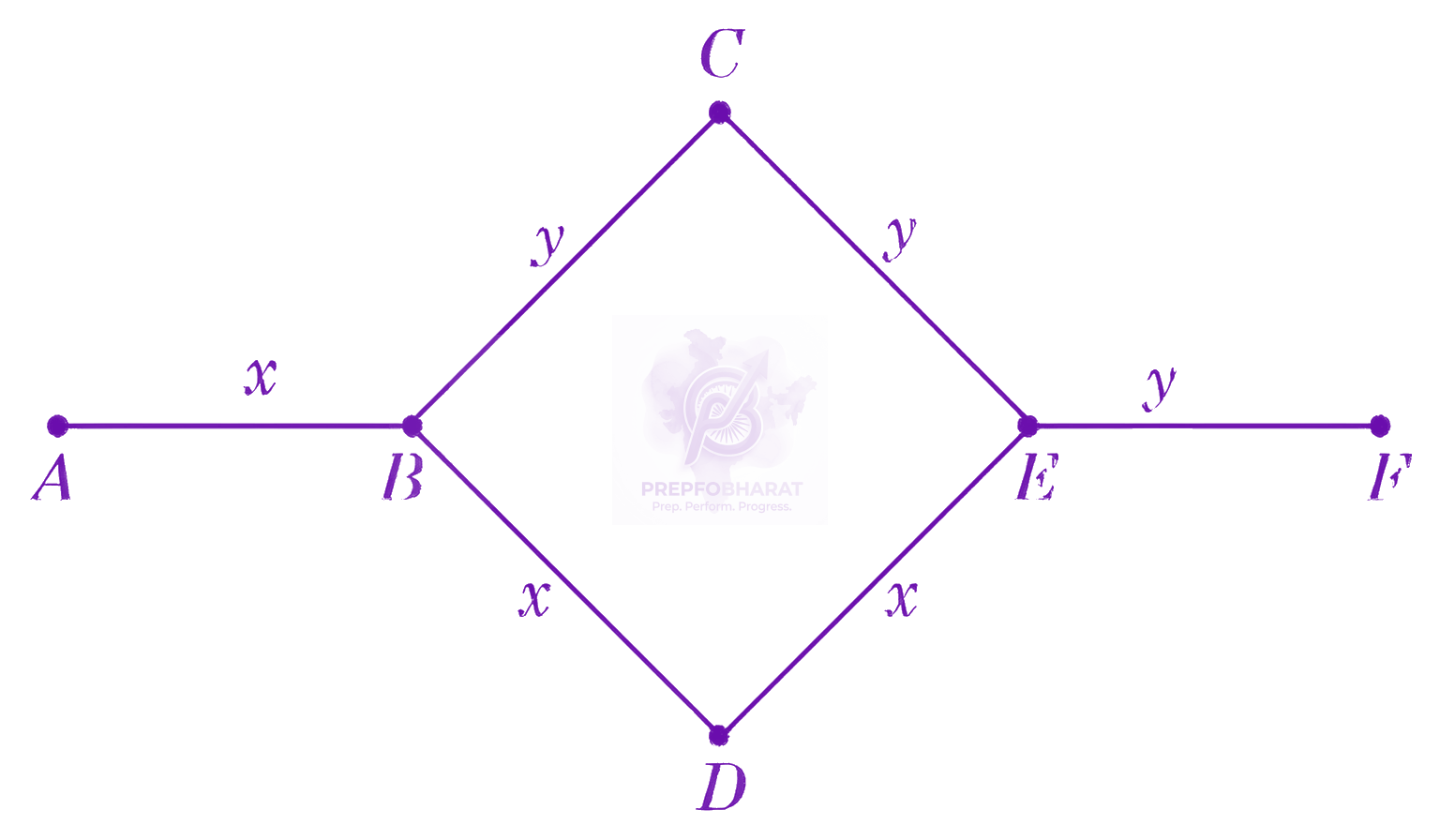
A vessel contains $0.15$ m$^3$ of a gas at pressure $8$ bar and temperature $140°$C with $c_p = 3R$ and $c_v = 2R$. It is expanded adiabatically till pressure falls to $1$ bar. The work done during this process is _______ kJ. ($R$ is gas constant)
The internal energy of a monoatomic gas is 3 nRT. One mole of helium is kept in a cylinder having internal cross section area of $17 \mathrm{~cm}^{2}$ and fitted with a light movable frictionless piston. The gas is heated slowly by suppling 126 J heat. If the temperature rises by $4^{\circ} \mathrm{C}$, then the piston will move $\_\_\_\_$ cm. (atmospheric pressure $=10^{5} \mathrm{~Pa}$)
If $2$ mole of an ideal monoatomic gas at temperature $T$, is mixed with $6$ mole of another ideal monoatomic gas at temperature $2T$ then the temperature of mixture is :
Initial pressure and volume of a monoatomic ideal gas are $P$ and $V$. The change in internal energy of this gas in adiabatic expansion to volume $V_{final}=27V$ is ________ J.
One mole of diatomic gas having rotational modes only is kept in a cylinder with a piston system. The cross-section area of the cylinder is $4$ cm$^2$. The gas is heated slowly to raise the temperature by $1.2\,^\circ$C during which the piston moves by $25$ mm. The amount of heat supplied to the gas is ________ J. (Atmospheric pressure $=100$ kPa, $R=8.3$ J/mol·K) (Neglect mass of the piston)
An aluminium and steel rods having same lengths and cross-sections are joined to make total length of 120 cm at $30^{\circ} \mathrm{C}$. The coefficient of linear expansion of aluminium and steel are $24 \times 10^{-6} /{ }^{\circ} \mathrm{C}$ and $1.2 \times 10^{-5} /{ }^{\circ} \mathrm{C}$, respectively. The length of this composite rod when its temperature is raised to $100^{\circ} \mathrm{C}$, is $\_\_\_\_$ cm.
Given below are two statements: one is labelled as Assertion A and the other is labelled as Reason R Statement I: Change in internal energy of a system containing $n$ mole of ideal gas can be written as $\Delta U = n C_v (T_f - T_i) = \dfrac{nR}{\gamma - 1}(T_f - T_i)$, where $\gamma = \dfrac{C_p}{C_v}$, $T_i =$ initial temperature, $T_f =$ final temperature. Statement II: Relation between degree of freedom $f$ and $\gamma (= C_p/C_v)$ is $\left(\gamma = 1 + \dfrac{2}{f}\right)$ Choose the correct answer from the options given below
10 mole of an ideal gas is undergoing the process shown in the figure. The heat involved in the process from $P_{1}$ to $P_{2}$ is $\alpha$ Joule ($P_{1}=21.7 \mathrm{~Pa}$ and $\left.P_{2}=30 \mathrm{~Pa}, \mathrm{C}_{v}=21 \mathrm{~J} / \mathrm{K}. \mathrm{mol}, R=8.3 \mathrm{~J} / \mathrm{mol}. \mathrm{K}\right)$. The value of $\alpha$ is $\_\_\_\_$. 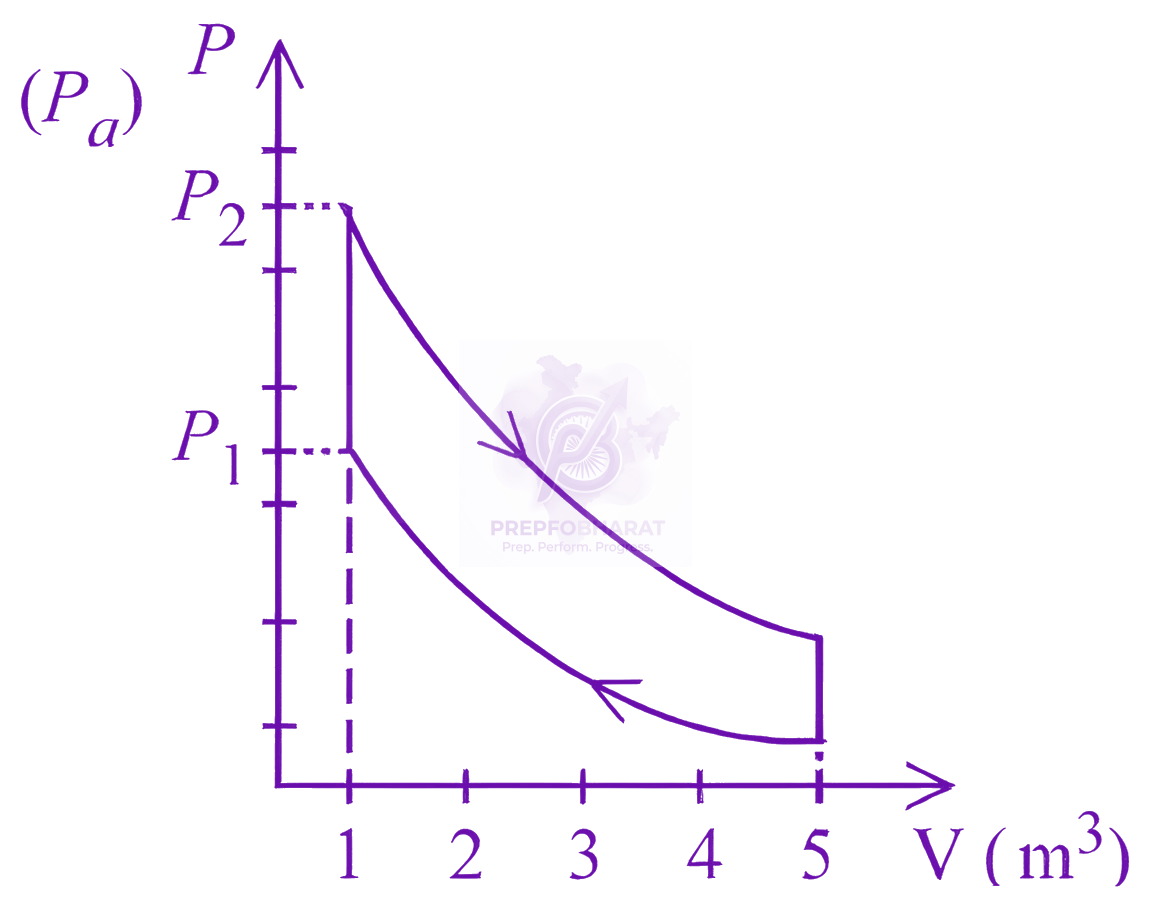
When 300 J of heat given to an ideal gas with $C_{p}=\frac{7}{2} R$ its temperature raises from $20^{\circ} \mathrm{C}$ to $50^{\circ} \mathrm{C}$ keeping its volume constant. If n is the number of moles of the gas, then what is the value of $100n$? $(\mathrm{R}=8.314 \mathrm{~J} / \mathrm{mol}. \mathrm{K})$
An ideal gas undergoes a process maintaining relation between pressure $(P)$ and volume $(V)$ as $P = P_o\left(1 + \left(\dfrac{V_o}{V}\right)^2\right)^{-1}$, where $P_o$ and $V_o$ are constants. If two samples $A$ and $B$ (two moles each) with initial volumes $V_o$ and $3V_o$ respectively undergo above mentioned process and attain same pressure, then the difference at the temperatures of these samples, $T_B - T_A$ is _____. ($R = $ gas constant)
A mixture of carbon dioxide and oxygen has volume $8310$ cm$^3$, temperature $300$ K, pressure $100$ kPa and mass $13.2$ g. The number of moles of carbon dioxide and oxygen gases in the mixture respectively are _______. (Assume both carbon dioxide and oxygen gases behave like ideal gases) $[R = 8.31$ J/mol.K$]$
An insulated cylinder of volume $60 \mathrm{~cm}^{3}$ is filled with a gas at $27^{\circ} \mathrm{C}$ and 2 atmospheric pressure. Then the gas is compressed making the final volume as $20 \mathrm{~cm}^{3}$ while allowing the temperature to rise to $77^{\circ} \mathrm{C}$. The final pressure is $\_\_\_\_$ atmospheric pressure.
Consider two boxes containing ideal gases $A$ and $B$ such that their temperatures, pressures and number densities are same. The molecular size of $A$ is half of that of $B$ and mass of molecule $A$ is four times that of $B$. If the collision frequency in gas $B$ is $32 \times 10^{18} / \mathrm{s}$ then collision frequency in gas $A$ is $\_\_\_\_$ $/ \mathrm{s}$.
One mole of an ideal diatomic gas expands from volume $V$ to 2 V isothermally at a temperature $27^{\circ} \mathrm{C}$ and does $W$ joule of work. If the gas undergoes same magnitude of expansion adiabatically from $27^{\circ} \mathrm{C}$ doing the same amount of work $W$, then its final temperature will be (close to) $\_\_\_\_$ ${ }^{\circ} \mathrm{C}$. $\left(\log _{\mathrm{e}} 2=0.693\right)$
The temperature of a metal strip having coefficient of linear expansion $\alpha$ is increased from $T_1$ to $T_2$ resulting in increase of its length by $\Delta L_1$. The temperature is further increased from $T_2$ to $T_3$ such that the increase in its length is $\Delta L_2$. Given $T_3+T_1=2T_2$ and $T_2-T_1=\Delta T$, the value of $\Delta L_2$ is ______.
The mean free path of a molecule of diameter $5 \times 10^{-10} \mathrm{~m}$ at the temperature $41^{\circ} \mathrm{C}$ and pressure $1.38 \times 10^{5} \mathrm{~Pa}$, is given as $\_\_\_\_$ m. (Given $k_{B}=1.38 \times 10^{-23} \mathrm{~J} / \mathrm{K}$).
Two closed vessels of same volume are joined through a narrow tube and both vessels are filled with air of pressure $90$ kPa and temperature $400$ K. Keeping the temperature of one vessel constant at $400$ K the second vessel temperature is raised to $500$ K. The final pressure in the vessels is _______ kPa.
Heat is supplied to a diatomic gas at constant pressure. Then the ratio of $\Delta Q : \Delta U : \Delta W$ is _______.