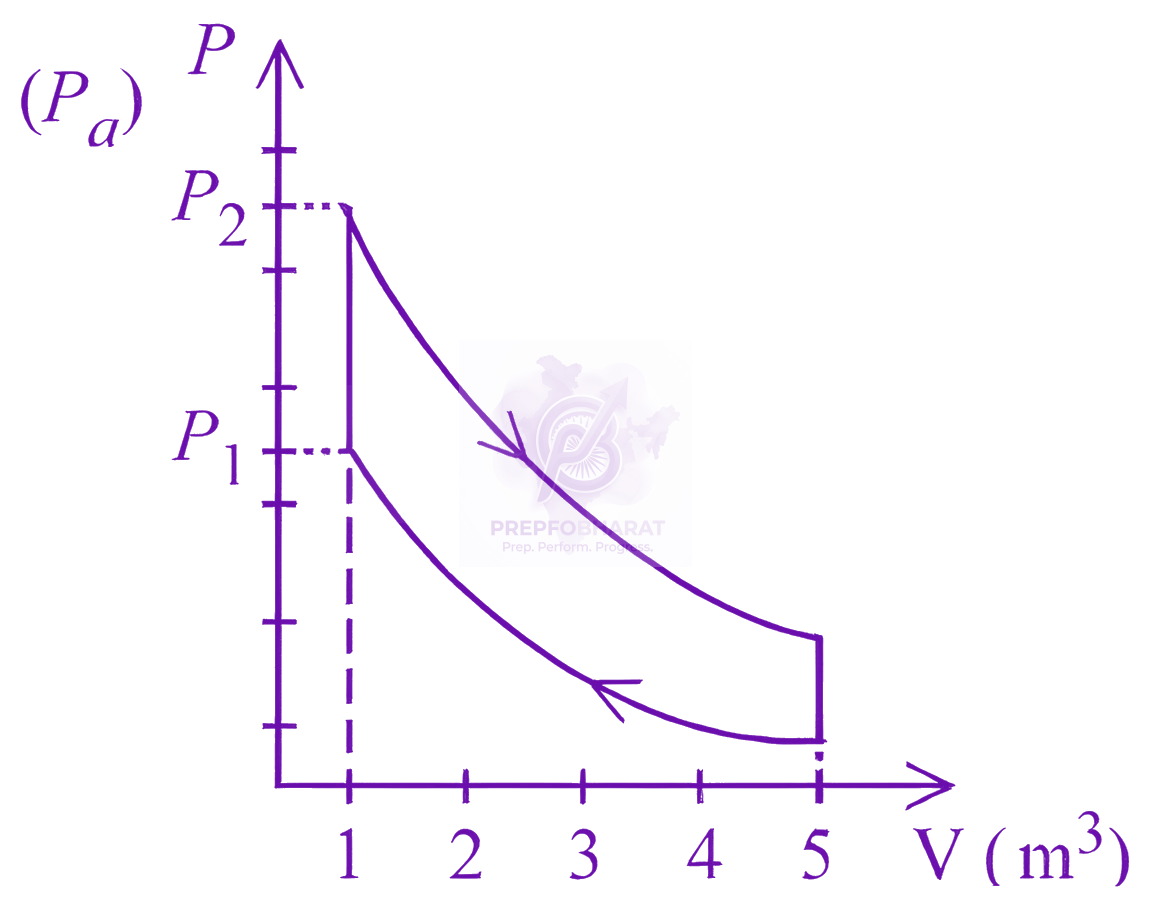
From the given P−V diagram, the process from P1 to P2 is an isochoric process because the volume remains constant at V=1 m3.
For an isochoric process, the work done W=0.
According to the first law of thermodynamics, the heat involved is Q=ΔU+W=ΔU.
The change in internal energy is given by ΔU=nCvΔT.
Using the ideal gas equation PV=nRT, we have nΔT=RVΔP.
Substituting this into the expression for Q:
Q=Cv(RV(P2−P1))
Given values: n=10 moles, V=1 m3, P1=21.7 Pa, P2=30 Pa, Cv=21 J/mol⋅K, and R=8.3 J/mol⋅K.
Q=21×8.31×(30−21.7)
Q=21×8.38.3=21 J.
Thus, the value of α is 21.