JEE Main 2014 — Thermodynamics
Physics Thermodynamics questions from JEE Main 2014.
Other Years
12 Thermodynamics Questions from 2014
Three rods of Copper, Brass and Steel are welded together to form a Y-shaped structure. Area of cross-section of each rod is $4{\mathrm{cm}}^{2}$. End of copper rod is maintained at $100^{\circ}C$. Where as ends of brass and steel are kept at $0^{\circ}C$. Lengths of the copper, brass and steel rods are $46,13$and $12\mathrm{cms}$ respectively. The rods are thermally insulated from surroundings except at ends. Thermal conductivities of copper, brass and steel are $0.92,0.26$ and $0.12$ CGS units respectively. Rate of heat flow through copper rod is :
During an adiabatic compression, $830 \mathrm{~J}$ of work is done on 2 moles of a diatomic ideal gas to reduce its volume by $50 \%$. The change in its temperature is nearly: $\left(\mathrm{R}=8.3 \mathrm{JK}^{-1} \mathrm{~mol}^{-1}\right)$
A monoatomic gas is compressed from a volume of $2{m}^{3}$ to a volume of $1{m}^{3}$ at a constant pressure of $100N{m}^{2}$. Then it is heated at constant volume by supplying $150J$ of energy. As a result, the internal energy of the gas
One mole of diatomic ideal gas undergoes a cyclic process ABC as shown in figure. The process BC is adiabatic. The temperatures at A, B and C are 400 K, 800 K and 600 K respectively. Choose the correct statement : 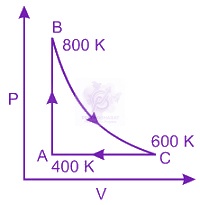
A gas molecule of mass $M$ at the surface of the earth has kinetic energy equivalent to $0^{\circ}C$. If it were to go up straight without colliding with any other molecules, how high it would rise? Assume that the height attained is much less than the radius of the earth. (${k}_{B}$ is Boltzmann constant)
A black coloured solid sphere of radius $R$ and mass $M$ is inside a cavity with a vacuum inside. The walls of the cavity are maintained at temperature ${T}_{0}$. The initial temperature of the sphere is $3{T}_{0}$. If the specific heat of the material of the sphere varies as $\alpha {T}^{3}$ per unit mass with the temperature $T$ of the sphere, where $\alpha$ is a constant, then the time taken for the sphere to cool down to temperature $2{T}_{0}$ will be ($\sigma$ is Stefan Boltzmann constant)
At room temperature a diatomic gas is found to have an r.m.s. speed of $1930 \mathrm{~ms}^{-1}$. The gas is:
Modern vacuum pumps can evacuate a vessel down to a pressure of $\text{4.0} \times 1 {0}^{ - 1 5 }$ atm. at room temperature (300 K). Taking R = 8.3 JK$^{-1}$ mole$^{-1}$, 1 atm = 10$^{5}$ Pa and ${\text{N}}_{\text{Avogadro}} = 6 \times 1 {0}^{ 2 3 } {mole}^{ - 1 }$, the mean distance between molecules of gas in an evacuated vessel will be of the order of :
An ideal monoatomic gas is confined in a cylinder by a spring loaded piston of cross section $8.0 \times 10^{-3} \mathrm{~m}^2$. Initially the gas is at $300 \mathrm{~K}$ and occupies a volume of $2.4 \times 10^{-3} \mathrm{~m}^3$ and the spring is in its relaxed state as shown in figure. The gas is heated by a small heater until the piston moves out slowly by $0.1 \mathrm{~m}$. The force constant of the spring is $8000 \mathrm{~N} / \mathrm{m}$ and the atmospheric pressure is $1.0 \times 10^5 \mathrm{~N} / \mathrm{m}^2$. The cylinder and the piston are thermally insulated. The piston and the spring are massless and there is no friction between the piston and the cylinder. The final temperature of the gas will be: (Neglect the heat loss through the lead wires of the heater. The heat capacity of the heater coil is also negligible). 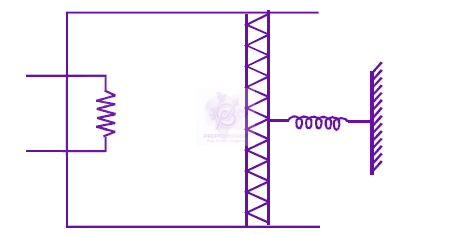
Water of volume 2 L in a closed container is heated with a coil of 1 kW. While water is heated, the container loses energy at a rate of 160 J/s. In how much time will the temperature of water rise from 27$^{o}$C to 77$^{o}$C ? (Specific heat of water is 4.2 kJ/kg and that of the container is negligible).
The equation of state for a gas is given by $\text{PV} = \text{nRT} + \alpha \text{V}$, where n is the number of moles and $\alpha$ is a positive constant. The initial temperature and pressure of one mole of the gas contained in a cylinder are T$_{0}$ and P$_{0}$ respectively. The work done by the gas when its temperature doubles isobarically will be :
The pressure that has to be applied to the ends of a steel wire of length $10\mathrm{cm}$ to keep its length constant when its temperature is raised by $100^{\circ}C$ is : (For steel, Young's modulus is $2\times {10}^{11}N{m}^{-2}$ and coefficient of thermal expansion is $1.1\times {10}^{-5}{K}^{-1}$)