JEE Main 2015 — Thermodynamics
Physics Thermodynamics questions from JEE Main 2015.
Other Years
7 Thermodynamics Questions from 2015
In an ideal gas at temperature T, the average force that a molecule applies on the walls of a closed container depends on $T as {T}^{q}$ . A good estimate for q is:
Using equipartition of energy, the specific heat (in $J {\mathrm{kg}}^{-1} {K}^{-1}$ ) of Aluminium at high temperature can be estimated to be (atomic weight of Aluminium $=27$)
An ideal gas goes through a reversible cycle $a\rightarrow b\rightarrow c\rightarrow d$ has the V - T diagram shown below. Process $d\rightarrow a and b\rightarrow c$ are adiabatic. 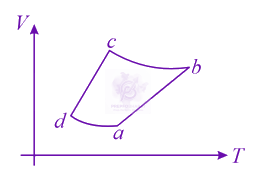 The corresponding P - V diagram for the process is (all figures are schematic and not drawn to scale) :
Consider an ideal gas confined in an isolated closed chamber. As the gas undergoes an adiabatic expansion, the average time of collision between molecules increases as ${V}^{q}$ , where $V$ is the volume of the gas. The value of $q$ is: $(\gamma =\frac{{C}_{P}}{{C}_{v}})$
Consider a spherical shell of radius R at temperature T. The black body radiation inside it can be considered as an ideal gas of photons with internal energy per unit volume $u=\frac{U}{V}\propto {T}^{4}$ and pressure $p=\frac{1}{3}(\frac{U}{V})$ . If the shell now undergoes an adiabatic expansion the relation between T and R is:
An experiment takes $10\mathrm{min}$ to raise the temperature of water in a container from ${0}^{o}C$ to ${100}^{o}C$ and another $55\mathrm{min}$ to convert it totally into steam by a heater supplying heat at a uniform rate. Neglecting the specific heat of the container and taking specific heat of the water to be $1\mathrm{cal}{({g}^{\circ }C)}^{-1}$ , the heat of vaporization according to this experiment will come out to be:
A solid body of constant heat capacity $1J{(℃)}^{-1}$ is being heated by keeping it in contact with reservoirs in two ways: (i) Sequentially keeping in contact with 2 reservoirs such that each reservoir supplies the same amount of heat. (ii) Sequentially keeping in contact with $8$ reservoirs such that each reservoir supplies the same amount of heat. In both, cases the body is brought from initial temperature $100K$ to final temperature $200K$ . Entropy change of the body in the two cases respectively is: Note: This question was awarded as a bonus since temperatures were given in centigrade instead of in Kelvin. Proper corrections are made in the question to avoid it.