(a) Isothermal ⇒Temperature constant
(a)→(ii)
(b) Isochoric ⇒ Volume constant
(b)→(iii)
(c) Adiabatic ⇒ΔQ=0
⇒Heat content is constant
(c)→(iv)
(d) Isobaric⇒Pressure constant
(d)→(i)
JEE Main 2021 — Physics Thermodynamics
Match List I with List II.
| List I | List II | ||
| (a) | Isothermal | (i) | Pressure constant |
| (b) | Isochoric | (ii) | Temperature constant |
| (c) | Adiabatic | (iii) | Volume constant |
| (d) | Isobaric | (iv) | Heat content is constant |
Held on 24 Feb 2021 · Verified 6 Jul 2026.
(a)→(ii),(b)→(iii),(c)→(iv),(d)→(i)
(a)→(iii),(b)→(ii),(c)→(i),(d)→(iv)
(a)→(i),(b)→(iii),(c)→(ii),(d)→(iv)
(a)→(ii),(b)→(iv),(c)→(iii),(d)→(i)
Sign in to track your attempts and accuracy.
Sign in to keep a private note on this question. Nothing you write is ever public.
10 mole of oxygen is heated at constant volume from $30^{\circ} \mathrm{C}$ to $40^{\circ} \mathrm{C}$. The change in the internal energy of the gas is $\_\_\_\_$ cal. (The molecular specific heat of oxygen at constant pressure, $C_{P}=7 \mathrm{cal} / \mathrm{mol}.{ }^{\circ} \mathrm{C}$ and $\mathrm{R}=2 \mathrm{cal} / \mathrm{mol}.{ }^{\circ} \mathrm{C}$.)
An ideal gas at pressure $P$ and temperature $T$ is expanding such that $PT^3 = $ constant. The coefficient of volume expansion of the gas is _______.
In the following $p-V$ diagram the equation of state along the curved path is given by $(V-2)^{2}=4 a p$ where $a$ is a constant. The total work done in the closed path is 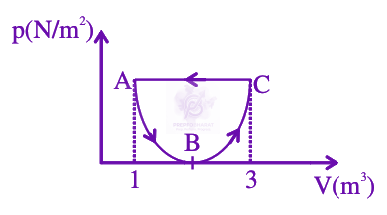
The volume of an ideal gas increases 8 times and temperature becomes $(1 / 4)^{\text {th }}$ of initial temperature during a reversible change. If there is no exchange of heat in this process $(\Delta \mathrm{Q}=0)$ then identify the gas from the following options (Assuming the gases given in the options are ideal gases):
A certain gas is isothermally compressed to $\left(\dfrac{1}{3}\right)^{rd}$ of its initial volume ($V_o = 3$ litre) by applying required pressure. If the bulk modulus of the gas is $3 \times 10^5$ N/m$^2$, the magnitude of work done on the gas is _______ J.
Work through every JEE Main Thermodynamics PYQ, year by year.