JEE Main 2021 — Waves & Oscillations
Physics Waves & Oscillations questions from JEE Main 2021.
Other Years
50 Waves & Oscillations Questions from 2021
An object of mass $0.5\mathrm{kg}$ is executing simple harmonic motion. It amplitude is $5\mathrm{cm}$ and time period (T) is $0.2s$. What will be the potential energy of the object at an instant $t=\frac{T}{4}s$ starting from mean position. Assume that the initial phase of the oscillation is zero.
In the given figure, a body of mass $M$ is held between two massless springs, on a smooth inclined plane. The free ends of the springs are attached to firm supports. If each spring has spring constant $k,$ the frequency of oscillation of given body is: 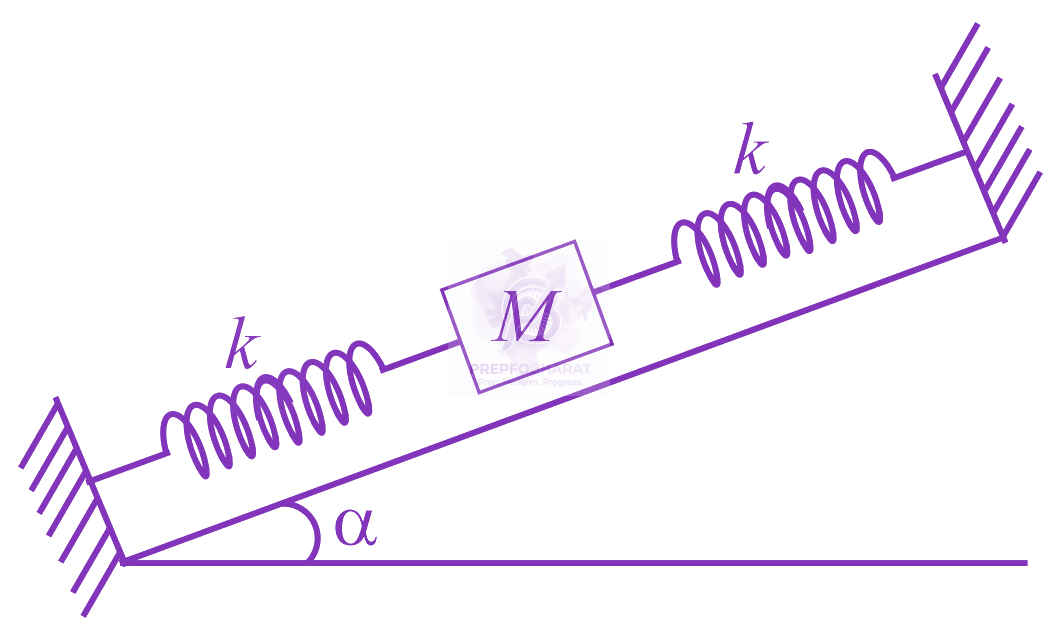
Which of the following equations represents a travelling wave?
The mass per unit length of a uniform wire is $0.135g{\mathrm{cm}}^{-1}$. A transverse wave of the form $y=-0.21\mathrm{sin}(x+30t)$ is produced in it, where $x$ is in meter and $t$ is in second. Then, the expected value of tension in the wire is $x\times {10}^{-2}N$. Value of $x$ is (Round-off to the nearest integer)
A $25m$ long antenna is mounted on an antenna tower. The height of the antenna tower is $75m$. The wavelength (in meter) of the signal transmitted by this antenna would be :
Time period of a simple pendulum is $T$. The time taken to complete $\frac{5}{8}$ oscillations starting from mean position is $\frac{\alpha }{12}T$. The value of $\alpha$ is $______$.
A particle performs simple harmonic motion with a period of $2$ second. The time taken by the particle to cover a displacement equal to half of its amplitude from the mean position is $\frac{1}{a}s.$ The value of $a$ to the nearest integer is
Time period of a simple pendulum is $T$ inside a lift when the lift is stationary. If the lift moves upwards with an acceleration $\frac{g}{2}$, the time period of pendulum will be :
Two particles $A$ and $B$ of equal masses are suspended from two massless springs of spring constants ${K}_{1}$ and ${K}_{2}$ respectively.If the maximum velocities during oscillations are equal, the ratio of the amplitude of $A$ and $B$ is
A pendulum bob has a speed of $3m{s}^{-1}$ at its lowest position. The pendulum is $50\mathrm{cm}$ long. The speed of bob, when the length makes an angle of $60^{\circ}$ to the vertical will be $(g=10m{s}^{-2})$ ______ $m{s}^{-1}$.
A wire having a linear mass density $9.0\times {10}^{-4}\mathrm{kg}{m}^{-1}$ is stretched between two rigid supports with a tension of $900N.$ The wire resonates at a frequency of $500\mathrm{Hz}.$ The next higher frequency at which the same wire resonates is $550\mathrm{Hz}.$ The length of the wire is ___________ $m.$
A tuning fork $A$ of unknown frequency produces $5\mathrm{beats}{s}^{-1}$ with a fork of known frequency $340\mathrm{Hz}$. When fork $A$ is filed, the beat frequency decreases to $2\mathrm{beats}{s}^{-1}$. What is the frequency of fork $A$ ?
In the reported figure, two bodies $A\mathrm{and}B$ of masses $200g$ and $800g$ are attached with the system of springs. Springs are kept in a stretched position with some extension when the system is released. The horizontal surface is assumed to be frictionless. The angular frequency will be _______ $\mathrm{rad}{s}^{-1}$ when $k=20N{m}^{-{1}^{}}$. 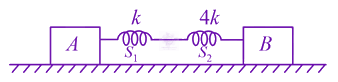
A particle is making simple harmonic motion along the $X$-axis. If at a distances ${x}_{1}$ and ${x}_{2}$ from the mean position the velocities of the particle are ${v}_{1}$ and ${v}_{2}$, respectively. The time period of its oscillation is given as:
The amplitude of wave disturbance propagating in the positive $x$-direction is given by $y=\frac{1}{(1+x{)}^{2}}$ at time $t=0$ and $y=\frac{1}{1+(x-2{)}^{2}}$ at $t=1s$, where $x$ and $y$ are in metres. The shape of wave does not change during the propagation. The velocity of the wave will be $m{s}^{-1}.$
The phase difference between two points separated by 1 m on a wave of wavelength 4 m is:
A mass of $5\mathrm{kg}$ is connected to a spring. The potential energy curve of the simple harmonic motion executed by the system is shown in the figure. A simple pendulum of length $4m$ has the same period of oscillation as the spring system. What is the value of acceleration due to gravity on the planet where these experiments are performed ? 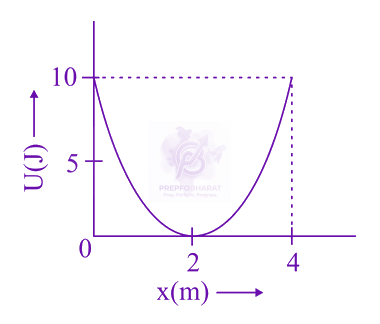
Two travelling waves produces a standing wave represented by equation. $y=(1.0\mathrm{mm})\mathrm{cos}[(1.57{\mathrm{cm}}^{-1})x]\mathrm{sin}[(78.5{s}^{-1})t]$. The node closest to the origin in the region $x>0$ will be at $x=......(\text{in}\mathrm{cm}).$
Two simple harmonic motion, are represented by the equations ${y}_{1}=10\mathrm{sin}(3\pi t+\frac{\pi }{3});{y}_{2}=5(\mathrm{sin}3\pi t+\sqrt{3}\mathrm{cos}3\pi t)$ Ratio of amplitude of ${y}_{1}$ to ${y}_{2}=x:1$. The value of $x$ is
Two simple harmonic motions are represented by the equations ${x}_{1}=5\mathrm{sin}(2\pi t+\frac{\pi }{4})$ and ${x}_{2}=5\sqrt{2}(\mathrm{sin}2\pi t+\mathrm{cos}2\pi t).$ The amplitude of the second motion is _____ times the amplitude in the first motion.
A particle of mass $1\mathrm{kg}$ is hanging from a spring of force constant $100N{m}^{-1}.$ The mass is pulled slightly downward and released so that it executes free simple harmonic motion with time period $T.$ The time when the kinetic energy and potential energy of the system will become equal, is $\frac{T}{n}.$ The value of $n$ is ________.
The function of time representing a simple harmonic motion with a period of $\frac{\pi }{\omega }$ is :
Consider two identical springs each of spring constant $k$ and negligible mass compared to the mass $M$ as shown. Fig. $1$ shows one of them and Fig. $2$ shows their series combination. The ratios of time period of oscillation of the two SHM is $\frac{{T}_{b}}{{T}_{a}}=\sqrt{x},$ where value of $x$ is ______. (Round off to the Nearest Integer) 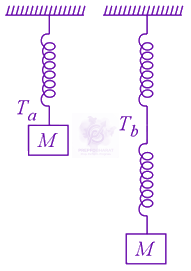
A particle executes S.H.M. with amplitude $A$ and time period $T$. The displacement of the particle when its speed is half of maximum speed is $\frac{\sqrt{x}A}{2}.$ The value of $x$ is
Given below are two statements: Statement $I$: A second's pendulum has a time period of $1$ second. Statement $\mathrm{II}$: It takes precisely one second to move between the two extreme positions. In the light of the above statements, choose the correct answer from the options given below
A particle executes S.H.M., the graph of velocity as a function of displacement is :
If the time period of a two meter long simple pendulum is $2s$, the acceleration due to gravity at the place where pendulum is executing S.H.M. is:
The point $A$ moves with a uniform speed along the circumference of a circle of radius $0.36m$ and covers $30^{\circ}$ in $0.1s$. The perpendicular projection $P$ from $A$ on the diameter $MN$ represents the simple harmonic motion of $P$. The restoration force per unit mass when $P$ touches $M$ will be : 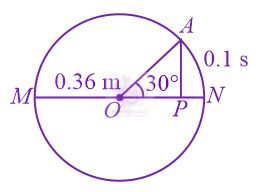
A particle starts executing simple harmonic motion $(\mathrm{SHM})$ of amplitude $a$ and total energy $E.$ At any instant, its kinetic energy is $\frac{3E}{4}$, then its displacement $y$ is given by:
The percentage increase in the speed of transverse waves produced in a stretched string if the tension is increased by $4%$, will be ___ $%$.
A closed organ pipe of length $L$ and an open organ pipe contain gases of densities ${\rho }_{1}$ and ${\rho }_{2}$ respectively. The compressibility of gases are equal in both the pipes. Both the pipes are vibrating in their first overtone with same frequency. The length of the open pipe is $\frac{x}{3}L\sqrt{\frac{{\rho }_{1}}{{\rho }_{2}}}$, where $x$ is _______. (Round off to the Nearest Integer)
In a simple harmonic oscillation, what fraction of total mechanical energy is in the form of kinetic energy, when the particle is midway between mean and extreme position.
Two identical springs of spring constant $2k$ are attached to a block of mass $m$ and to fixed support (see figure). When the mass is displaced from equilibrium position on either side, it executes simple harmonic motion. The time period of oscillations of this system is : 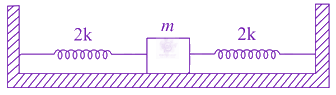
A block of mass $1\mathrm{kg}$ attached to a spring is made to oscillate with an initial amplitude of $12\mathrm{cm}$. After $2$ minutes the amplitude decreases to $6\mathrm{cm}$. Determine the value of the damping constant for this motion. (take $\mathrm{ln}2=0.693$ )
When a particle executes SHM, the nature of graphical representation of velocity as a function of displacement is:
Assume that a tunnel is dug along a chord of the earth, at a perpendicular distance $\frac{R}{2}$ from the earth's centre, where $R$ is the radius of the earth. The wall of the tunnel is frictionless. If a particle is released in this tunnel, it will execute a simple harmonic motion with a time period:
$Y=A\mathrm{sin}(\omega t+{\phi }_{0})$ is the time-displacement equation of a $SHM.$ At $t=0$ the displacement of the particle is $Y=\frac{A}{2}$ and it is moving along negative $x$-direction. Then the initial phase angle ${\phi }_{0}$ will be:
A student is performing the experiment of the resonance column. The diameter of the column tube is $6\mathrm{cm}$. The frequency of the tuning fork is $504\mathrm{Hz}$. Speed of the sound at the given temperature is $336m{s}^{-1}$. The zero of the meter scale coincides with the top end of the resonance column tube. The reading of the water level in the column when the first resonance occurs is:
${T}_{0}$ is the time period of a simple pendulum at a place. If the length of the pendulum is reduced to $\frac{1}{16}$ times of its initial value, the modified time period is
Two identical tennis balls each having mass $m$ and charge $q$ are suspended from a fixed point by threads of length $l.$ What is the equilibrium separation when each thread makes a small angle $\theta$ with the vertical?
In the given figure, a mass $M$ is attached to a horizontal spring which is fixed on one side to a rigid support. The spring constant of the spring is $k.$ The mass oscillates on a frictionless surface with time period $T$ and amplitude $A.$ When the mass is in equilibrium position, as shown in the figure, another mass $m$ is gently fixed upon it. The new amplitude of oscillation will be: 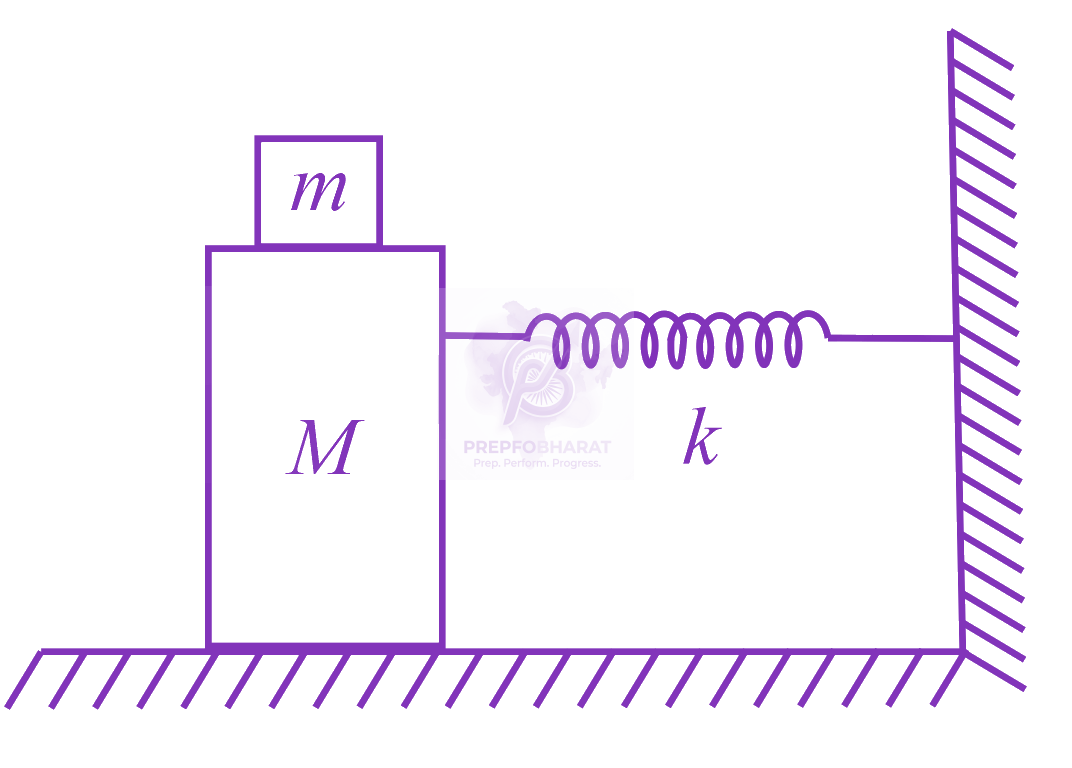
For what value of displacement the kinetic energy and potential energy of a simple harmonic oscillation become equal?
A sound wave of frequency $245\mathrm{Hz}$ travels with the speed of $300{ms}^{-1}$ along the positive x-axis. Each point of the wave moves to and fro through a total distance of $6\mathrm{cm}$. What will be the mathematical expression of this travelling wave?
The amplitude of a mass-spring system, which is executing simple harmonic motion decreases with time. If mass $=500g$, Decay constant $=20g{s}^{-1}$ then how much time is required for the amplitude of the system to drop to half of its initial value? $(\mathrm{ln}2=0.693)$
A particle executes simple harmonic motion represented by displacement function as $x(t)=A\mathrm{sin}(\omega t+\phi )$. If the position and velocity of the particle at $t=0s$ are $2\mathrm{cm}$ and $2\omega \mathrm{cm}{s}^{-1}$ respectively, then its amplitude is $x\sqrt{2}\mathrm{cm}$ where the value of $x$ is
A tuning fork is vibrating at $250\mathrm{Hz}$. The length of the shortest closed organ pipe that will resonate with the tuning fork will be _____$\mathrm{cm}$. (Take speed of sound in air as $340{ms}^{-1}$ )
The variation of displacement with time of a particle executing free simple harmonic motion is shown in the figure. 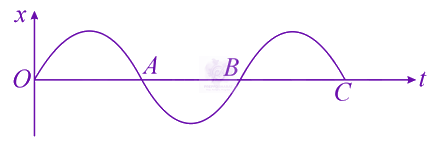 The potential energy $U(x)$ versus time $(t)$ plot of the particle is correctly shown in figure:
For a body executing S.H.M. : (a) Potential energy is always equal to its $K.E.$ (b) Average potential and kinetic energy over any given time interval are always equal. (c) Sum of the kinetic and potential energy at any point of time is constant. (d) Average $K.E.$ in one time period is equal to average potential energy in one time period. Choose the most appropriate option from the options given below :
Two waves are simultaneously passing through a string and their equations are : ${y}_{1}={A}_{1}\mathrm{sin}k(x-vt),{y}_{2}={A}_{2}\mathrm{sin}k(x-vt+{x}_{0}).$ Given amplitudes ${A}_{1}=12\mathrm{mm}$ and ${A}_{2}=5\mathrm{mm}$, ${x}_{0}=3.5\mathrm{cm}$ and wave number $k=6.28{\mathrm{cm}}^{-1}.$ The amplitude of resulting wave will be _____ $\mathrm{mm}.$
A bob of mass $m$ suspended by a thread of length $\ell$ undergoes simple harmonic oscillations with time period $T.$ If the bob is immersed in a liquid that has density $\frac{1}{4}$ times that of the bob and the length of the thread is increased by ${(\frac{1}{3})}^{rd}$ of the original length, then the time period of the simple harmonic oscillations will be: