JEE Main 2026 — Waves & Oscillations
Physics Waves & Oscillations questions from JEE Main 2026.
Other Years
27 Waves & Oscillations Questions from 2026
In an open organ pipe $\nu_{3}$ and $\nu_{6}$ are $3^{\text {rd }}$ and $6^{\text {th }}$ harmonic frequencies, respectively. If $\nu_{6}-\nu_{3}=2200 \mathrm{~Hz}$ then length of the pipe is $\_\_\_\_$ mm . (Take velocity of sound in air is $330 \mathrm{~m} / \mathrm{s}$.)
Two waves of same frequency and amplitude travel in opposite directions. The resulting pattern is:
A spring-mass system oscillates with angular frequency ω. If the mass is doubled and the spring constant is halved, the new angular frequency is:
The time period of a simple harmonic oscillator is $T=2 \pi \sqrt{\frac{k}{m}}$. Measured value of mass $(m)$ of the object is 10 g with an accuracy of 10 mg and time for 50 oscillations of the spring is found to be 60 s using a watch of 2 s resolution. Percentage error in determination of spring constant $(k)$ is $\_\_\_\_$ \%.
A simple pendulum of string length 30 cm performs 20 oscillations in 10 s. The length of the string required for the pendulum to perform 40 oscillations in the same time duration is $\_\_\_\_$ cm. [Assume that the mass of the pendulum remains same.]
The equation of a plane progressive wave is given by $y = 5\cos\pi\left(200t - \dfrac{x}{150}\right)$ where $x$ and $y$ are in cm and $t$ is in second. The velocity of the wave is _______ m/s.
Two loudspeakers ($L_{1}$ and $L_{2}$) are placed with a separation of 10 m, as shown in figure. Both speakers are fed with an audio input signal of same frequency with constant volume. A voice recorder, initially at point $A$, at equidistance to both loud speakers, is moved by 25 m along the line $A B$ while monitoring the audio signal. The measured signal was found to undergo 10 cycles of minima and maxima during the movement. The frequency of the input signal is $\_\_\_\_$ Hz (Speed of sound in air is $324 \mathrm{~m} / \mathrm{s}$ and $\sqrt{5}=2.23$) 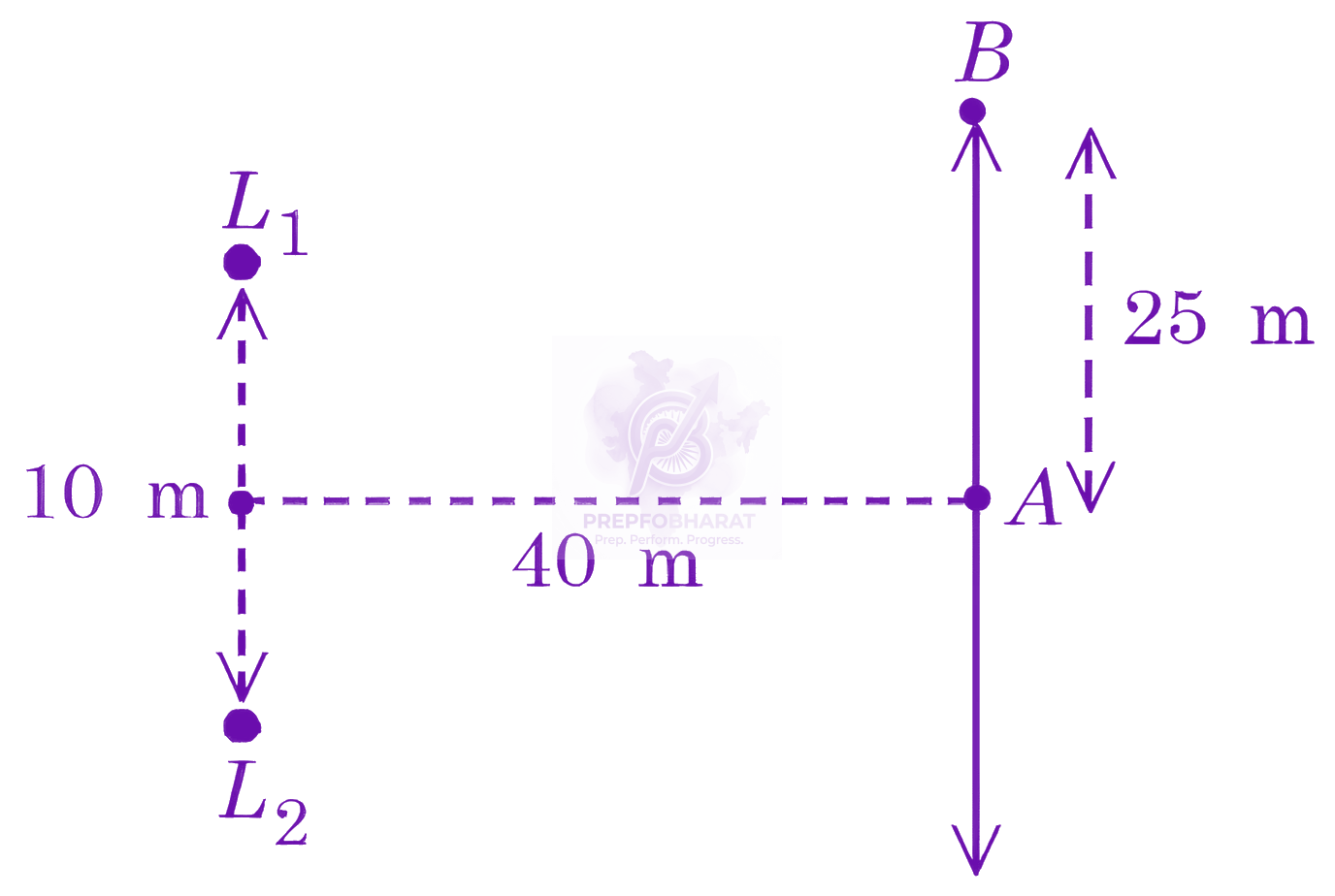
Match List-I with List-II. <table class="pyq-table"><tbody><tr><th>List-I</th><th>List-II</th></tr><tr><td>A. $\sin^2 \omega t$</td><td>I. Periodic with time period $T = \dfrac{\pi}{\omega}$ but not simple harmonic motion (SHM)</td></tr><tr><td>B. $\sin^3(2\omega t)$</td><td>II. Periodic with time period $T = \dfrac{2\pi}{\omega}$ but Not SHM</td></tr><tr><td>C. $\sin(\omega t) + \cos(\pi \omega t)$</td><td>III. Periodic with time period $T = \dfrac{\pi}{\omega}$ and SHM</td></tr><tr><td>D. $\cos\omega t + \cos 2\omega t$</td><td>IV. Non-periodic</td></tr></tbody></table> Choose the correct answer from the options given below :
A transverse wave on a string is described by $y = 3\sin(36t + 0.018x + \pi/4)$, where $x, y$ are in cm and $t$ in seconds. The least distance between the two successive crests in the wave is _____ cm. (Nearest integer) ($\pi = 3.14$)
Using a simple pendulum experiment $g$ is determind by measuring its time period $T$. Which of the following plots represent the correct relation between the pendulum length $L$ and time period $T$ ?
A spring stretches by $2$ mm when it is loaded with a mass of $200$ g. From equilibrium position the mass is further pulled down by $2$ mm and released. The frequency associated with the system and maximum energy in the spring are __________ Hz and __________ J, respectively. (Take g $= 10$ m/s$^2$)
The velocity of a particle executing simple harmonic motion along $x$-axis is described as $v^2 = 50 - x^2$, where $x$ represents displacement. If the time period of motion is $\dfrac{x}{7}$ s, the value of $x$ is _____.
The displacement of a particle, executing simple harmonic motion with time period $T$, is expressed as $x(t)=A \sin \omega t$, where $A$ is the amplitude. The maximum value of potential energy of this oscillator is found at $t=T / 2 \beta$. The value of $\beta$ is $\_\_\_\_$.
Two blocks with masses 100 g and 200 g are attached to the ends of springs $A$ and $B$ as shown in figure. The energy stored in $A$ is $E$. The energy stored in $B$, when spring constants $k_{A}, k_{B}$ of $A$ and $B$, respectively satisfy the relation $4 k_{A}=3 k_{B^{\prime}}$, is : 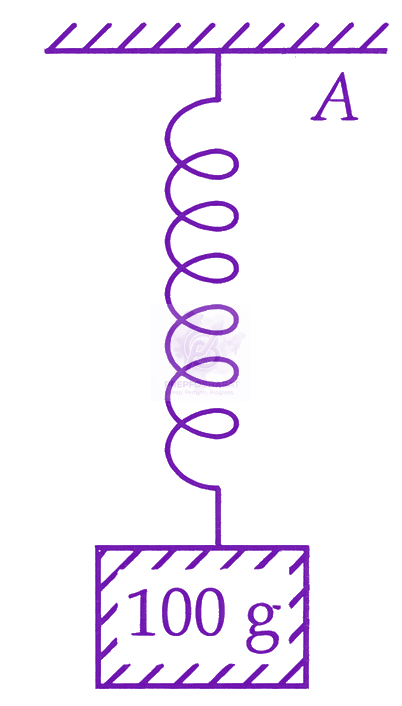 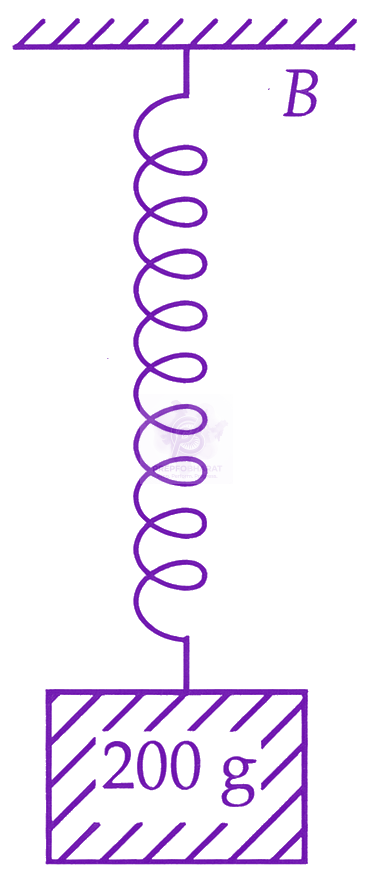
A point source is kept at the center of a spherically enclosed detector. If the volume of the detector increased by 8 times, the intensity will
The velocity of sound in air is doubled when the temperature is raised from $0^{\circ} \mathrm{C}$ to $\alpha^{\circ} \mathrm{C}$. The value of $\alpha$ is $\_\_\_\_$.
The frequency of oscillation of a mass $m$ suspended by a spring is $v_1$. If the length of the spring is cut to half, the same mass oscillates with frequency $v_2$. The value of $v_2/v_1$ is ________.
A uniform disc of radius $R$ and mass $M$ is free to oscillate about the axis $A$ as shown in the figure. For small oscillations the time period is ______. ($g$ is acceleration due to gravity) 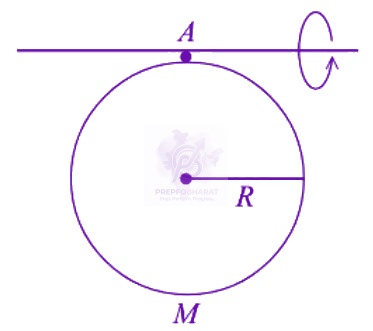
A particle is executing simple harmonic motion. Its amplitude is $A$ and time period is $5$ sec. The time required by it to move from $x = A$ to $x = \dfrac{A}{\sqrt{2}}$ is _______ sec.
The equation of motion of a particle is given by $x = a \sin\left(50t + \dfrac{\pi}{3}\right)$ cm. The particle will come to rest at time $t_1$ and it will have zero acceleration at time $t_2$. The $t_1$ and $t_2$ respectively are _______.
The fifth harmonic of a closed organ pipe is found to be in unison with the first harmonic of an open pipe. The ratio of lengths of closed pipe to that of the open pipe is $5 / x$. The value of $x$ is $\_\_\_\_$.
The speed of a longitudinal wave in a metallic bar is $400 \mathrm{~m} / \mathrm{s}$. If the density and Young's modulus of the bar material are increased by $0.5 \%$ and $1 \%$, respectively then the speed of the wave is changed approximately to $\_\_\_\_$ $\mathrm{m} / \mathrm{s}$.
The kinetic energy of a simple harmonic oscillator is oscillating with angular frequency of $176 \mathrm{rad} / \mathrm{s}$. The frequency of this simple harmonic oscillator is $\_\_\_\_$ Hz. $\left[\right.$ take $\left.\pi=\frac{22}{7}\right]$
A cylindrical block of mass $M$ and area of cross section $A$ is floating in a liquid of density $\rho$ and with its axis vertical. When depressed a little and released the block starts oscillating. The period of oscillation is $\_\_\_\_$.
Two strings $(A, B)$ having linear densities $\mu_{A}=2 \times 10^{-4} \mathrm{~kg} / \mathrm{m}$ and, $\mu_{B}=4 \times 10^{-4} \mathrm{~kg} / \mathrm{m}$ and lengths $L_{A}=2.5 \mathrm{~m}$ and $L_{B}=1.5 \mathrm{~m}$ respectively are joined. Free ends of $A$ and $B$ are tied to two rigid supports $C$ and $D$, respectively creating a tension of 500 N in the wire. Two identical pulses, sent from $C$ and $D$ ends, take time $t_{1}$ and $t_{2}$, respectively, to reach the joint. The ratio $t_{1} / t_{2}$ is :
As shown in the figure, a spring is kept in a stretched position with some extension by holding the masses 1 kg and 0.2 kg with a separation more than spring natural length and are released. Assuming the horizontal surface to be frictionless, the angular frequency (in SI unit) of the system is : $k=150 \mathrm{~N} / \mathrm{m}$ 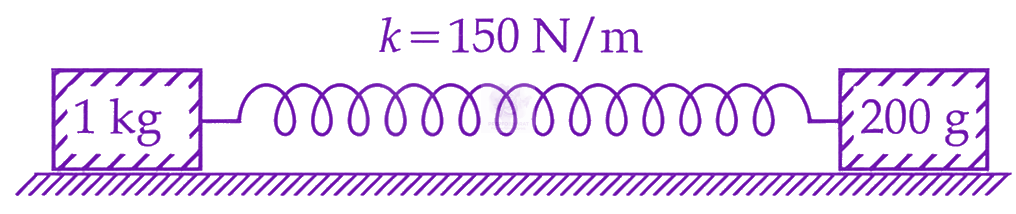
Two tuning forks $A$ and $B$ are sounded together giving rise to 8 beats in 2 s. When fork $A$ is loaded with wax, the beat frequency is reduced to 4 beats in 2 s. If the original frequency of tuning fork $B$ is 380 Hz then original frequency of tuning fork $A$ is $\_\_\_\_$ Hz.